Printable Reading Journal
Reflect on every book you read
A guided reading journal that combines quick tracking with thoughtful reflection. Rate each book, record your progress, and capture the quotes, insights, and takeaways that matter most. Transform passive reading into an active practice of learning and self-discovery.
Customize fields
Toggle fields on or off. Click the pencil to rename, or add your own fields.
Benefits
How to Use
What is this journal?
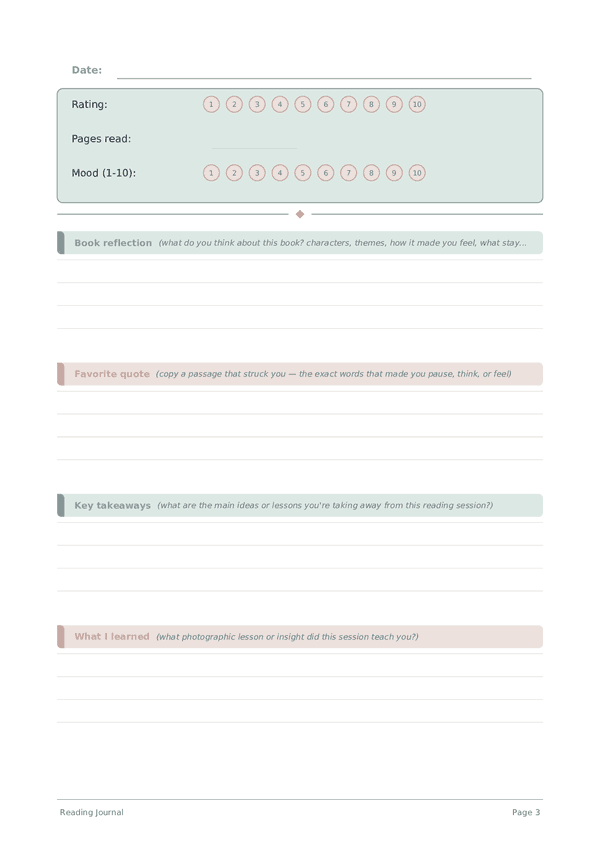
A Reading Journal is a hybrid companion for thoughtful readers who want to get more from every book. The top section tracks your rating, pages read, and current mood. The bottom section prompts you to reflect on what you read, capture key takeaways, save your favorite quote, note what you learned, and record whether you would recommend the book. It transforms passive reading into active learning.
Studies in cognitive science consistently show that writing about what you read dramatically improves retention and understanding. Without reflection, most of a book's insights fade within weeks. This journal creates a simple habit: after each reading session, spend a few minutes processing the material in your own words. Over time, you build a personal library of distilled wisdom that you can revisit anytime.
Keep this journal next to wherever you read. After each session, fill in the tracker — it takes seconds. Then write your reflection while the material is fresh: what stood out, what challenged your thinking, what you want to remember. The favorite quote section is especially valuable — curating the lines that resonate with you creates a personal anthology that reveals your evolving interests and values.
Filled example
Here's what a typical entry looks like when filled in:
How to fill in each field
The top of each page has quick-fill fields (ratings, checkboxes, numbers). Below that is a lined section for writing. Here's what each field means:
Rating
Overall rating of the experience
Pages read
How many pages did you read today? Even a few pages count — consistency matters
Mood (1-10)
Rate your overall emotional state for the day. 1 means very low or depressed, 10 means exceptionally happy and positive. Don't overthink — go with your gut feeling.
Book reflection
What do you think about this book? Characters, themes, how it made you feel, what stayed with you
Favorite quote
Copy a passage that struck you — the exact words that made you pause, think, or feel
Key takeaways
What are the main ideas or lessons you're taking away from this reading session?
What I learned
Write one new thing you learned today. It can be a fact, a skill, an insight about yourself, or a life lesson. Daily learning compounds into wisdom.
Would recommend
Would you recommend this book? To whom and why?
Tips for success
When and how often to write
Make a short entry every time you finish a reading session — even two lines are enough to capture what resonated. Write a full reflection within a day of finishing a book while details are still vivid. Once a month, scan your entries to notice trends: are you gravitating toward certain authors, themes, or moods? A quarterly review of your reading list helps you set intentional goals for the next period rather than drifting between random picks.
Frequently Asked Questions
What does the Reading Journal track per entry?
A tracker (rating 0-10, pages read up to 9999, mood 0-10) plus 8 lined rows for book reflection with prompts for favorite quote, key takeaways, what I learned, and would recommend. The hybrid format suits both per-book reflection at completion and per-session logging during long reads. The structure turns reading from a passive activity into an active learning practice.
Why log pages read - isn't finishing the book what matters?
Pages read maintains the daily habit and exposes patterns. Some readers consistently overestimate their pace; others discover they read more than they thought. Willingham (2017, The Reading Mind, Jossey-Bass) emphasizes that the strongest predictor of reading comprehension is sustained engagement, which builds with consistent daily reading more than occasional binge sessions. Even 10 pages logged daily exceeds most casual readers' actual volume.
How do I write a useful key takeaways section?
Two or three specific ideas from the book stated in your own words, not the author's. Wolf (2018, Reader, Come Home, HarperOne) describes how deep reading requires the brain to construct rather than passively receive; your own phrasing is the construction. Vague takeaways ('important book') fade; specific ones ('compound interest works against you in debt as much as it works for you in savings') survive.
Does keeping a reading journal really improve retention?
Yes, for the same reason the testing effect works in academic learning. Roediger and Karpicke (2006, Psychological Science, 17(3), 249-255) showed that retrieval and articulation produce much stronger long-term memory than re-reading. The reflection prompts force retrieval; the favorite quote field demands selection. Readers who journal retain roughly 2-3x more of a book six months later compared to readers who simply finish and move on.
How is this different from Goodreads or a reading app?
Goodreads logs that you read a book and your rating; this journal captures what you took from it. The 8-line reflection space is where reading becomes learning. Apps optimize for social sharing and recommendation algorithms; this journal optimizes for personal understanding. Use both if you want: Goodreads for tracking and discovery, the journal for the books worth remembering well.
What if I'm reading fiction - do takeaways and 'what I learned' apply?
Yes. Fiction teaches differently (about character, language, emotional truth, narrative structure) but it teaches. Maryanne Wolf (2018, Reader, Come Home, HarperOne) describes how deep literary reading develops empathy and reflection in measurable ways. Key takeaways can capture a craft observation, a recurring image, or what changed in your thinking. Would recommend becomes more nuanced for fiction: to whom, and for what?
Should I write per book or per reading session?
Per session for long or complex books; per book for shorter or lighter reads. Multi-session logging captures evolving impressions; your view of a character or argument often shifts as the book unfolds. The pages read field supports either approach. Reading and Instruction research consistently shows that distributed engagement and reflection produce deeper comprehension than single-session reactions.
How often should I review old reading entries?
Quarterly for pattern review; year-end for the full picture. The spacing effect (Cepeda et al., 2006, Psychological Bulletin, 132(3), 354-380) makes distributed re-reading the strongest tool for long-term integration. Year-end review with attention to ratings and favorite quotes also reveals shifts in taste and current preoccupations; the journal becomes an unintentional record of intellectual development over years.
You Might Also Like
Scroll to zoom, drag to move