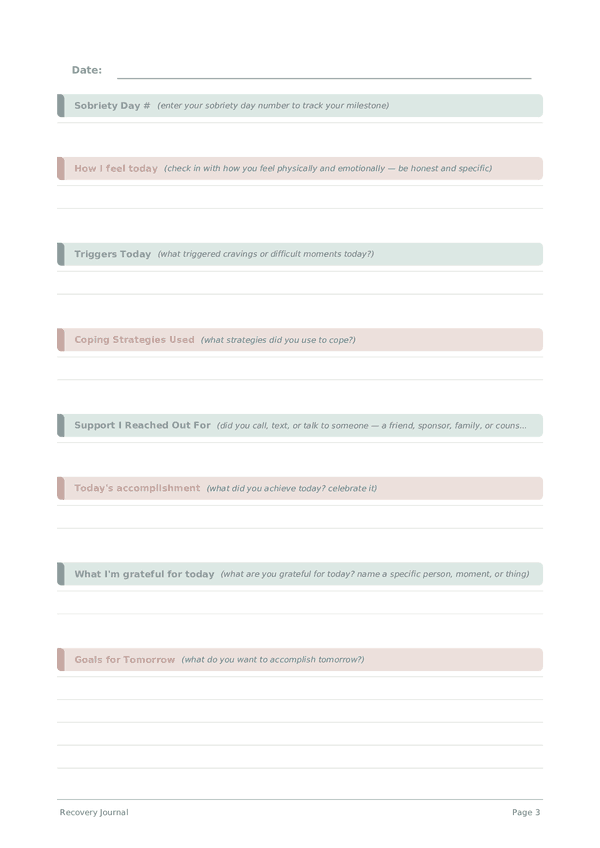
Printable Recovery Journal
Daily recovery support and sobriety accountability journal
Support your recovery journey with daily check-ins, trigger awareness, and coping strategy documentation. Track sobriety milestones, celebrate progress, and maintain connection to your recovery community.
Customize fields
Toggle fields on or off. Click the pencil to rename, or add your own fields.
What is this journal?
A recovery journal is a deeply personal daily writing practice designed for individuals on the path of addiction recovery or healing from any life-altering challenge. Each entry provides structured prompts that guide you through reflecting on your emotional state, identifying triggers, acknowledging your coping strategies, and celebrating daily accomplishments — no matter how small they may seem.
Recovery is not a straight line, and a journal helps you navigate its inevitable ups and downs with greater awareness. Writing about your feelings and triggers creates emotional distance, allowing you to process difficult experiences rather than react impulsively. Documenting the coping strategies that work reinforces healthy patterns, while noting what you are grateful for shifts your focus toward the positive aspects of your new life.
Many recovery programs, including 12-step and therapeutic approaches, recommend journaling as a core practice. This journal supports that recommendation with a clear daily structure that reduces the intimidation of a blank page. Over time, reading back through your entries becomes a powerful reminder of how far you have come and the strength you carry within you.
Filled example
Here's what a typical entry looks like when filled in:
How to fill in each field
Each day you'll find several labeled sections with lines for writing. Here's what each section is for:
Sobriety Day #
Enter your sobriety day number to track your milestone
How I feel today
Check in with yourself: how are you feeling physically and emotionally right now? Be specific — 'tired but hopeful' is more useful than 'fine.'
Triggers Today
What triggered cravings or difficult moments today?
Coping Strategies Used
What strategies did you use to cope?
Support I Reached Out For
Did you call, text, or talk to someone — a friend, sponsor, family, or counselor?
Today's accomplishment
Write something you achieved today, no matter how small. Acknowledging daily wins builds confidence and momentum.
What I'm grateful for today
List 1–3 things you're grateful for today. They can be big or tiny — a good meal, a kind word, sunshine. Gratitude journaling is one of the most scientifically supported well-being practices.
Goals for Tomorrow
What do you want to accomplish tomorrow?
Tips for success
When and how often to write
Write every single day, especially in the first 90 days. Evening journaling is ideal — it processes the day and releases emotional pressure that might otherwise build overnight. On hard days, write in the moment if you can. In early recovery, even a 3-sentence entry counts. After 90 days, daily remains ideal, but the habit should feel natural by then. Weekly, re-read your entries to see growth you cannot feel in the moment. Monthly, note how your triggers and coping strategies have evolved.