Printable Recovery Journal
Daily recovery support and sobriety accountability journal
Support your recovery journey with daily check-ins, trigger awareness, and coping strategy documentation. Track sobriety milestones, celebrate progress, and maintain connection to your recovery community.
Customize fields
Toggle fields on or off. Click the pencil to rename, or add your own fields.
What is this journal?
A recovery journal is a deeply personal daily writing practice designed for individuals on the path of addiction recovery or healing from any life-altering challenge. Each entry provides structured prompts that guide you through reflecting on your emotional state, identifying triggers, acknowledging your coping strategies, and celebrating daily accomplishments — no matter how small they may seem.
Recovery is not a straight line, and a journal helps you navigate its inevitable ups and downs with greater awareness. Writing about your feelings and triggers creates emotional distance, allowing you to process difficult experiences rather than react impulsively. Documenting the coping strategies that work reinforces healthy patterns, while noting what you are grateful for shifts your focus toward the positive aspects of your new life.
Many recovery programs, including 12-step and therapeutic approaches, recommend journaling as a core practice. This journal supports that recommendation with a clear daily structure that reduces the intimidation of a blank page. Over time, reading back through your entries becomes a powerful reminder of how far you have come and the strength you carry within you.
Filled example
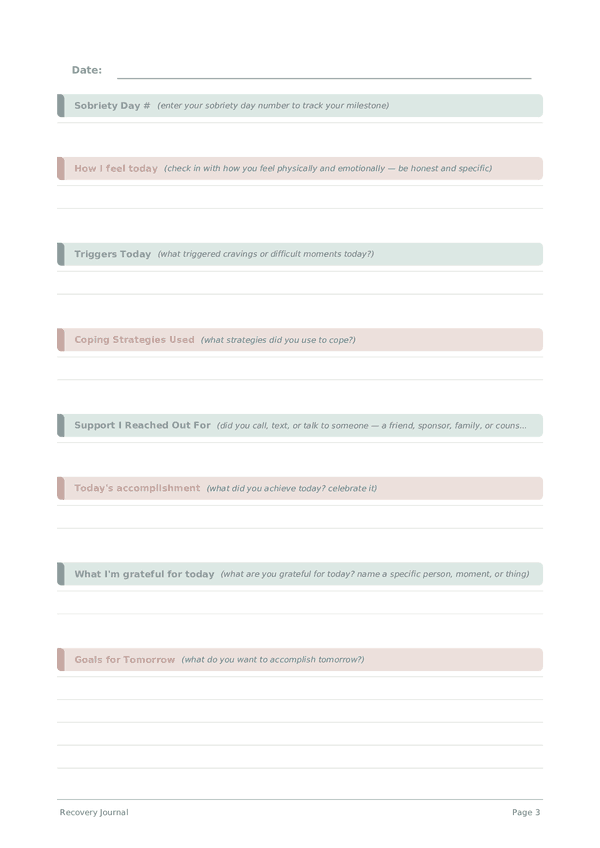
Here's what a typical entry looks like when filled in:
How to fill in each field
Each day you'll find several labeled sections with lines for writing. Here's what each section is for:
Sobriety Day #
Enter your sobriety day number to track your milestone
How I feel today
Check in with yourself: how are you feeling physically and emotionally right now? Be specific — 'tired but hopeful' is more useful than 'fine.'
Triggers Today
What triggered cravings or difficult moments today?
Coping Strategies Used
What strategies did you use to cope?
Support I Reached Out For
Did you call, text, or talk to someone — a friend, sponsor, family, or counselor?
Today's accomplishment
Write something you achieved today, no matter how small. Acknowledging daily wins builds confidence and momentum.
What I'm grateful for today
List 1–3 things you're grateful for today. They can be big or tiny — a good meal, a kind word, sunshine. Gratitude journaling is one of the most scientifically supported well-being practices.
Goals for Tomorrow
What do you want to accomplish tomorrow?
Tips for success
When and how often to write
Write every single day, especially in the first 90 days. Evening journaling is ideal — it processes the day and releases emotional pressure that might otherwise build overnight. On hard days, write in the moment if you can. In early recovery, even a 3-sentence entry counts. After 90 days, daily remains ideal, but the habit should feel natural by then. Weekly, re-read your entries to see growth you cannot feel in the moment. Monthly, note how your triggers and coping strategies have evolved.
Frequently Asked Questions
How does daily journaling support recovery from addiction?
NIH NIAAA (2021, Treating Alcohol Use Disorder) and NIDA evidence-based principles identify self-monitoring as a core relapse prevention skill. APA and SAMHSA report that daily reflection, particularly trigger awareness and gratitude practice, reduces relapse risk by reinforcing recovery identity and coping skill recall. This template's structured prompts (sobriety day number, triggers, coping strategies, support contacts) align with cognitive-behavioral relapse prevention models. Use alongside professional treatment, not as a replacement.
What's the value of tracking sobriety days?
Per NIAAA and AA/NA peer-support traditions, sobriety milestones reinforce identity change. Behavioral research in Journal of Substance Abuse Treatment shows visible day counters correlate with longer abstinence. The sobriety day number field provides daily affirmation, and research from APA (2021) notes that small consistent reinforcement outperforms infrequent intensive markers. Celebrate milestones (30, 60, 90 days; 1 year) with your sponsor or support network.
How should I identify and document triggers?
Per NIDA (2020, Principles of Drug Addiction Treatment) and Marlatt's relapse prevention framework, triggers fall into emotional (HALT: hungry/angry/lonely/tired), social (people/places), environmental (visual cues), and internal (thoughts/cravings) categories. Use the triggers today prompt to record specific events, intensity (mild/moderate/severe), and how you responded. Patterns over 4-8 weeks reveal high-risk situations to plan around.
What counts as a 'coping strategy' worth tracking?
SAMHSA and APA evidence-based coping strategies include urge surfing, calling a sponsor, attending a meeting, exercise, mindfulness practice, removing oneself from a trigger location, and calling a crisis line. Document what you used in coping strategies used and whether it worked. NIH NIDA research shows that recalling effective past coping in writing builds 'self-efficacy', confidence in future coping ability, the single strongest predictor of sustained recovery.
Why is the support i reached out for prompt important?
Per NIDA and AA/NA peer support research, social isolation is the strongest acute relapse predictor; daily connection, even brief, significantly protects against relapse. The support i reached out for field records sponsor calls, meeting attendance, friend texts, or therapist sessions. APA (2021) data show that recovery community engagement of any form correlates with longer abstinence. No outreach for 3+ days is a clinical warning sign worth raising with your treatment provider.
How does gratitude practice fit into recovery?
Per Journal of Substance Abuse Treatment and APA Positive Psychology research, gratitude practice activates reward pathways differently from substance use and reduces dysphoria, a major relapse driver. The what I'm grateful for today prompt requires specificity (per Emmons, 2003, Journal of Personality and Social Psychology, 84(2)): name three specific things, not generic items. Three weeks of consistent practice shows measurable mood improvement in clinical studies.
Is this journal appropriate without professional treatment?
It supports but does not replace clinical care. SAMHSA and NIDA emphasize that severe substance use disorder typically requires medical detox, medication-assisted treatment (e.g., buprenorphine, naltrexone), and behavioral therapy. The journal adds to treatment by providing data your counselor or physician can review. Withdrawal from alcohol, benzodiazepines, or opioids without medical supervision can be life-threatening; consult addiction medicine specialists or call the SAMHSA helpline (1-800-662-HELP).
When should journal patterns prompt urgent help?
SAMHSA crisis criteria: thoughts of self-harm or suicide (call 988 in US), active relapse, severe withdrawal symptoms, or persistent inability to use coping strategies. Patterns in the journal (escalating triggers, declining support contacts, repeated craving entries) warrant immediate contact with your sponsor, therapist, or treatment center. NIDA notes that early intervention during 'lapse' moments prevents progression to full relapse; your journal can detect this trajectory days ahead.
You Might Also Like
Scroll to zoom, drag to move