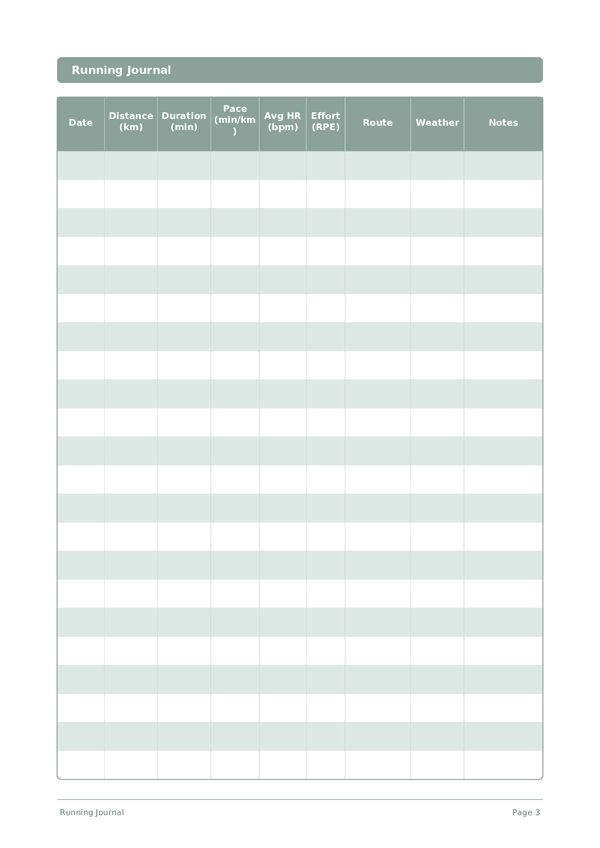
Printable Running Journal
Track every run, measure progress, and reach your goals
The Running Journal is a structured training log that helps you record key metrics for every run — distance, pace, heart rate, effort level, route, and more. Whether you are training for a race or building a consistent habit, this log gives you the data to analyse trends, identify patterns, and improve over time.
Customize fields
Toggle fields on or off. Click the pencil to rename, or add your own fields.
Benefits
How to Use
What is this journal?
A running journal is a dedicated log where you record the details of every run — distance, duration, pace, heart rate, effort level, route, and conditions. It transforms your running from a series of disconnected outings into a structured training history that reveals trends, celebrates progress, and helps you train smarter.
This journal is for runners of all levels: beginners building up to their first 5K, recreational joggers who want to stay consistent, and experienced runners training for marathons or ultras. It is also valuable for people returning to running after injury, as tracking effort levels and how your body responds helps you avoid doing too much too soon.
Experienced coaches will tell you that a running journal is one of the most important tools a runner can have. By looking back at weeks and months of data, you can see how your pace improves at a given heart rate, identify which training approaches work best for you, and spot warning signs of overtraining before they lead to injury. On days when motivation is low, flipping back through your journal and seeing how far you have come is one of the most powerful reminders of why you run.
Filled example
Here's what a typical entry looks like when filled in:
| Date | Distance (km) | Duration (min) | Pace (min/km) | Avg HR (bpm) | Effort (RPE) | Route | Weather | Notes |
|---|---|---|---|---|---|---|---|---|
| 2025-01-06 | 5.2 | 28 | 5:23/km | 148 | 6 | River path loop | Overcast, 4°C | Easy recovery run. Legs felt fresh after rest day. |
| 2025-01-08 | 8 | 40 | 5:00/km | 158 | 7 | Park circuit (2 laps) | Sunny, 2°C | Tempo run. Held pace well through km 6, then slowed slightly. |
| 2025-01-10 | 6.5 | 42 | 6:28/km | 135 | 4 | Neighborhood streets | Light rain, 6°C | Easy conversational pace. Practiced nasal breathing. |
| 2025-01-11 | 12 | 65 | 5:25/km | 155 | 8 | Lakeside trail | Cloudy, 3°C | Long run. Felt strong first 10 km, last 2 km were a grind. Fueled with gel at km 8. |
| 2025-01-13 | 5 | 23 | 4:36/km | 172 | 9 | Track (400m) | Clear, 1°C | Interval session: 5 x 1000m at 4:20 pace with 90s rest. Hit all splits. |
| 2025-01-14 | 4 | 24 | 6:00/km | 128 | 3 | Flat neighborhood loop | Overcast, 5°C | Shake-out run after hard intervals. Kept effort very low. |
How to fill in each field
Each page is a table with columns. Fill in one row per entry. Here's what each column is for:
Date
Write today's date. This anchors your entry in time and helps when reviewing entries later.
Distance (km)
Record the distance covered (in km or miles). Watching your distance increase over weeks is a powerful motivator.
Duration (min)
Record how long you exercised or practiced in minutes. Tracking duration helps you see your commitment grow and find your optimal session length.
Pace (min/km)
Note your pace (e.g., min/km or min/mile). Tracking pace alongside how you felt helps you find your sweet spot.
Avg HR (bpm)
Average heart rate in beats per minute
Effort (RPE)
Rate of perceived exertion: 1=very easy, 10=maximum effort
Route
Name of route, neighborhood, or trail
Weather
Sunny, cloudy, rain, wind — current conditions
Notes
Add any additional context or thoughts. This catch-all column is for anything that doesn't fit elsewhere but might be useful later.
Tips for success
When and how often to write
Log every run within 15 minutes of finishing, while the details are fresh. Even short recovery jogs deserve an entry — they reveal patterns in how your body responds to training load. At the end of each week, review your total volume and note how it compares to the previous week. A safe progression rule is no more than 10% weekly mileage increase. Monthly, look for pace-at-effort trends: the same heart rate producing faster splits is the clearest sign of fitness gains.