Printable Sales Journal
Sales activity tracker and pipeline management log
Stay on top of your sales pipeline with daily activity tracking, deal progress monitoring, and follow-up management. Convert more prospects and close more deals with consistent logging.
Customize fields
Toggle fields on or off. Click the pencil to rename, or add your own fields.
What is this journal?
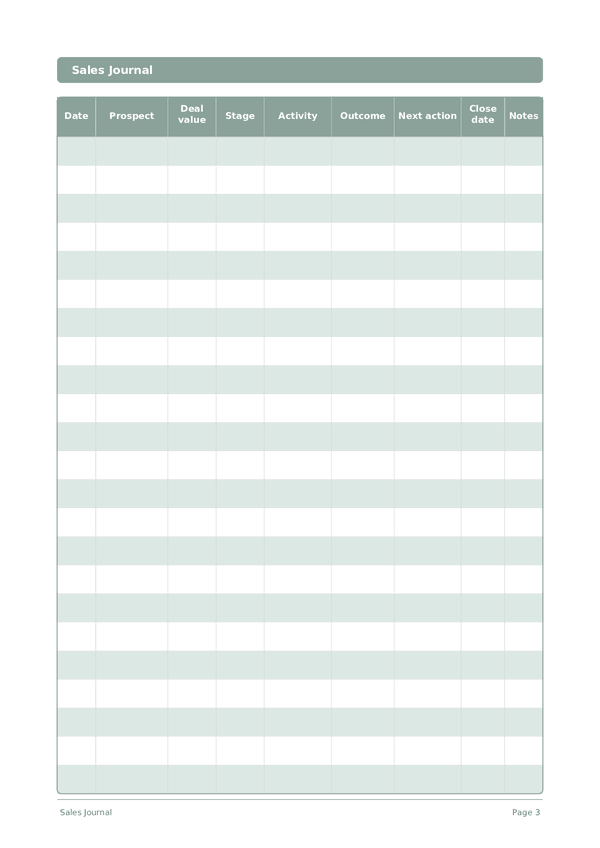
A Sales Journal is a deal-tracking log designed for sales professionals who want to manage their pipeline with clarity and discipline. Each row records the date, prospect name, deal value, pipeline stage, activity performed, outcome, next action, expected close date, and notes. It gives you a bird's-eye view of every opportunity you are working, so nothing slips through the cracks.
Top-performing salespeople share one trait: they are obsessively organized about their pipeline. They know exactly which deals are hot, which need nurturing, and which are stalled. This journal provides that level of organization in a simple, printable format. By reviewing it daily, you ensure that every prospect gets the right attention at the right time.
Update your journal after every sales activity — calls, emails, demos, and meetings. Be specific in the notes column: record objections raised, decision-makers involved, and any personal details that help build rapport. Review the log each morning to plan your day around the highest-value actions, and each Friday to forecast your month.
Filled example
Here's what a typical entry looks like when filled in:
| Date | Prospect | Deal value | Stage | Activity | Outcome | Next action | Close date | Notes |
|---|---|---|---|---|---|---|---|---|
| 2025-01-06 | Meridian Health | 24000 | Proposal | Sent proposal | Awaiting review | Follow up Thursday | 2025-01-31 | CFO is the final decision-maker |
| 2025-01-07 | Atlas Logistics | 18500 | Discovery | Discovery call | Needs identified | Send case study | 2025-02-14 | Pain point: manual inventory tracking |
| 2025-01-07 | Pinnacle Retail | 36000 | Demo | Product demo | Very interested | Schedule pilot | 2025-02-07 | Asked about API integration options |
| 2025-01-08 | Crestview Financial | 12000 | Negotiation | Pricing discussion | Requested discount | Prepare counter-offer | 2025-01-20 | Competing bid from DataSync at $10K |
| 2025-01-08 | Eastwood Media | 8500 | Prospecting | Cold email | Opened, no reply | Follow up call Mon | 2025-03-01 | Marketing director found via LinkedIn |
How to fill in each field
Each page is a table with columns. Fill in one row per entry. Here's what each column is for:
Date
Write today's date. This anchors your entry in time and helps when reviewing entries later.
Prospect
Deal value
Stage
Activity
Outcome
What actually happened as a result?
Next action
Close date
Notes
Add any additional context or thoughts. This catch-all column is for anything that doesn't fit elsewhere but might be useful later.
Tips for success
When and how often to write
Update your sales log at the end of every working day — add new contacts, update deal stages, and note follow-up dates. This takes 10 minutes and is the single highest-ROI habit in sales. Weekly, review your pipeline by stage: are there enough leads at the top? Are deals stuck in the middle? Monthly, calculate your conversion rate by stage, average deal cycle, and revenue closed versus target. Adjust your daily activity targets based on the data, not on gut feeling.
Frequently Asked Questions
What pipeline stages should I use in the stage column?
Standardize a short ladder: Prospecting, Qualified, Proposal, Negotiation, Closed-Won, Closed-Lost. Harvard Business Review (Adamson et al., 2012, 'The End of Solution Sales', HBR July-August 2012) describes consistent stage definitions as foundational to pipeline accuracy. The same vocabulary on every row lets you scan the page and count deals by stage; ambiguous custom stages destroy comparability over time.
How does logging activity differ from logging outcome?
Activity is what you did: a call, demo, or email. Outcome is what resulted: a meeting booked, an objection, no answer. Harvard Business Review (Adamson et al., 2012, 'The End of Solution Sales', HBR July-August 2012) emphasizes separating effort metrics from result metrics. The two columns side by side reveal which activity types produce which outcomes, the foundation for adjusting your approach with evidence.
Why include next action on every row?
An opportunity without a next step is a lost opportunity. Harvard Business Review (Adamson et al., 2012, 'The End of Solution Sales', HBR July-August 2012) frames continuous progression as the discipline separating top performers. Filling next action when logging activity prevents the most common pipeline failure: deals that fade because nobody owned the next step. Pair with close date to keep urgency visible.
How is this paper journal different from Salesforce or HubSpot?
CRMs optimize team-level reporting; this journal optimizes individual rep reflection. Thaler & Sunstein, 'Nudge' (Yale University Press, 2008) describe written friction as a behavioral feature. Writing prospect, deal value, stage, activity, outcome, and next action by hand each day produces awareness CRM dashboards mask. Many reps run both: the CRM for company process, the journal for personal pipeline discipline.
What deal value should I enter - full contract or weighted by stage?
Enter the full deal value and let stage carry the probability information. Harvard Business Review (Adamson et al., 2012, 'The End of Solution Sales', HBR July-August 2012) treats stage-based weighting as a forecasting layer applied to raw values. Mixing weighting into the column makes raw analysis impossible later. Keep deal value clean; calculate weighted forecasts separately if needed.
How often should I review the sales journal?
Daily entry, weekly review. Harvard Business Review (Adamson et al., 2012, 'The End of Solution Sales', HBR July-August 2012) ties consistent pipeline review to forecasting accuracy. With 15 rows per page, a Friday review can scan recent activity, outcome patterns, and overdue next action items in 10 minutes. Without weekly review, the close date column drifts and deals quietly age out.
What goes in the notes column for a busy rep?
Decision-maker names, objections raised, pricing referenced, competitor mentions. Harvard Business Review (Adamson et al., 2012, 'The End of Solution Sales', HBR July-August 2012) shows top reps document buyer signals systematically. The narrow notes width forces shorthand; if you need more, mark a star and continue on the back. The goal is recall before the next prospect conversation, not transcription.
Does sales journaling actually improve close rates?
Structured reflection improves measurable performance across knowledge work. Harvard Business Review (Di Stefano et al., 2014, 'Learning by Thinking', HBR Working Paper 14-093) demonstrated end-of-day reflection improved performance by over 20%. Adamson et al. (2012, 'The End of Solution Sales', HBR July-August 2012) tie deliberate pipeline analysis to top-quartile sales performance. The nine columns turn both into one daily habit.
You Might Also Like
Scroll to zoom, drag to move