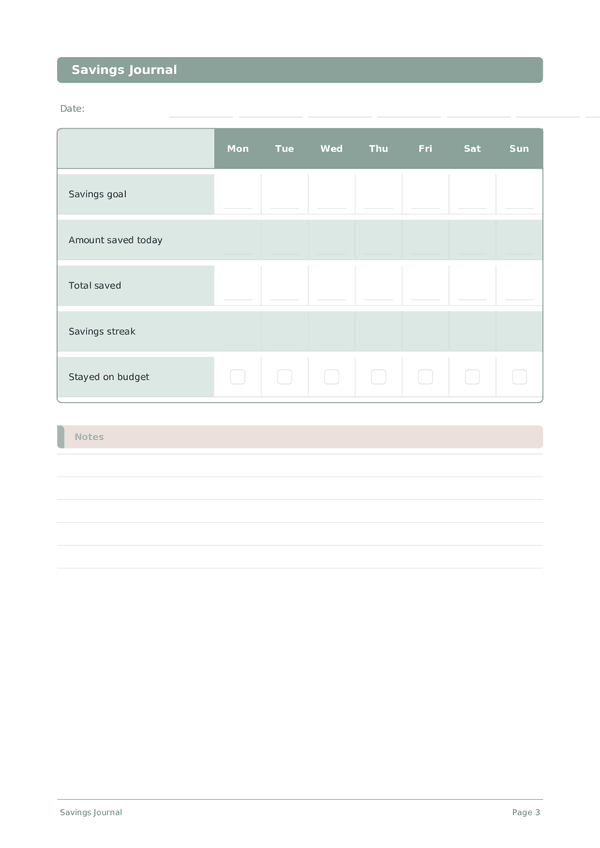
Printable Savings Journal
Track daily savings habits and build toward your financial goals
Log how much you save each day, track your running total, and rate your consistency streak. Research shows that daily tracking and visible progress are the two most powerful drivers of financial goal achievement — this template puts both in your hands.
Customize fields
Toggle fields on or off. Click the pencil to rename, or add your own fields.
Benefits
How to Use
What is this journal?
A Savings Journal is a weekly tracker designed to help you build consistent saving habits and watch your money grow over time. Each week, you log your savings goal, the amount you saved each day, your running total, whether you stayed on budget, and your current savings streak. This simple visual format makes it easy to spot trends and stay motivated.
Tracking your savings daily transforms an abstract financial goal into a concrete, manageable routine. Research in behavioral economics shows that people who monitor their finances regularly save significantly more than those who do not. By recording even small amounts, you reinforce the habit and build momentum.
Use this journal every evening as part of your wind-down routine. Fill in the amount you set aside today, check whether you stayed within your daily budget, and update your streak. Over weeks and months, the filled-in rows become a powerful visual reminder of your progress and discipline.
Filled example
Here's what a typical entry looks like when filled in:
| Mon | Tue | Wed | Thu | Fri | Sat | Sun | |
|---|---|---|---|---|---|---|---|
| Savings goal | 50 | 50 | 50 | 50 | 50 | 50 | 50 |
| Amount saved today | 50 | 30 | 50 | 45 | 60 | 25 | 50 |
| Total saved | 1250 | 1280 | 1330 | 1375 | 1435 | 1460 | 1510 |
| Savings streak | 5 | 0 | 1 | 2 | 3 | 0 | 1 |
| Stayed on budget | ✓ | ✓ | ✓ | ✓ | ✓ |
How to fill in each field
Each page is a weekly grid. Rows are your tracking items, columns are days of the week. Here's what each item means:
Savings goal
Amount saved today
Total saved
Savings streak
Stayed on budget
Tips for success
When and how often to write
Make a daily entry noting whether you saved anything today, even a small amount, and update your running total. The daily rhythm builds identity as a saver — it takes about 30 seconds. Weekly, review your consistency streak and total saved that week. Monthly, compare your actual savings rate to your target, check that your money is in the best available account, and adjust your daily or weekly target if needed.