Printable Skin Journal
Daily skincare routine tracker and skin health journal
Build your best skin through daily routine tracking and pattern recognition. Log products, monitor lifestyle factors like hydration and sleep, and identify what truly improves your complexion over time.
Customize fields
Toggle fields on or off. Click the pencil to rename, or add your own fields.
What is this journal?
A skin journal is a daily tracking tool designed for anyone who wants to understand and improve their skin health. By rating your skin condition, logging water intake, sleep, stress levels, and noting breakouts alongside your skincare routine and diet, you create a holistic picture of the factors influencing your complexion. This journal bridges the gap between guessing what works and knowing what works.
Skin is the body's largest organ, and its condition is influenced by a complex web of internal and external factors. A product that works wonders for one person may cause breakouts in another, and environmental changes can shift your skin's needs overnight. By maintaining consistent daily entries, you can isolate which products, foods, or habits correlate with your best and worst skin days — information that even a dermatologist cannot determine from a single office visit.
Whether you are battling acne, managing eczema or rosacea, building an anti-aging routine, or simply curious about optimizing your skin, this journal turns anecdotal impressions into reliable data. It is especially powerful when introducing new products, as you can precisely track their effects over the crucial first weeks of use.
Filled example
Here's what a typical entry looks like when filled in:
How to fill in each field
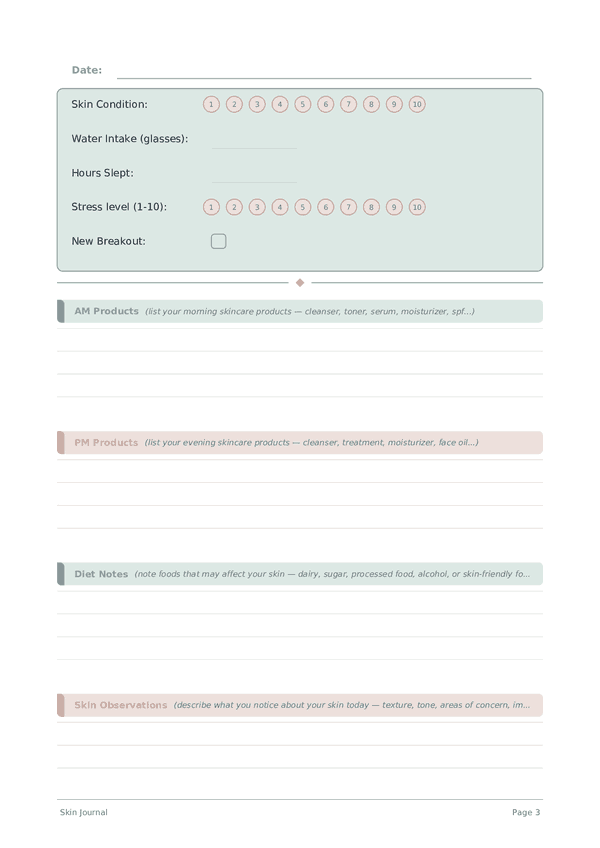
The top of each page has quick-fill fields (ratings, checkboxes, numbers). Below that is a lined section for writing. Here's what each field means:
Skin Condition
Rate your skin condition today. Track improvements or flare-ups to identify triggers like food, stress, or products.
Water Intake (glasses)
How many glasses of water did you drink today? Aim for 6–8 glasses for optimal skin hydration
Hours Slept
Write how many hours you actually slept (not just time in bed). Tracking this alongside mood and energy often reveals powerful connections.
Stress level (1-10)
Rate your stress on a scale of 1–10. Over time, you'll identify your stress patterns and which coping strategies work best.
New Breakout
Did any new breakouts appear today? Check if yes to track patterns over time
AM Products
List your morning skincare products — cleanser, toner, serum, moisturizer, SPF...
PM Products
List your evening skincare products — cleanser, treatment, moisturizer, face oil...
Diet Notes
Note foods that may affect your skin — dairy, sugar, processed food, alcohol, or skin-friendly foods
Skin Observations
Describe what you notice about your skin today — texture, tone, areas of concern, improvements
What Changed
Did you change anything today — new product, different diet, more sleep? Note it to track cause and effect
Tips for success
When and how often to write
Do a brief skin check and log every morning — note any new breakouts, irritation, dryness, or improvement. Record your full skincare routine (AM and PM products) and mark any product changes. Weekly, review your skin photos side by side to detect gradual changes invisible day-to-day. Monthly, assess which products and habits correlate with your best and worst skin weeks. Before dermatologist visits, prepare a summary from your journal: current routine, recent changes, trigger patterns, and product duration. This data transforms your appointment from guesswork into evidence-based care.
Frequently Asked Questions
How does daily tracking actually improve skin condition?
Per American Academy of Dermatology (AAD) and Journal of the American Academy of Dermatology, structured tracking shows which products, foods, and lifestyle factors actually affect your skin. Skin cell turnover takes ~28 days, so cause-effect patterns emerge across 4-6 weeks. The template's mix of objective metrics (sleep, water, stress) and product logs lets you test hypotheses; most users identify 1-3 actionable triggers within 8 weeks.
What's the connection between sleep, stress, and skin?
AAD and dermatology research in JAAD (2019) confirm that cortisol from poor sleep (<7 hours per NHLBI) and chronic stress increase sebum production, worsen acne, and slow barrier repair. The hours slept and stress level (1-10) fields track these variables. Patterns over 6-8 weeks reveal personal thresholds; many users find acne flares correlate with stress at or above 7/10 or sleep under 6 hours for 3+ consecutive nights.
How should I log AM and PM skincare products?
Per AAD guidance, separate product lists make pattern analysis cleaner. Use the morning products and evening products prompts to list each product (brand, key active ingredient like retinol, salicylic acid, niacinamide). When adding a new product, note the start date and watch 4-6 weeks before judging; initial 'purging' from retinoids and acids is normal. Stop and consult a dermatologist for persistent irritation.
Can diet really affect skin?
Per JAAD (2017, 77(6)) and AAD reviews: high-glycemic diets and dairy correlate with acne; rosacea may flare with alcohol and spicy foods; eczema can flare with food allergens. Use the diet notes prompt to log suspect foods, with skin response 24-48 hours later. Cochrane reviews acknowledge dietary effects are individualized; your journal patterns matter more than population averages. Consult a dermatologist or allergist for systematic evaluation.
What does the new breakout checkbox tell me over time?
Checking new breakout daily builds a breakout frequency chart over weeks. AAD considers consistent patterns clinically meaningful: 3+ new lesions/week may indicate hormonal acne, contact reactions, or product irritation. The checkbox paired with stress, sleep, and product logs reveals causal patterns. Photographs alongside the journal (separate device) add objective evidence dermatologists value during virtual visits.
How is this different from skincare apps like TroveSkin or YouCam Makeup?
AI-based apps analyze photos for surface metrics but rarely include lifestyle context. Per JAAD (2021, 84(5)) digital dermatology reviews, app accuracy varies widely and cannot diagnose conditions. The paper journal captures the behavioral and environmental factors (diet, sleep, stress, products) that drive most skin issues. Combine them if useful: app for visual tracking, journal for context. Apps don't replace dermatologist evaluation.
How long until I see results from a new skincare routine?
Per AAD: cell turnover takes ~28 days for adults, longer with age. Most actives (retinoids, exfoliating acids, vitamin C) show measurable results in 6-12 weeks. The what changed prompt is most useful at the 4-, 8-, and 12-week marks; review baseline ratings against current. Patience matters; switching products too quickly prevents proper evaluation. Document changes; bring them to your dermatologist for personalized assessment.
When should skin issues prompt a dermatologist visit?
AAD red flags: persistent acne unresponsive to OTC treatment for 8+ weeks, sudden severe breakouts, painful cystic lesions, persistent rash, suspicious moles (ABCDE criteria: asymmetry, border, color, diameter >6mm, evolution), unexplained skin changes. Bring 8+ weeks of journal data: products tried, diet and lifestyle patterns, breakout frequency. This speeds accurate diagnosis. Sudden facial swelling or a blistering rash with fever needs urgent care.
You Might Also Like
Scroll to zoom, drag to move