Printable Sleep Journal
Sleep tracker and rest quality journal
Track your sleep patterns, analyze rest quality, and identify factors that help or hinder your sleep. Build better sleep habits with evidence-based insights.
Customize fields
Toggle fields on or off. Click the pencil to rename, or add your own fields.
Benefits
How to Use
What is this journal?
A sleep journal is a daily record where you track your sleep patterns — bedtime, wake time, total hours slept, and subjective quality — alongside factors that influence your rest, such as caffeine intake, screen time, and exercise. By logging this information each morning, you build a detailed map of your sleep habits that can reveal hidden patterns and problem areas.
This journal is designed for anyone who wants to improve their sleep, whether you struggle with insomnia, wake up feeling unrested despite getting enough hours, have an irregular schedule, or simply want to optimize your rest for better performance and well-being. Sleep specialists often ask patients to keep a sleep diary as a first step before any treatment, because it provides essential baseline data.
Most people drastically overestimate or underestimate how much they sleep and how long it takes them to fall asleep. A sleep journal replaces these guesses with facts. Over time, you may discover that caffeine after 2 PM adds 30 minutes to your falling-asleep time, or that you sleep an hour longer on nights when you avoid screens before bed. These personal insights are far more actionable than generic sleep advice, because they are based on your own data and your own life.
Filled example
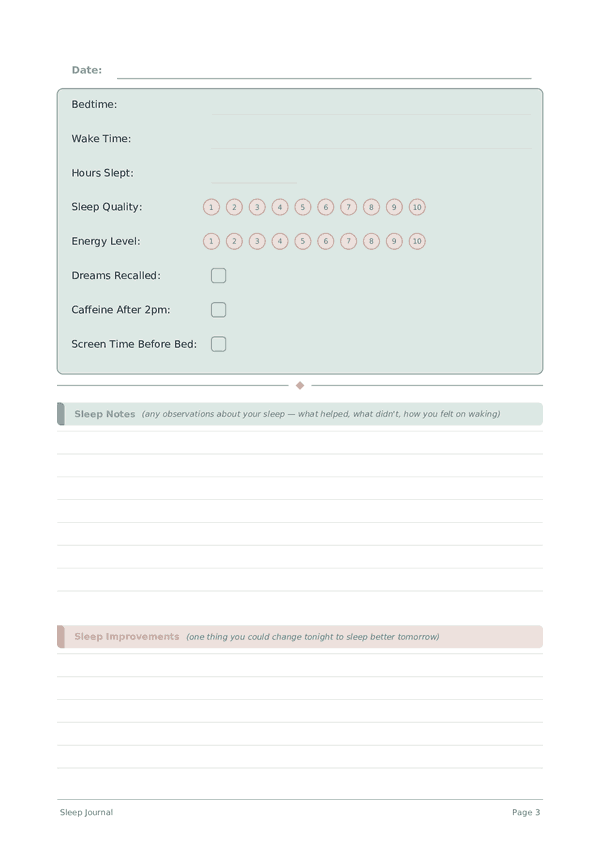
Here's what a typical entry looks like when filled in:
How to fill in each field
The top of each page has quick-fill fields (ratings, checkboxes, numbers). Below that is a lined section for writing. Here's what each field means:
Bedtime
What time did you go to bed? (e.g. 10:30 PM)
Wake Time
What time did you wake up? (e.g. 6:30 AM)
Hours Slept
Write how many hours you actually slept (not just time in bed). Tracking this alongside mood and energy often reveals powerful connections.
Sleep Quality
Rate how restful your sleep was. 1 means terrible and restless, 5 means deep and refreshing. Quality matters as much as quantity.
Energy Level
How energized do you feel this morning? (1=exhausted, 5=fully charged)
Dreams Recalled
Did you remember any dreams upon waking?
Caffeine After 2pm
Did you consume caffeine (coffee, tea, energy drinks) after 2pm?
Screen Time Before Bed
Did you use screens (phone, TV, computer) within 1 hour of bedtime?
Sleep Notes
Any observations about your sleep — what helped, what didn't, how you felt on waking
Sleep Improvements
One thing you could change tonight to sleep better tomorrow
Tips for success
When and how often to write
Fill in your sleep data every morning within the first 30 minutes of waking, while you still remember how you slept. The tracker takes under a minute. Add brief notes about anything unusual — late meals, stress, noise. After two weeks of consistent tracking, review your data to identify your optimal bedtime window (the time range that consistently produces your highest quality scores). Monthly, assess whether your average sleep duration matches your actual need.
Frequently Asked Questions
How many hours of sleep do adults actually need?
AASM (American Academy of Sleep Medicine) and Sleep (2015, 38(6)) consensus: adults need 7-9 hours nightly; teens 8-10; school-age children 9-12. NHLBI confirms that consistently under 6 hours raises cardiovascular, metabolic, and immune risks. Use the hours slept field to track actual sleep, not just time in bed. Less than 7 hours for 14+ consecutive days warrants clinical attention.
What does sleep quality really measure beyond hours?
AASM defines quality across efficiency (time asleep / time in bed), wake-after-sleep onset, and restorative feeling. The 1-10 rating captures subjective restoration, which is distinct from duration. Sleep Medicine (2018, 41) shows 7 hours of fragmented sleep equals ~5 hours of consolidated rest physiologically. Pair hours slept with sleep quality ratings to spot quality issues that hour counts miss.
How does caffeine after 2 PM affect sleep?
Caffeine has a 5-6 hour half-life per AASM and Sleep (2013, 36(11)), so 200 mg consumed at 2 PM still has 50 mg active at bedtime. Studies show caffeine within 6 hours of bed cuts total sleep by 41 minutes and measurably lowers sleep quality. The caffeine after 2pm checkbox, paired with sleep quality ratings, builds personal evidence. Most people underestimate caffeine's impact on their sleep.
Why track screen time before bed?
AASM and NIH NIA evidence shows blue light suppresses melatonin onset by ~90 minutes, delaying sleep. Sleep (2017, 40(9)) found phones within 1 hour of bedtime reduced total sleep by 35 minutes on average. The screen time before bed checkbox correlates with sleep quality ratings; most users discover a 1.5-2 point quality drop on screen-heavy evenings. Try a 1-hour screen-free wind-down.
How is this different from a sleep tracker watch?
Wearables estimate sleep stages from movement and heart rate, with ~70-80% accuracy versus polysomnography per Sleep (2020, 43(7)). They miss context: caffeine, stress, room temperature, dreams. This journal complements wearable data with the variables that actually drive sleep quality. AASM clinical evaluation still uses sleep diaries as the gold standard for outpatient assessment, not wearable data.
When should sleep problems prompt a doctor visit?
AASM red flags: trouble falling or staying asleep 3+ nights weekly for 3+ months (chronic insomnia), loud snoring with daytime sleepiness (suspect sleep apnea), legs urge to move at night (restless legs), or excessive daytime sleepiness despite adequate hours. Bring 2 weeks of journal entries; they shorten the diagnostic workup and may qualify you for polysomnography or home sleep testing.
What's the most effective sleep improvement based on evidence?
Per AASM Clinical Practice Guidelines (2021) and Cochrane reviews, CBT-I (cognitive behavioral therapy for insomnia) outperforms sleep medications long-term. Key elements you can apply yourself: consistent wake time (even weekends), stimulus control (bed = sleep only), and sleep restriction. The sleep improvements prompt encourages testing one change at a time. NHLBI sleep hygiene guidelines are also evidence-based starting points.
Why log dreams in the journal?
Dream recall correlates with REM sleep, which makes up 20-25% of healthy sleep per AASM. Frequent nightmares may indicate trauma response, sleep apnea, or medication effects; APA notes nightmare disorder is clinically diagnosable. Tracking dream recall (yes/no) alongside sleep quality reveals REM disruption patterns. The notes section can capture dream content if therapeutic; psychotherapy traditions value this as self-insight material.
You Might Also Like
Scroll to zoom, drag to move