Printable Tea Journal
Track every cup — from leaf to last sip
A structured log for tea enthusiasts who want to deepen their tasting practice. Record brewing parameters, aroma, flavor notes, and ratings to build a personal reference of your favorite teas. Whether you explore single-origin loose-leaf or seasonal herbals, this journal helps you brew better with every session.
Customize fields
Toggle fields on or off. Click the pencil to rename, or add your own fields.
Benefits
How to Use
What is this journal?
A tea journal is a tasting and steeping log for documenting your exploration of tea. By recording tea type, origin, steeping parameters, and detailed sensory notes, you deepen your appreciation of one of the world's most nuanced beverages and learn to brew each tea at its best.
This journal is for tea enthusiasts who want to move beyond tea bags into the rich world of loose-leaf tea — from delicate white teas and complex oolongs to robust pu-erhs and fragrant jasmine greens. It is equally valuable whether you practice gongfu cha or Western-style brewing.
Tea masters emphasize that the same leaf can produce dramatically different cups depending on water temperature, steeping time, and leaf-to-water ratio. This journal helps you find the optimal parameters for each tea and track how teas evolve across multiple infusions — a journey that transforms tea drinking from a casual habit into a mindful practice with centuries of wisdom behind it.
Filled example
Here's what a typical entry looks like when filled in:
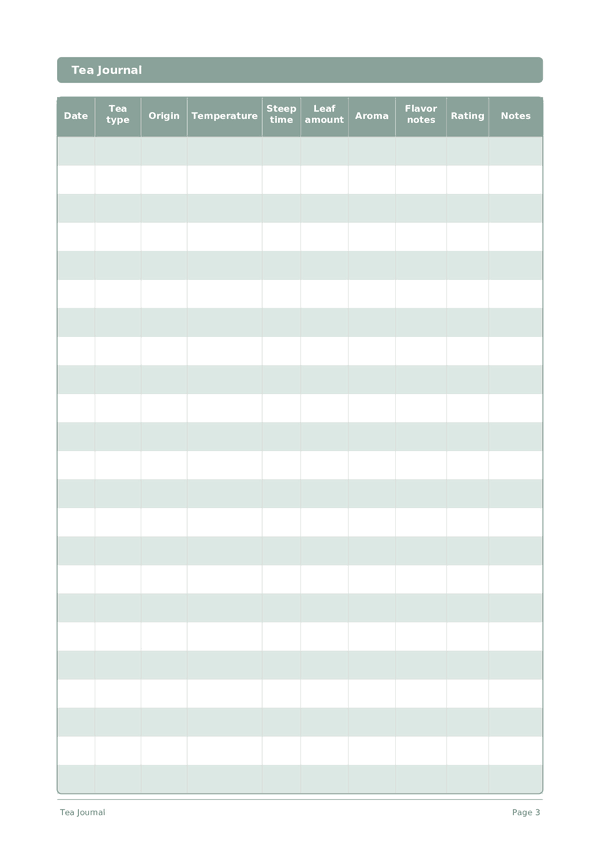
| Date | Tea type | Origin | Temperature | Steep time | Leaf amount | Aroma | Flavor notes | Rating | Notes |
|---|---|---|---|---|---|---|---|---|---|
| 2025-03-04 | Oolong — Tieguanyin | Anxi, Fujian, China | 90 | 30s / 45s / 60s / 90s | 7g / 100ml gaiwan | Orchid, fresh cream, hint of roasted grain | 1st steep: bright floral, buttery. 2nd: orchid deepens, light honey. 3rd: toasted grain emerges, mineral finish. 4th: gentle, sweet, lingering. | 8 | Excellent Tieguanyin — opened beautifully over 4 steeps. The leaves unfurled into full, intact leaves. Best at 2nd and 3rd steep. Gongfu style brings out complexity. |
| 2025-03-04 | Green — Gyokuro | Uji, Kyoto, Japan | 60 | 90s / 60s / 30s | 5g / 60ml kyusu | Intense umami, seaweed, sweet grass, ocean breeze | 1st steep: rich umami bomb, sweet marine, buttery. 2nd: lighter, more vegetal, asparagus. 3rd: delicate, sweet, refreshing. | 9 | This Gyokuro is exceptional. Low temperature is essential — anything above 65C brings bitterness. The umami is almost broth-like. Paired well with mild white fish for lunch. |
How to fill in each field
Each page is a table with columns. Fill in one row per entry. Here's what each column is for:
Date
Write today's date. This anchors your entry in time and helps when reviewing entries later.
Tea type
Origin
Temperature
Record your basal body temperature. Temperature shifts help track ovulation and overall cycle health.
Steep time
Leaf amount
Aroma
Flavor notes
Rating
Overall rating of the experience
Notes
Add any additional context or thoughts. This catch-all column is for anything that doesn't fit elsewhere but might be useful later.
Tips for success
When and how often to write
Log each tea session as you brew — the table format is designed for quick capture while the kettle cools. If you drink 2-3 teas daily, log the one you want to remember or improve. When exploring a new tea type (say, transitioning from black to pu-erh), log every session for at least two weeks to build baseline understanding. Monthly, review your entries to see which teas you rated highest and which brewing parameters consistently produce your best cups.