Printable Trading Journal
Trade logging and performance analysis journal
Improve your trading edge with meticulous trade documentation, risk management tracking, and performance analysis. Identify patterns in your wins and losses to become a consistently profitable trader.
Customize fields
Toggle fields on or off. Click the pencil to rename, or add your own fields.
What is this journal?
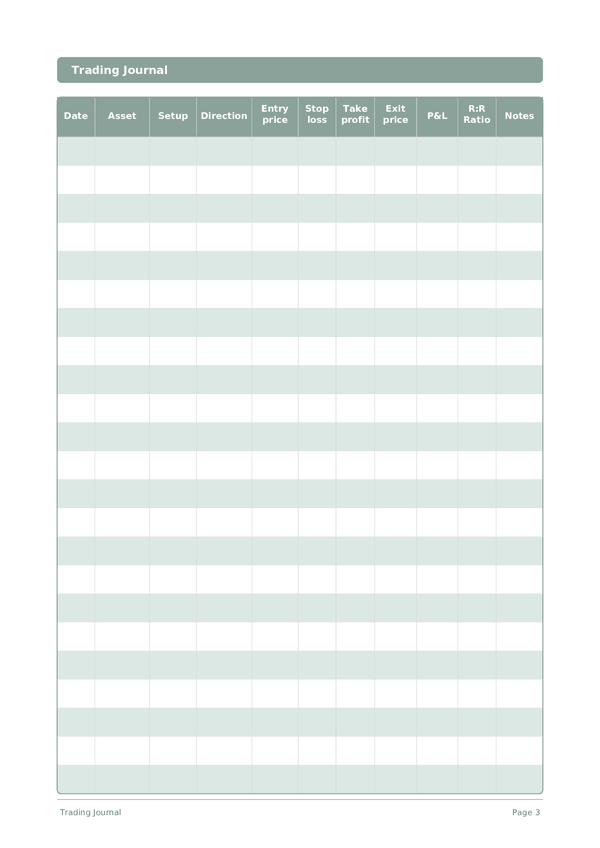
A Trading Journal is an essential record-keeping tool for anyone who trades stocks, options, forex, or crypto. Each row captures the date, asset traded, setup type, direction, entry price, stop loss, take profit, exit price, profit or loss, risk-to-reward ratio, and notes. By logging every trade, you build a personal dataset that reveals your true edge — or exposes costly patterns you need to fix.
Professional traders universally agree that journaling is one of the highest-leverage habits for improving performance. Without a journal, it is impossible to know whether your strategy is genuinely profitable or whether recent gains are just luck. A well-kept trading log lets you calculate your win rate, average gain-to-loss ratio, and performance by setup type, time of day, or market conditions.
Log every trade immediately after closing the position — not at the end of the week when details have faded. Record your rationale in the notes column: what did the setup look like, what was your thesis, and what emotion did you feel when entering? Review your journal weekly to identify which setups are working and which you should stop trading.
Filled example
Here's what a typical entry looks like when filled in:
| Date | Asset | Setup | Direction | Entry price | Stop loss | Take profit | Exit price | P&L | R:R Ratio | Notes |
|---|---|---|---|---|---|---|---|---|---|---|
| 2025-01-06 | AAPL | Breakout | Long | 248.5 | 245 | 255 | 254.2 | 570 | 1.63 | Clean break above resistance on volume |
| 2025-01-06 | EUR/USD | Pullback | Short | 1.0385 | 1.041 | 1.034 | 1.0342 | 430 | 1.72 | Bearish engulfing on 4H after news catalyst |
| 2025-01-07 | TSLA | Gap fill | Long | 395 | 390 | 405 | 392.1 | -290 | -0.58 | Stopped out early — gap did not hold support |
| 2025-01-08 | BTC/USD | Range break | Long | 97200 | 96000 | 100000 | 99400 | 1100 | 1.83 | Broke 12-day consolidation range on high volume |
| 2025-01-08 | NVDA | Momentum | Long | 148.3 | 146.5 | 152 | 147 | -195 | -0.72 | Entered too late in the move, weak follow-through |
How to fill in each field
Each page is a table with columns. Fill in one row per entry. Here's what each column is for:
Date
Write today's date. This anchors your entry in time and helps when reviewing entries later.
Asset
Setup
Direction
Entry price
Stop loss
Take profit
Exit price
P&L
R:R Ratio
Notes
Add any additional context or thoughts. This catch-all column is for anything that doesn't fit elsewhere but might be useful later.
Tips for success
When and how often to write
Make a journal entry for every trade — before, during, and after. Before: write your thesis, setup, and planned risk parameters. During: note any deviations from the plan. After: record the outcome, what went right, and what you would do differently. On non-trading days, spend 15 minutes reviewing recent trades and updating your statistics. Weekly, calculate your win rate, average R-multiple, and largest drawdown. Monthly, identify your top three setups by profitability and your worst three by loss — then trade more of the former and less of the latter.
Frequently Asked Questions
Why must I log entry price, stop loss, and take profit before the trade closes?
Pre-trade plans expose execution discipline after the trade. The SEC (2023, investor.gov, 'Day Trading') warns that most active traders lose money, often because plans drift mid-trade. Writing stop loss and take profit at entry creates the only honest record of whether you followed your plan. Without it, hindsight rewrites every trade as intentional and learning stops.
How do I calculate the risk-to-reward ratio column?
Risk-to-reward ratio is (take profit minus entry price) divided by (entry price minus stop loss) for a long trade, with signs reversed for shorts. The SEC (2023, investor.gov, 'Trading Basics') frames risk management as the core discipline of active trading. Logging the ratio per trade lets you verify whether your setup type actually achieves the risk-reward you assume when sizing positions.
What is the setup column actually for?
A short tag for the recurring pattern you traded — breakout, mean reversion, news, gap fill. The SEC (2023, investor.gov, 'Investor Bulletin: Day Trading') notes that active traders rarely label setups and therefore cannot evaluate which approaches work. Consistent setup labels turn a row of trades into a sortable dataset; over 50-100 trades, patterns of PnL by setup reveal your real edge — or the absence of one.
How is this journal different from broker statements or TradingView notes?
Broker data shows execution; this journal records intention plus execution. The SEC (2023, investor.gov, 'Investor Bulletin: Keep Records') recommends personal trade records kept independent of broker reports. The 11 columns — including setup, direction, stop loss, take profit, risk-to-reward ratio, and notes — capture the decision context that broker statements omit. Without that context, post-trade learning collapses into luck attribution.
Does keeping a trading journal actually improve performance?
Documentation supports the deliberate-practice loop the SEC repeatedly recommends for any investor. The SEC (2023, investor.gov, 'Day Trading') states that most day traders lose money; structured review is one of the documented practices that distinguishes those who survive. Daniel Kahneman, 'Thinking, Fast and Slow' (Farrar, Straus & Giroux, 2011), shows that post-hoc memory of trades is systematically biased toward self-flattering reconstructions.
What goes in the notes column for a typical trade?
Why you took the trade beyond the setup tag, the broader market context, your emotional state, and what surprised you. Daniel Kahneman, 'Thinking, Fast and Slow' (Farrar, Straus & Giroux, 2011), describes how emotional context drives execution errors invisible in price data. Brief notes captured at exit keep later review honest; reconstructed notes are systematically biased toward whatever outcome occurred.
Should I journal losing trades or only winners?
Losers especially. The SEC (2023, investor.gov, 'Day Trading') warns that most active traders lose, making loss analysis the primary source of edge improvement. Filling every row — entry price, stop loss, exit price, PnL — particularly when PnL is negative, builds the dataset that exposes rule violations and setup failure modes. Selective journaling produces a flattering and ultimately useless record.
How many trades should I log before doing a review?
Review weekly for execution discipline; review by setup after roughly 20-30 trades for statistical signal. The SEC (2023, investor.gov, 'Investor Bulletin: Day Trading') stresses that small samples are misleading. With 15 trades per page, a swing trader covers months; an active day trader covers a week. Match your review cadence to entry frequency rather than to a calendar habit.
You Might Also Like
Scroll to zoom, drag to move