Printable Travel Journal
Capture every journey, one day at a time
A structured daily travel companion for recording where you went, what you saw, who you met, and what surprised you. Track your mood, budget, and favorite moments while preserving local discoveries and tips for fellow travelers.
Customize fields
Toggle fields on or off. Click the pencil to rename, or add your own fields.
Benefits
How to Use
What is this journal?
A travel journal is your daily companion for capturing the sights, flavors, encounters, and discoveries that make each trip unforgettable. By tracking location, mood, and expenses alongside written reflections about highlights and local discoveries, you create a vivid travel memoir that photographs alone cannot provide.
This journal is for any traveler — whether you are backpacking through Southeast Asia, on a weekend road trip, or exploring a new neighborhood in your own city. It is for people who believe that travel is not just about where you go but about what you notice, who you meet, and how the experience changes you.
Travel psychology research shows that the memories we treasure most from trips are not the famous landmarks but the unexpected encounters and sensory details. People who journal during travel report 2-3x richer recall of their trips years later. This journal ensures those details — the taste of that street food, the conversation with that local, the color of that sunset — are preserved before they fade.
Filled example
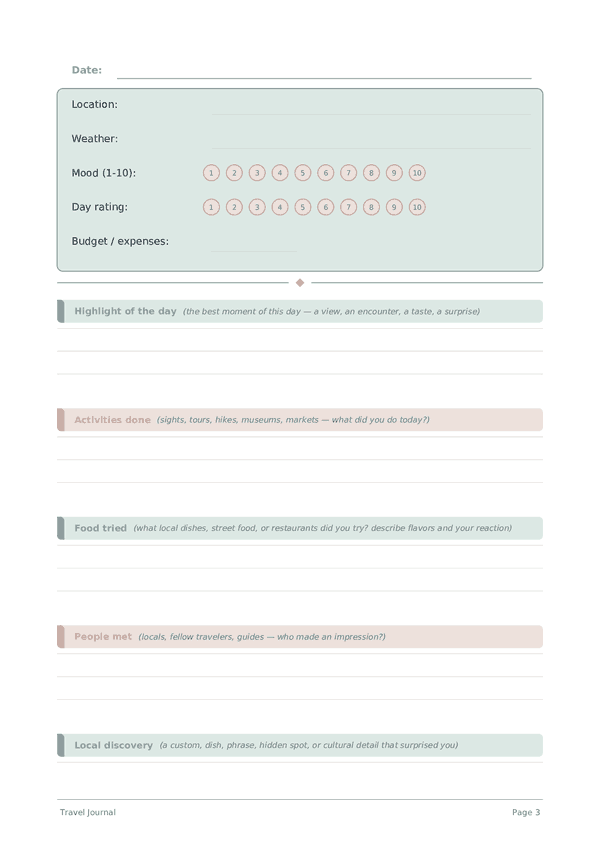
Here's what a typical entry looks like when filled in:
How to fill in each field
The top of each page has quick-fill fields (ratings, checkboxes, numbers). Below that is a lined section for writing. Here's what each field means:
Location
Where was the photo taken?
Weather
Sunny, cloudy, rain, wind — current conditions
Mood (1-10)
Rate your overall emotional state for the day. 1 means very low or depressed, 10 means exceptionally happy and positive. Don't overthink — go with your gut feeling.
Day rating
How would you rate this travel day overall? Rate from 1 (rough) to 10 (amazing)
Budget / expenses
How much did you spend today? Include meals, transport, accommodation, and activities
Highlight of the day
What was the best part of your day? Capture the moment that made today worth living. These highlights become a collection of your happiest memories.
Activities done
Sights, tours, hikes, museums, markets — what did you do today?
Food tried
What local dishes, street food, or restaurants did you try? Describe flavors and your reaction
People met
Locals, fellow travelers, guides — who made an impression?
Local discovery
A custom, dish, phrase, hidden spot, or cultural detail that surprised you
Travel tip
A recommendation for those visiting the same place — transport, timing, what to see
Tips for success
When and how often to write
Write every evening of your trip, ideally at a cafe or before bed, while the day is still fresh. Spend 10-15 minutes per entry. If you skip a day on the road, fill it in the next morning before new experiences overwrite the old ones. After returning home, spend one session reviewing and adding any final notes within the first week. The longer you wait, the more your memories flatten into generic impressions.
Frequently Asked Questions
What should I write in the daily highlight section?
One specific moment that defined the day — a conversation, a view, an unexpected detour. Pico Iyer's travel essays consistently argue that travel memory lives in particulars, not summaries. The seven-line space is sized for one rich vignette, not a chronological recap. If you can name the highlight in a sentence and expand it in five, you'll reread it years later with full recall.
Why track budget and expenses inside a travel journal?
Budget awareness changes trip behavior. World Tourism Organization (UNWTO) traveler research consistently identifies money management as the top stressor on multi-week trips. The budget / expenses field — capped at 999,999 to handle any currency — lets you log daily spend and notice patterns: which days you overspent, which transit choices saved you, which countries demand bigger contingency. Memory of cost fades fastest of all trip variables.
How is this different from a travel blog or Instagram?
Social platforms reward performance for an audience; this private journal rewards observation for yourself. Pico Iyer and Paul Theroux both write about the difference between presented travel and witnessed travel. The local discovery and travel tip prompts capture the granular knowledge that never makes it to public posts — the bus number that saved you, the café open at 6 a.m., the rule about tipping.
What's worth noting in the people met section?
Names (or descriptions), context, and one specific thing they said or did. Bruce Chatwin's travel notebooks treat encounters as the structural backbone of journeys. A barista's recommendation, a fellow traveler's warning, a host's family story — these age into the most valuable entries. Avoid generic 'met nice people.' Specifics like 'Marta, third-generation baker in Florence, hates her brother' survive decades.
How does logging mood support travel well-being?
The 1-10 mood rating creates a longitudinal record of how travel actually affects you, separate from how you assume it should. White et al. (2019, Scientific Reports, 9, article 7730) found nature contact thresholds for well-being; similar logic applies to travel — some trips drain, some restore. Reviewing past mood entries across destinations and trip lengths reveals your personal travel patterns.
Should I write every day or only when something happens?
Every day, even briefly. Travel memory compresses fast — a quiet rest day in Lisbon becomes indistinguishable from one in Porto after a month. The hybrid layout supports both: complete the tracker fields (location, weather, mood, rating, expenses) in two minutes on slow days, and reserve the seven-line section for highlight-worthy days. The tracker alone preserves the trip's skeleton.
What belongs in the local discovery prompt?
Specific knowledge you couldn't have gotten from a guidebook — the market that opens an hour earlier than posted, the side street with the real version of the famous dish, the local bus that beats the tourist shuttle. World Travel & Tourism Council research consistently shows repeat travelers cite hyperlocal knowledge as their most valued asset. Your discoveries become a private guidebook for any return trip.
When should I fill in the entry — morning or evening?
Evening, ideally before sleep, while sensory detail is sharp. Paul Theroux notes in his travel writing that morning entries describe yesterday at one remove; evening entries describe today directly. The how to use note in this journal aligns with that — 'fill in your entry each evening while details are fresh.' Reserve mornings for re-reading yesterday's entry over coffee, which strengthens consolidation.
You Might Also Like
Scroll to zoom, drag to move