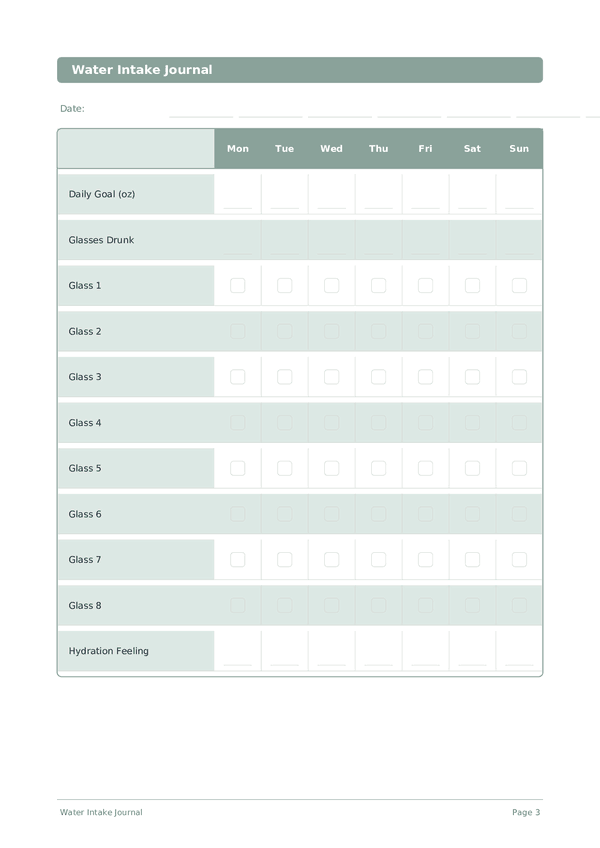
Printable Water Intake Journal
Daily water intake tracker and hydration log
Stay hydrated and build healthy water drinking habits. Track your daily water intake glass by glass, set personalized goals, and monitor how hydration affects your energy and wellbeing.
Customize fields
Toggle fields on or off. Click the pencil to rename, or add your own fields.
What is this journal?
A water journal is a simple daily tracker that helps you monitor your hydration by recording how many glasses of water you drink throughout the day. With checkboxes for each glass and a space to note how hydrated you feel, it turns an easy-to-forget habit into a visible, satisfying routine you can see at a glance.
This journal is for anyone who suspects they are not drinking enough water — and research suggests that is most people. It is especially helpful for those who get so absorbed in work or daily activities that they forget to drink, people who rely heavily on coffee or other beverages and want to increase their plain water intake, and anyone experiencing symptoms of mild dehydration like fatigue, headaches, or difficulty concentrating.
Hydration affects nearly every system in your body, from cognitive function and energy levels to digestion and skin health. Yet because the effects of mild dehydration are subtle and gradual, most people do not connect their afternoon slump or persistent headache to simply not drinking enough water. A water journal makes the invisible visible. By checking off each glass and rating how you feel at the end of the day, you quickly learn your personal hydration sweet spot — and staying there becomes second nature.
Filled example
Here's what a typical entry looks like when filled in:
| Mon | Tue | Wed | Thu | Fri | Sat | Sun | |
|---|---|---|---|---|---|---|---|
| Daily Goal (oz) | 64 | 64 | 64 | 64 | 64 | 64 | 64 |
| Glasses Drunk | 8 | 6 | 7 | 8 | 5 | 9 | 7 |
| Glass 1 | ✓ | ✓ | ✓ | ✓ | ✓ | ✓ | ✓ |
| Glass 2 | ✓ | ✓ | ✓ | ✓ | ✓ | ✓ | ✓ |
| Glass 3 | ✓ | ✓ | ✓ | ✓ | ✓ | ✓ | ✓ |
| Glass 4 | ✓ | ✓ | ✓ | ✓ | ✓ | ✓ | ✓ |
| Glass 5 | ✓ | ✓ | ✓ | ✓ | ✓ | ✓ | ✓ |
| Glass 6 | ✓ | ✓ | ✓ | ✓ | ✓ | ✓ | |
| Glass 7 | ✓ | ✓ | ✓ | ✓ | ✓ | ||
| Glass 8 | ✓ | ✓ | ✓ | ||||
| Hydration Feeling | 8 | 5 | 6 | 8 | 4 | 9 | 7 |
How to fill in each field
Each page is a weekly grid. Rows are your tracking items, columns are days of the week. Here's what each item means:
Daily Goal (oz)
Glasses Drunk
Glass 1
Check off each glass of water as you drink it throughout the day. Visual progress motivates you to reach your hydration goal.
Glass 2
Check off each glass of water as you drink it throughout the day. Visual progress motivates you to reach your hydration goal.
Glass 3
Check off each glass of water as you drink it throughout the day. Visual progress motivates you to reach your hydration goal.
Glass 4
Check off each glass of water as you drink it throughout the day. Visual progress motivates you to reach your hydration goal.
Glass 5
Check off each glass of water as you drink it throughout the day. Visual progress motivates you to reach your hydration goal.
Glass 6
Check off each glass of water as you drink it throughout the day. Visual progress motivates you to reach your hydration goal.
Glass 7
Check off each glass of water as you drink it throughout the day. Visual progress motivates you to reach your hydration goal.
Glass 8
Check off each glass of water as you drink it throughout the day. Visual progress motivates you to reach your hydration goal.
Hydration Feeling
Tips for success
When and how often to write
Mark each intake as it happens throughout the day — this is the only way to get accurate data. Set 3–4 checkpoint times (morning, midday, afternoon, evening) and check your running total at each one. If you are behind, adjust. At the end of each week, review your daily totals and compare them with your energy and focus ratings. Most people see a clear pattern: better hydration equals better performance. Adjust your target seasonally — summer and exercise days need more.
Frequently Asked Questions
How much water should I actually drink per day?
The U.S. National Academies of Sciences (2005, Dietary Reference Intakes) and CDC suggest about 2.7 L (women) or 3.7 L (men) total daily water from all sources — beverages and food. Roughly 8 glasses of plain water is a useful target for most healthy adults. Needs rise with heat, exercise, pregnancy, or illness. Set your daily goal (oz) field accordingly and consult your physician if you have kidney or heart conditions.
How do the 8 glass checkboxes connect to my daily goal?
Each checkbox represents one ~8-oz (240 ml) glass, summing to about 1.9 L when all are checked — close to CDC's minimum hydration target. NIH NIDDK guidance recommends visible cues to support consistent intake. Checking off each glass turns an abstract goal into discrete actions, the technique behavior-change research (NIH NCCIH, 2022) calls an 'implementation intention.' Adjust daily goal (oz) for active or hot days.
What is the hydration feeling rating actually measuring?
It captures subjective hydration signals — thirst, urine color, headache, energy — that complement the objective glass count. Mayo Clinic and NHS guidance note that pale-yellow urine and absent thirst indicate adequate hydration. American Journal of Clinical Nutrition (2014, 99(3)) shows mild dehydration (1-2% body weight) impairs cognition and mood. The rating helps you connect intake patterns to how you actually feel.
Can I drink too much water?
Yes. NEJM and Mayo Clinic warn that hyponatremia from over-hydration is rare but serious, mostly in endurance athletes drinking far beyond thirst. For healthy adults, drinking to thirst plus a glass with each meal is safe. Patients with heart failure, kidney disease, or SIADH require physician-set limits. The journal's daily goal (oz) field helps you avoid both under- and over-drinking.
Do coffee, tea, and other beverages count toward my intake?
Yes. The U.S. National Academies and EFSA include all fluids except alcohol in total water intake. Coffee and tea are net hydrating despite mild diuretic effects, per American Journal of Clinical Nutrition (2014, 99(3)). Sugary drinks, though, add calories. The journal focuses on water glasses to build a single, measurable habit — record other fluids in the notes area if helpful.
What signs indicate I am dehydrated?
CDC and NHS signs: dark-yellow urine, infrequent urination, thirst, dry mouth, headache, fatigue, dizziness. Mayo Clinic notes that thirst is a late signal — by then you're already 1-2% dehydrated. The hydration feeling rating helps catch these earlier. Severe symptoms (confusion, rapid heartbeat, fainting) require immediate medical attention. Older adults and children show signs faster than healthy young adults.
How long until consistent hydration changes how I feel?
Most users notice clearer thinking and reduced afternoon fatigue within 5-7 days. American Journal of Clinical Nutrition (2012, 142(2)) found that increasing water intake in chronically under-hydrated adults improved mood and concentration within a week. Headache frequency often drops in 2-3 weeks. Use the hydration feeling column to verify — chart your ratings against daily glass counts over a month.
Is this template suitable for kids or elderly users?
Yes, with adjusted targets. AAP recommends about 4-8 cups daily for children depending on age; NIA notes older adults have blunted thirst and need scheduled drinking. Reduce daily goal (oz) proportionally for children, or set reminders for elderly users. Patients on diuretics, dialysis, or with heart failure must follow physician-set fluid limits — the journal is a tool, not a substitute for clinical guidance.
You Might Also Like
Scroll to zoom, drag to move