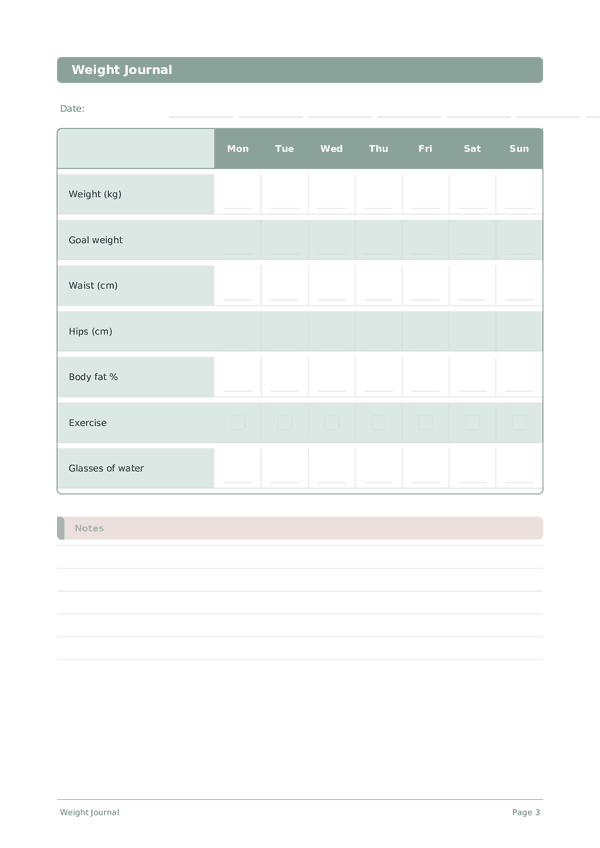
Printable Weight Journal
Track body measurements and reach your weight goals
Monitor weight, waist measurements, exercise, and water intake in a weekly grid. See trends that help you stay on course toward your body composition goals.
Customize fields
Toggle fields on or off. Click the pencil to rename, or add your own fields.
Benefits
How to Use
What is this journal?
A weight journal is a weekly tracker where you record your body weight alongside related measurements — body fat percentage, waist and hip circumference — as well as daily habits like exercise and water intake. By capturing these numbers consistently over time, you build a clear, objective picture of your body composition changes that goes far beyond what the scale alone can tell you.
This journal is for anyone with a body composition goal: people looking to lose weight, gain muscle, or maintain their current physique. It is equally useful for those who have struggled with inconsistent tracking or who feel discouraged by day-to-day weight fluctuations and want a more balanced, data-driven perspective on their progress.
Daily weight can swing by a kilogram or more due to water retention, meal timing, and other factors that have nothing to do with actual fat loss or gain. A weight journal helps you see through this noise by showing weekly trends and correlations. When you notice that your waist measurement is decreasing even though the scale hasn't moved, you know your body composition is improving. Tracking exercise and water intake alongside your measurements reveals which habits most strongly correlate with the results you want.
Filled example
Here's what a typical entry looks like when filled in:
| Mon | Tue | Wed | Thu | Fri | Sat | Sun | |
|---|---|---|---|---|---|---|---|
| Weight (kg) | 82.4 | 82.1 | 82.6 | 82 | 81.8 | 82.2 | 81.5 |
| Goal weight | 79 | 79 | 79 | 79 | 79 | 79 | 79 |
| Waist (cm) | 88 | 88 | 87.5 | ||||
| Hips (cm) | 101 | 101 | 100.5 | ||||
| Body fat % | 22.1 | 22 | 21.8 | ||||
| Exercise | ✓ | ✓ | ✓ | ✓ | |||
| Glasses of water | 8 | 6 | 9 | 8 | 7 | 10 | 8 |
How to fill in each field
Each page is a weekly grid. Rows are your tracking items, columns are days of the week. Here's what each item means:
Weight (kg)
Record your weight if you're tracking it. Weigh yourself at the same time each day for consistent data. Focus on weekly trends, not daily fluctuations.
Goal weight
Waist (cm)
Measure your waist circumference. More reliable than weight alone, waist measurement reflects actual body composition changes.
Hips (cm)
Body fat %
Exercise
Check off whether you exercised today. Even a 10-minute walk counts. The goal is building awareness of your activity patterns.
Glasses of water
Track your daily water intake. Most people need 6–8 glasses. Ticking off glasses throughout the day helps you stay hydrated.
Tips for success
When and how often to write
Step on the scale every morning under the same conditions for the most reliable trend data. Record the number without judgment — it is just data. At the end of each week, calculate and log your 7-day average weight. Compare weekly averages, not daily readings, to determine real progress. Monthly, take body measurements (waist, hips, chest) to capture changes the scale misses. A rate of 0.5–1% body weight change per week is sustainable in either direction.