Printable Weight Journal
Track body measurements and reach your weight goals
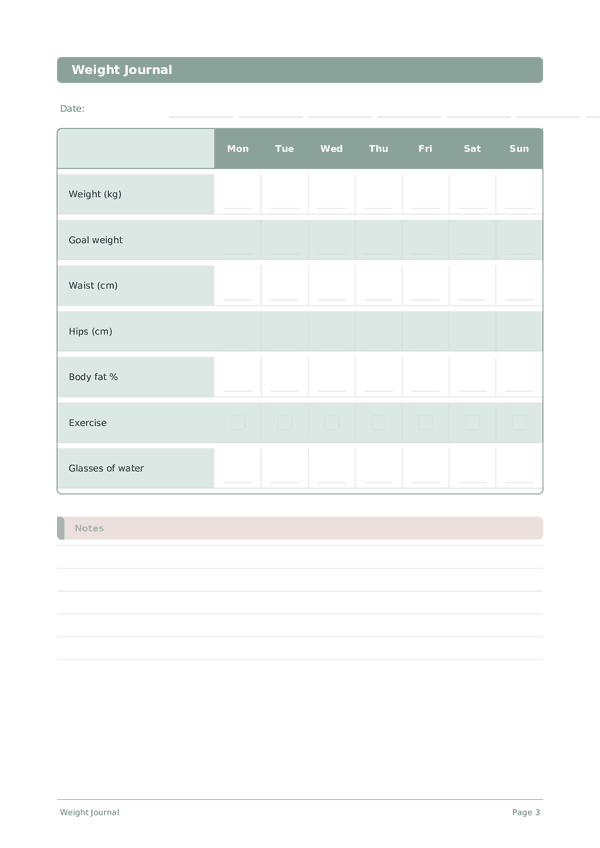
Monitor weight, waist measurements, exercise, and water intake in a weekly grid. See trends that help you stay on course toward your body composition goals.
Customize fields
Toggle fields on or off. Click the pencil to rename, or add your own fields.
Benefits
How to Use
What is this journal?
A weight journal is a weekly tracker where you record your body weight alongside related measurements — body fat percentage, waist and hip circumference — as well as daily habits like exercise and water intake. By capturing these numbers consistently over time, you build a clear, objective picture of your body composition changes that goes far beyond what the scale alone can tell you.
This journal is for anyone with a body composition goal: people looking to lose weight, gain muscle, or maintain their current physique. It is equally useful for those who have struggled with inconsistent tracking or who feel discouraged by day-to-day weight fluctuations and want a more balanced, data-driven perspective on their progress.
Daily weight can swing by a kilogram or more due to water retention, meal timing, and other factors that have nothing to do with actual fat loss or gain. A weight journal helps you see through this noise by showing weekly trends and correlations. When you notice that your waist measurement is decreasing even though the scale hasn't moved, you know your body composition is improving. Tracking exercise and water intake alongside your measurements reveals which habits most strongly correlate with the results you want.
Filled example
Here's what a typical entry looks like when filled in:
| Mon | Tue | Wed | Thu | Fri | Sat | Sun | |
|---|---|---|---|---|---|---|---|
| Weight (kg) | 82.4 | 82.1 | 82.6 | 82 | 81.8 | 82.2 | 81.5 |
| Goal weight | 79 | 79 | 79 | 79 | 79 | 79 | 79 |
| Waist (cm) | 88 | 88 | 87.5 | ||||
| Hips (cm) | 101 | 101 | 100.5 | ||||
| Body fat % | 22.1 | 22 | 21.8 | ||||
| Exercise | ✓ | ✓ | ✓ | ✓ | |||
| Glasses of water | 8 | 6 | 9 | 8 | 7 | 10 | 8 |
How to fill in each field
Each page is a weekly grid. Rows are your tracking items, columns are days of the week. Here's what each item means:
Weight (kg)
Record your weight if you're tracking it. Weigh yourself at the same time each day for consistent data. Focus on weekly trends, not daily fluctuations.
Goal weight
Waist (cm)
Measure your waist circumference. More reliable than weight alone, waist measurement reflects actual body composition changes.
Hips (cm)
Body fat %
Exercise
Check off whether you exercised today. Even a 10-minute walk counts. The goal is building awareness of your activity patterns.
Glasses of water
Track your daily water intake. Most people need 6–8 glasses. Ticking off glasses throughout the day helps you stay hydrated.
Tips for success
When and how often to write
Step on the scale every morning under the same conditions for the most reliable trend data. Record the number without judgment — it is just data. At the end of each week, calculate and log your 7-day average weight. Compare weekly averages, not daily readings, to determine real progress. Monthly, take body measurements (waist, hips, chest) to capture changes the scale misses. A rate of 0.5–1% body weight change per week is sustainable in either direction.
Frequently Asked Questions
Why does the journal track waist and hips alongside weight?
American Heart Association (2022, Circulation, 146(5)) and WHO guidance identify waist circumference as a stronger predictor of cardiometabolic risk than weight alone — visceral fat matters more than total mass. NIH NIDDK considers waist >102 cm (men) or >88 cm (women) elevated risk. Waist and hips also reveal body composition shifts when weight is stable, useful during recomposition phases when muscle replaces fat.
How often should I actually weigh myself?
Daily, at the same time after using the bathroom and before eating, per Mayo Clinic and Obesity (2015, 23(11)) research showing daily weighing improves long-term weight maintenance. Obesity journal data demonstrate that focusing on the 7-day moving average — not single-day spikes — prevents discouragement from normal 1-2 kg fluctuations driven by hydration, sodium, and glycogen stores.
What is a safe weight-loss rate to aim for?
CDC and USPSTF (2022, JAMA, 328(11)) recommend 0.5-1 kg (1-2 lb) per week — about a 250-500 kcal/day deficit. Faster loss increases muscle loss and rebound risk. ADA Standards of Care (2024, Diabetes Care, 47 Suppl 1) note that even 5-10% body weight reduction meaningfully improves blood pressure, glycemic control, and lipids. Weekly weight column trends are the right metric, not single readings.
Why measure body fat percentage and how accurate is home estimation?
Body fat percentage reflects composition better than BMI. NIH NHLBI considers >25% body fat (men) or >32% (women) elevated risk. Bioimpedance scales have ±3-8% error per NEJM device evaluations and depend heavily on hydration. Use the body fat % column for monthly trend, not daily precision. DEXA is the clinical reference but unnecessary for tracking — consistency in method matters most.
Is daily weighing safe for someone with disordered eating risk?
Often not. APA and the Academy for Eating Disorders advise against daily weighing for individuals with anorexia, bulimia, binge eating disorder, or orthorexia. Weight fluctuations can trigger restrictive behaviors. If you have such a history, consult a clinician and consider focusing on the exercise checkbox and water-intake columns instead. Weight is one data point, not a measure of self-worth.
How do hydration and exercise tracking connect to weight changes?
Hydration affects scale weight by 1-2 kg daily — undrunk water inflates apparent weight, then resolves. American Journal of Clinical Nutrition (2010, 91(3)) shows pre-meal water reduces caloric intake. Exercise drives muscle retention during caloric deficit, per ACSM. Together, the water and exercise columns explain about 30% of daily weight noise and help distinguish real progress from temporary fluctuation.
When should I see a doctor about weight changes?
Mayo Clinic and NIH NIDDK red-flag guidance: unintentional loss of 5% body weight in 6-12 months, rapid weight gain of 2+ kg per week, or weight changes accompanied by fatigue, appetite shifts, or other symptoms warrant medical evaluation. Thyroid, diabetes, and cardiovascular conditions all show up through weight changes. Bring 4+ weeks of journal data to your appointment for a clearer clinical picture.
How long until I see meaningful trends on the weight journal?
Roughly 3-4 weeks. Obesity research shows daily variance of ±1-2 kg is normal; statistically reliable trends require at least three full weekly cycles to filter sodium, hormonal, and bowel-related noise. The template's weekly grid is built for this — calculate Monday-to-Sunday averages rather than fixating on individual days. Patterns in waist measurements often emerge before weight changes do.
You Might Also Like
Scroll to zoom, drag to move