Printable Yoga Journal
Daily yoga practice tracker and mindfulness journal
Deepen your yoga practice with mindful session logging, body awareness reflection, and intention tracking. Build consistency, monitor energy shifts, and document your journey toward greater flexibility, strength, and peace.
Customize fields
Toggle fields on or off. Click the pencil to rename, or add your own fields.
What is this journal?
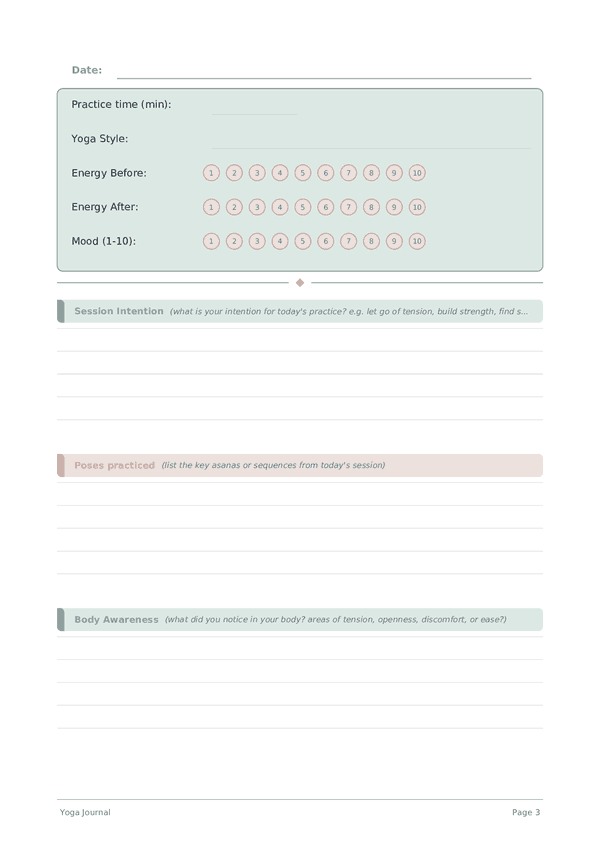
A yoga journal is a reflective practice companion that combines session tracking with mindful self-observation. The top section captures the quantitative aspects of your practice — duration, style, energy levels before and after, and mood — while the bottom section invites you to explore your intentions, body awareness, and moments of gratitude through freeform writing.
Yoga is far more than physical exercise; it is a journey of self-awareness that unfolds over months and years. A journal helps you notice subtle changes that are easy to overlook in daily practice: how certain styles affect your energy, which poses reveal tension patterns, and how your mental state evolves with consistent practice. By capturing these observations, you build a personal map of your yogic development.
Whether you are a beginner exploring different styles or an experienced practitioner deepening your practice, this journal adds a dimension of intentionality to every session. It encourages you to arrive on the mat with purpose and leave with insights, transforming routine practice into a meaningful ritual of growth and self-discovery.
Filled example
Here's what a typical entry looks like when filled in:
How to fill in each field
The top of each page has quick-fill fields (ratings, checkboxes, numbers). Below that is a lined section for writing. Here's what each field means:
Practice time (min)
How many minutes did you practice today?
Yoga Style
e.g. Hatha, Vinyasa, Yin, Restorative, Ashtanga, Kundalini, Power...
Energy Before
Rate your energy level before practice (1=very low, 5=very high)
Energy After
Rate your energy level after practice (1=very low, 5=very high)
Mood (1-10)
Rate your overall emotional state for the day. 1 means very low or depressed, 10 means exceptionally happy and positive. Don't overthink — go with your gut feeling.
Session Intention
What is your intention for today's practice? e.g. Let go of tension, build strength, find stillness...
Poses practiced
List the key asanas or sequences from today's session
Body Awareness
What did you notice in your body? Areas of tension, openness, discomfort, or ease?
Gratitude Moment
One specific thing you are grateful for from today's practice
Tips for success
When and how often to write
Write immediately after practice while body sensations and mental insights are still vivid — even 5 minutes of delay blurs the internal experience. Log every session, including home practices, short stretching routines, and restorative sessions. For the tracker portion, record practice duration, style, and key poses. For the written portion, capture your inner experience. Weekly, review which styles and durations leave you feeling best. Monthly, assess your progress in poses you are working on — growth in yoga is slow but undeniable when tracked.
Frequently Asked Questions
What does the evidence say about yoga's health benefits?
NIH NCCIH (2023, Yoga: What You Need To Know) summarizes the evidence: yoga reduces low back pain (Cochrane Review, 2017), improves balance and flexibility, lowers stress markers, and helps anxiety and mild depression per APA (2021) reviews. JAMA Internal Medicine (2016, 176(11)) showed yoga matches PT for chronic back pain. The energy before and energy after ratings let you build personal evidence — most practitioners see measurable mood improvement within 4–6 weeks.
How does tracking energy before and after sessions help?
Per APA mindfulness research and the Journal of Behavioral Medicine, comparing pre- and post-practice energy ratings reveals which styles and durations best fit your needs. Restorative or yin practices typically raise energy from a low baseline; vinyasa or power yoga may reduce excess agitation. Patterns emerge in 3–4 weeks — use them to choose practices on purpose, based on your starting state rather than habit.
Which yoga style should I track in the yoga style field?
Common styles per Yoga Alliance and NCCIH classifications: Hatha (foundational), Vinyasa (flowing), Ashtanga (set sequences), Yin (passive long holds), Restorative (props-supported rest), Iyengar (alignment-focused), Power (athletic). Note the specific style — different styles have different physiological effects. Energy and mood patterns vary by style; tracking style in the field shows which type best supports your goals.
How long and how often should I practice for results?
Per NCCIH and ACSM, 2–3 sessions per week of 20–60 minutes produce measurable flexibility and stress reduction within 8–12 weeks. JAMA Psychiatry (2017, 74(2)) found 90 minutes weekly improved depression scores. The practice time (min) field tracks session length — consistency beats intensity. Aim for total weekly minutes, not perfect daily practice. The body awareness prompt helps you notice gradual changes.
Is yoga safe for everyone?
Mostly yes, with caveats. NCCIH and Mayo Clinic note that inversions and intense backbends carry risk for glaucoma, uncontrolled hypertension, severe osteoporosis, recent surgery, or pregnancy beyond first trimester (avoid prone poses). Consult your physician if you have these conditions. Use the body awareness prompt to track joint discomfort or pain — pain ≥3/10 in a pose signals to back off. Yoga should not cause injury.
How does setting intentions support practice depth?
Per APA mindfulness-based intervention research and Journal of Consciousness Studies, intention-setting (sankalpa) directs attention and improves outcomes from meditation and movement practices. The session intention prompt is the entry point — even simple intentions ('be present,' 'release shoulder tension') focus the mind. Long-term practitioners report that journaling intentions builds meta-awareness about recurring themes in their practice and life.
What's the difference between yoga journaling and meditation journaling?
Yoga journals tie the physical (poses, duration, energy) to mindfulness (intention, awareness), covering both kosha (body, mind) dimensions per traditional frameworks. Pure meditation journals focus on mental states. This template's hybrid design captures both: tracker for physiological data, lined section for reflection. NCCIH research shows combining movement and contemplation yields broader health benefits than either alone.
Can yoga journaling support therapy for anxiety or depression?
Yes, as an adjunct. NIH NIMH and APA (2021) describe yoga as adjunctive for mild-moderate depression and anxiety — not a replacement for psychotherapy or medication when indicated. JAMA Psychiatry (2017, 74(2)) supports 12-week protocols. Track mood ratings carefully and share patterns with your therapist. If mood ratings drop persistently below 4/10 or suicidal thoughts emerge, contact your mental health provider immediately — yoga supplements but does not replace clinical mental health care.
You Might Also Like
Scroll to zoom, drag to move