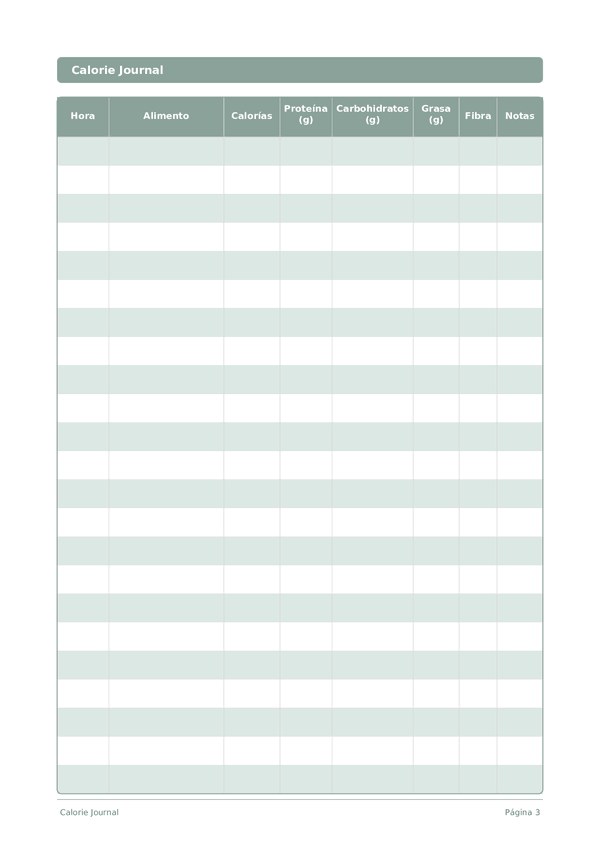
Printable Calorie Journal
Track calories and macros every meal
A structured table log for recording every meal with full macro breakdown — calories, protein, carbs, fat, and fiber. Build awareness of your eating patterns and reach your nutrition goals with data-driven consistency.
Personalizar campos
Activa o desactiva campos. Haz clic en el lápiz para renombrar, o añade tus propios campos.
Beneficios
Cómo Usar
¿Qué es este diario?
A calorie journal is a detailed nutritional log where you track not just the calories in every food item you consume, but also the macronutrient breakdown — protein, carbohydrates, fat, and fiber. This level of detail transforms vague dietary intentions into precise, actionable data that supports specific fitness, health, or body composition goals.
This journal is ideal for people who are serious about understanding their nutrition on a granular level: athletes optimizing performance, individuals following structured meal plans, anyone tracking macros for weight loss or muscle gain, or people managing conditions like diabetes where carbohydrate awareness is essential. It is also an excellent learning tool for anyone who wants to develop an intuitive sense of what is in the food they eat.
By logging each food item with its full nutritional profile, you gain clarity about where your calories actually come from. Many people are surprised to discover how quickly fats add up or how little protein they consume relative to their goals. Over time, this journal helps you make informed adjustments — not through restriction, but through awareness — so that your diet genuinely supports the way you want to feel and perform.
Ejemplo completado
Así es como se ve una entrada típica cuando se rellena:
| Hora | Alimento | Calorías | Proteína (g) | Carbohidratos (g) | Grasa (g) | Fibra | Notas |
|---|---|---|---|---|---|---|---|
| 7:00 | Scrambled eggs (3 large) | 210 | 18 | 2 | 15 | 0 | Cooked in olive oil spray |
| 7:00 | Whole wheat toast (2 slices) | 180 | 8 | 30 | 3 | 4 | |
| 7:00 | Avocado (half) | 120 | 1 | 6 | 11 | 5 | On toast |
| 10:30 | Protein shake (whey, banana, milk) | 320 | 30 | 35 | 6 | 2 | Post-workout |
| 13:00 | Brown rice (1 cup cooked) | 215 | 5 | 45 | 2 | 3 | |
| 13:00 | Grilled chicken breast (150g) | 230 | 35 | 0 | 9 | 0 | Seasoned with herbs |
| 13:00 | Mixed vegetables, steamed | 85 | 4 | 15 | 1 | 5 | Broccoli, carrots, green beans |
| 16:00 | Almonds (30g) | 175 | 6 | 6 | 15 | 3 | Afternoon snack |
| 19:00 | Pasta with turkey bolognese | 520 | 32 | 60 | 14 | 4 | Whole wheat pasta |
| 19:00 | Side salad with olive oil | 110 | 2 | 5 | 10 | 2 | |
| 21:00 | Greek yogurt with berries | 150 | 12 | 18 | 3 | 2 | Low-fat yogurt |
Cómo rellenar cada campo
Cada pagina es una tabla con columnas. Completa una fila por entrada. Esto es lo que significa cada columna:
Hora
Registra a que hora comiste. Los horarios de comida afectan la energia, el sueno y la digestion. Los patrones se hacen visibles despues de un par de semanas.
Alimento
Escribe lo que comiste. Se lo suficientemente especifico para ser util (ej. 'ensalada de pollo a la parrilla', no solo 'almuerzo'). Esto ayuda a identificar sensibilidades alimentarias y patrones.
Calorías
Registra tu ingesta aproximada de calorias. No necesitas numeros perfectos: las estimaciones te ayudan a ser consciente de tus patrones alimenticios.
Proteína (g)
Registra tu ingesta de proteina en gramos. La proteina adecuada es crucial para la recuperacion y el desarrollo muscular, tipicamente 1.6-2.2g por kg de peso corporal.
Carbohidratos (g)
Grasa (g)
Fibra
Notas
Agrega cualquier contexto o pensamiento adicional. Esta columna general es para cualquier cosa que no encaje en otro lugar pero pueda ser util despues.
Consejos para el exito
Cuando y con que frecuencia escribir
Log each meal and snack immediately in the table format: food item, portion size, calories, and macros if tracking them. Total your calories at the end of each day. Weekly, calculate your daily average and compare it to your target — this weekly view is more meaningful than any single day. Monthly, assess whether your target needs adjustment based on how your body is responding. If counting starts feeling obsessive, take a 3-day break and rely on your built-up food awareness instead.
Preguntas frecuentes
¿Contar calorías realmente ayuda a controlar el peso?
Sí: una revisión Cochrane y las USDA Dietary Guidelines for Americans (2020-2025) confirman que la conciencia sobre el consumo energético mejora los resultados de peso cuando se combina con el equilibrio de macronutrientes. Estudios del American Journal of Clinical Nutrition muestran que los usuarios que hacen automonitorización pierden aproximadamente el doble de peso en seis meses. El diseño de cinco macros de esta plantilla (calorías, proteínas, hidratos, grasas, fibra) apoya el énfasis en la calidad dietética recomendado por la ADA, no solo la restricción calórica.
¿Qué tan precisas deben ser mis estimaciones de calorías y macros?
Un margen de ±10-15% es suficiente para el seguimiento de tendencias, según la Academy of Nutrition and Dietetics. Estudios del American Journal of Clinical Nutrition (2017) muestran que incluso el registro imperfecto produce cambios de comportamiento significativos. Use etiquetas de alimentos, USDA FoodData Central o una app de código de barras para las búsquedas. La consistencia durante semanas importa más que la precisión por comida: fíjese en los totales semanales en lugar de perseguir la exactitud en cada toma.
¿Por qué la plantilla separa la fibra de los hidratos de carbono?
Las USDA Dietary Guidelines (2020-2025) recomiendan 25-34 g de fibra diaria, pero la mayoría de los adultos consumen ~16 g. Los ADA Standards of Care (2024, Diabetes Care, 47 Suppl 1) destacan el papel de la fibra en el control glucémico y la salud cardiovascular. Rastrear la fibra por separado de los hidratos totales revela patrones de calidad dietética que el recuento de hidratos netos oculta. Aspire a un porcentaje alto de fibra respecto a los hidratos totales: es mejor para la salud metabólica.
¿Cuánta proteína debería intentar comer por comida?
La USDA recomienda 0,8 g/kg de peso corporal diarios para adultos sedentarios; el British Journal of Sports Medicine (2018, 52(6)) y el consenso del ISSN sugieren 1,4-2,0 g/kg para personas activas. Distribuir 20-40 g en 3-4 comidas optimiza la síntesis de proteínas musculares. Use la columna de proteínas para verificar la distribución: concentrar toda la proteína en la cena es habitual pero menos eficaz que un espaciado uniforme.
¿Es esta plantilla adecuada para alguien con historial de trastornos alimentarios?
Úsela con precaución. La APA y la Academy for Eating Disorders advierten que el recuento detallado de calorías puede empeorar la alimentación restrictiva o la ortorexia. Si tiene historial de anorexia, bulimia o trastorno por atracón, consulte a un dietista o terapeuta antes de llevar el registro. La variante sin calorías (food-journal) es generalmente más segura. El seguimiento es una herramienta, no una medida moral. Consulte a su médico si tiene dudas.
¿En qué se diferencia de MyFitnessPal o Cronometer?
Las apps automatizan la búsqueda pero fomentan el uso continuo del teléfono; esta tabla imprimible obliga a un registro breve e intencional en las comidas. El NIH NCCIH (2022) señala que las herramientas de cambio de conducta funcionan mejor cuando la fricción es la justa para provocar reflexión. Los registros en papel también evitan las capas sociales y publicitarias de las apps de nutrición. Use la app para las búsquedas y luego transfiera los números clave al diario para el registro real.
¿Cómo uso los totales semanales del diario?
Sume cada columna durante los 7 días. Compare los totales con los objetivos de las USDA Dietary Guidelines (2020-2025): calorías según las necesidades estimadas por las tablas de TMB de los CDC, proteínas a 0,8-2,0 g/kg, fibra 25-34 g/día, grasas saturadas por debajo del 10% de las calorías. Busque patrones entre días laborables y fin de semana: a menudo revelan el ajuste de mayor impacto tanto para el peso como para los marcadores metabólicos.
¿Cuál es el error más habitual en el registro?
No registrar los tentempiés ni las bebidas. Los datos del CDC NHANES y el American Journal of Clinical Nutrition (2019) muestran que las personas subestiman el consumo en un 20-40%, sobre todo por tentempiés olvidados y calorías líquidas (refrescos, zumos, alcohol, lattes). Use la columna hora para cada ocasión de ingesta, incluso una sola galleta o un café con leche. Registrar una estimación es mejor que no registrar nada.
También Te Puede Gustar
Rueda para ampliar, arrastra para mover