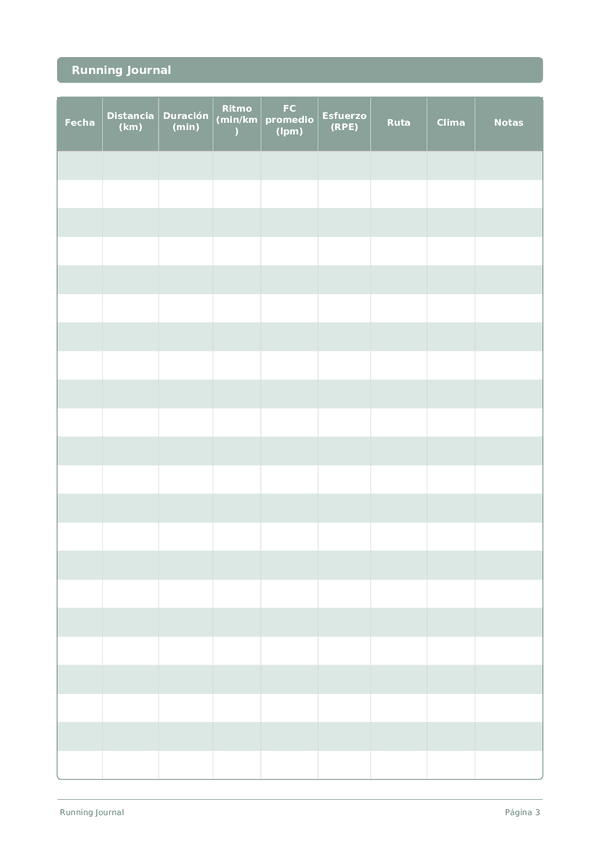
Printable Running Journal
Track every run, measure progress, and reach your goals
The Running Journal is a structured training log that helps you record key metrics for every run — distance, pace, heart rate, effort level, route, and more. Whether you are training for a race or building a consistent habit, this log gives you the data to analyse trends, identify patterns, and improve over time.
Personalizar campos
Activa o desactiva campos. Haz clic en el lápiz para renombrar, o añade tus propios campos.
Beneficios
Cómo Usar
¿Qué es este diario?
A running journal is a dedicated log where you record the details of every run — distance, duration, pace, heart rate, effort level, route, and conditions. It transforms your running from a series of disconnected outings into a structured training history that reveals trends, celebrates progress, and helps you train smarter.
This journal is for runners of all levels: beginners building up to their first 5K, recreational joggers who want to stay consistent, and experienced runners training for marathons or ultras. It is also valuable for people returning to running after injury, as tracking effort levels and how your body responds helps you avoid doing too much too soon.
Experienced coaches will tell you that a running journal is one of the most important tools a runner can have. By looking back at weeks and months of data, you can see how your pace improves at a given heart rate, identify which training approaches work best for you, and spot warning signs of overtraining before they lead to injury. On days when motivation is low, flipping back through your journal and seeing how far you have come is one of the most powerful reminders of why you run.
Ejemplo completado
Así es como se ve una entrada típica cuando se rellena:
| Fecha | Distancia (km) | Duración (min) | Ritmo (min/km) | FC promedio (lpm) | Esfuerzo (RPE) | Ruta | Clima | Notas |
|---|---|---|---|---|---|---|---|---|
| 2025-01-06 | 5.2 | 28 | 5:23/km | 148 | 6 | River path loop | Overcast, 4°C | Easy recovery run. Legs felt fresh after rest day. |
| 2025-01-08 | 8 | 40 | 5:00/km | 158 | 7 | Park circuit (2 laps) | Sunny, 2°C | Tempo run. Held pace well through km 6, then slowed slightly. |
| 2025-01-10 | 6.5 | 42 | 6:28/km | 135 | 4 | Neighborhood streets | Light rain, 6°C | Easy conversational pace. Practiced nasal breathing. |
| 2025-01-11 | 12 | 65 | 5:25/km | 155 | 8 | Lakeside trail | Cloudy, 3°C | Long run. Felt strong first 10 km, last 2 km were a grind. Fueled with gel at km 8. |
| 2025-01-13 | 5 | 23 | 4:36/km | 172 | 9 | Track (400m) | Clear, 1°C | Interval session: 5 x 1000m at 4:20 pace with 90s rest. Hit all splits. |
| 2025-01-14 | 4 | 24 | 6:00/km | 128 | 3 | Flat neighborhood loop | Overcast, 5°C | Shake-out run after hard intervals. Kept effort very low. |
Cómo rellenar cada campo
Cada pagina es una tabla con columnas. Completa una fila por entrada. Esto es lo que significa cada columna:
Fecha
Escribe la fecha de hoy. Esto ancla tu entrada en el tiempo y ayuda cuando revisas entradas despues.
Distancia (km)
Registra la distancia recorrida (en km o millas). Ver tu distancia aumentar a lo largo de las semanas es un motivador poderoso.
Duración (min)
Registra cuanto tiempo hiciste ejercicio o practicaste en minutos. Rastrear la duracion te ayuda a ver crecer tu compromiso y encontrar tu duracion optima de sesion.
Ritmo (min/km)
Anota tu ritmo (ej. min/km o min/milla). Rastrear el ritmo junto con como te sentiste te ayuda a encontrar tu punto ideal.
FC promedio (lpm)
Frecuencia cardiaca promedio en pulsaciones por minuto
Esfuerzo (RPE)
Percepcion del esfuerzo: 1=muy facil, 10=esfuerzo maximo
Ruta
Nombre de la ruta, barrio o sendero
Clima
Soleado, nublado, lluvia, viento: condiciones actuales
Notas
Agrega cualquier contexto o pensamiento adicional. Esta columna general es para cualquier cosa que no encaje en otro lugar pero pueda ser util despues.
Consejos para el exito
Cuando y con que frecuencia escribir
Log every run within 15 minutes of finishing, while the details are fresh. Even short recovery jogs deserve an entry — they reveal patterns in how your body responds to training load. At the end of each week, review your total volume and note how it compares to the previous week. A safe progression rule is no more than 10% weekly mileage increase. Monthly, look for pace-at-effort trends: the same heart rate producing faster splits is the clearest sign of fitness gains.
Preguntas frecuentes
¿Por qué registrar la frecuencia cardíaca y el RPE (esfuerzo) juntos en cada carrera?
El British Journal of Sports Medicine (2017, 51(20)) y el consenso del American College of Sports Medicine muestran que combinar la frecuencia cardíaca objetiva con el RPE subjetivo detecta mejor las ganancias de forma física y el sobreentrenamiento que cada uno por separado. Si la frecuencia cardíaca sube con el mismo RPE, se acumula fatiga. Si el RPE baja con la misma frecuencia cardíaca, aumenta la capacidad aeróbica. El diseño de dos columnas de esta plantilla capta ambas señales.
¿Cómo calculo el ritmo a partir de la distancia y la duración?
Ritmo (min/km) = duración ÷ distancia. Para 5 km en 30 minutos, el ritmo es 6:00/km. La plantilla incluye distancia, duración (min) y una columna dedicada al ritmo para que pueda verificar el cálculo. Medicine & Science in Sports & Exercise (2019, 51(4)) señala que el seguimiento consistente del ritmo durante semanas revela tendencias de forma aeróbica invisibles en entrenamientos individuales.
¿Qué significa realmente la escala RPE de 1 a 10?
La escala de Borg CR-10, usada por el ACSM y el British Journal of Sports Medicine, ancla 1 como 'muy ligero' (trote de calentamiento), 5 como 'algo duro' (ritmo conversacional), 7 como 'duro' (umbral) y 10 como 'esfuerzo máximo'. La mayor parte del kilometraje semanal debería estar a RPE 3-5 (aeróbico fácil). Reservar RPE 7+ para una o dos sesiones por semana reduce el riesgo de lesiones según la literatura de entrenamiento polarizado 80/20.
¿Cuántas carreras por semana son suficientes para ver progreso?
La USPSTF y las Directrices de Actividad Física de la OMS (2020) recomiendan 150 minutos de actividad aeróbica moderada a la semana. Para correr específicamente, el ACSM sugiere 3-5 sesiones semanales con al menos un día de descanso. Los principiantes pueden progresar con 3 carreras; los intermedios suelen registrar 4-5. Use los totales semanales del diario para verificar el volumen: los kilómetros y minutos totales impulsan la mayoría de las adaptaciones.
¿En qué zona de frecuencia cardíaca deben estar las carreras fáciles?
Aproximadamente el 60-70% de la frecuencia cardíaca máxima, según el ACSM. Estime la máxima como 220 menos la edad (fórmula aproximada; los valores reales varían). Para una persona de 40 años, máx. ≈ 180 ppm, así que la zona fácil es 108-126 ppm. Las revisiones del British Journal of Sports Medicine muestran que el 75-80% del kilometraje semanal debería estar en esta zona 'conversacional'. Use la columna fC promedio (lpm) para verificar que no está forzando demasiado en los días fáciles.
¿Cómo puede el diario ayudarme a evitar lesiones por sobreentrenamiento?
El British Journal of Sports Medicine (2016, 50(17)) muestra que las ratios de carga aguda a crónica superiores a 1,5 elevan drásticamente el riesgo de lesiones. Controle los totales de distancia semanales y compárelos con su promedio de 4 semanas: los aumentos superiores al 10% por semana son señales de advertencia. La frecuencia cardíaca creciente a ritmo constante, más RPE creciente, señalan fatiga acumulada. La columna de notas es el lugar adecuado para alertar sobre molestias y cansancio a tiempo.
¿En qué se diferencia este diario de Strava o Garmin Connect?
Las apps GPS automatizan la distancia y la frecuencia cardíaca, pero raramente capturan el contexto cualitativo. Las columnas de notas y clima permiten registrar viento en contra, perfiles de cuestas, calidad del sueño y alimentación: variables que explican una carrera lenta cuando los datos brutos parecen una pérdida de forma. El NIH NCCIH (2022) muestra que la revisión escrita a mano durante el enfriamiento mejora el cumplimiento y la autoevaluación más que los paneles pasivos.
¿Debo registrar las carreras fáciles y los calentamientos, o solo los entrenamientos clave?
Registre todo. El ACSM y Medicine & Science in Sports & Exercise destacan la carga de entrenamiento total, no solo las sesiones duras. Las carreras fáciles constituyen la mayor parte del volumen semanal y generan adaptaciones aeróbicas. Saltarlas en el registro subestima la carga y oscurece la ratio fácil/difícil. Una sola fila por carrera —incluso los trotes de recuperación de 20 minutos— mantiene el cuadro completo.
También Te Puede Gustar
Rueda para ampliar, arrastra para mover