Printable Language Learning Journal
Daily language learning tracker and study journal
Accelerate your language learning journey with daily practice tracking, vocabulary logging, and progress reflection. Build consistency and fluency one day at a time.
Personalizar campos
Activa o desactiva campos. Haz clic en el lápiz para renombrar, o añade tus propios campos.
¿Qué es este diario?
A language journal is your personal lab for tracking daily study sessions and measuring real progress over time. Learning a language involves dozens of micro-skills — vocabulary, grammar, listening, speaking, reading — and without a structured log it is easy to mistake busy-ness for progress. This journal fixes that by combining quick metrics with reflective writing after every session.
The tracker section captures how long you studied, which language and skill you focused on, your session rating, and your streak day. The writing section is where you consolidate learning: note new vocabulary, record phrases you practised, and jot down grammar rules you encountered. Writing these out by hand strengthens memory and reveals which areas need more attention.
Whether you are working through a textbook, using an app, or practising conversation with a partner, filling in this journal right after your session locks in the gains and gives you a clear roadmap for what to study next.
Ejemplo completado
Así es como se ve una entrada típica cuando se rellena:
Cómo rellenar cada campo
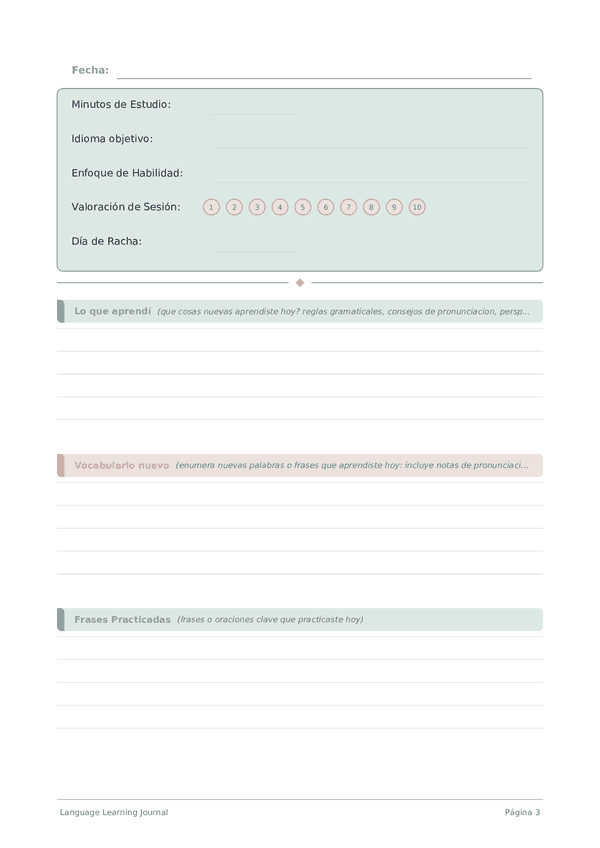
La parte superior de cada pagina tiene campos de llenado rapido (calificaciones, casillas, numeros). Debajo hay una seccion con lineas para escribir. Esto es lo que significa cada campo:
Minutos de Estudio
Minutos totales de estudio hoy
Idioma objetivo
Que idioma estas estudiando? ej. espanol, japones, frances
Enfoque de Habilidad
Lectura, escritura, escucha, conversacion, vocabulario, gramatica...
Valoración de Sesión
Que tan efectiva fue tu sesion? (1=pobre, 5=excelente)
Día de Racha
Cuantos dias consecutivos has estudiado?
Lo que aprendí
Escribe algo nuevo que aprendiste hoy. Puede ser un dato, una habilidad, una perspectiva sobre ti mismo o una leccion de vida. El aprendizaje diario se acumula en sabiduria.
Vocabulario nuevo
Enumera nuevas palabras o frases que aprendiste hoy: incluye notas de pronunciacion y oraciones de ejemplo
Frases Practicadas
Frases o oraciones clave que practicaste hoy
Notas de Gramática
Reglas, patrones o estructuras gramaticales en las que te enfocaste
Consejos para el exito
Cuando y con que frecuencia escribir
Write daily, even if only three sentences in your target language. Polyglot research consistently shows that 10 minutes of daily writing outperforms an hour-long weekly session for language retention. Use your journal as a warm-up before formal study sessions. Weekly, revisit five entries from the past month and correct them with your current knowledge — this spaced review solidifies grammar and vocabulary. Monthly, write one full page entirely in the target language as a benchmark of fluency progress.
Preguntas frecuentes
¿Qué registra el Diario de Aprendizaje de Idiomas por sesión?
Cinco elementos del rastreador — minutos de estudio, idioma objetivo, enfoque de habilidad (escucha/habla/lectura/escritura/gramática/vocabulario), valoración de la sesión (0-10) y día de racha — más cuatro líneas para lo que aprendí con indicaciones para nuevo vocabulario, frases practicadas y notas gramaticales. La estructura se alinea con el marco de cuatro habilidades del MCER (Marco Común Europeo de Referencia para las Lenguas, Consejo de Europa) y las directrices ACTFL.
¿Por qué es importante el campo de enfoque de habilidad — ¿no puedo simplemente 'practicar el idioma'?
Las directrices de competencia del MCER y ACTFL tratan la escucha, el habla, la lectura, la escritura, la gramática y el vocabulario como competencias distintas que se desarrollan de manera desigual. Rastrear el enfoque expone el descuido — la mayoría de los autodidactas dependen demasiado de la lectura y las apps de vocabulario mientras evitan hablar. Rotar el enfoque entre sesiones produce una competencia más equilibrada que dedicar todas las sesiones a lo que se siente cómodo.
¿Cuántos minutos al día se necesitan para hacer un progreso real?
20-30 minutos diarios de práctica enfocada produce un progreso de nivel MCER visible en 6-12 meses para la mayoría de los estudiantes. La hipótesis de insumo de Krashen (1985, The Input Hypothesis, Longman) argumenta que el insumo comprensible es el principal motor de adquisición. El campo de minutos de estudio rastrea el volumen, pero valorar las sesiones por calidad importa más — 20 minutos enfocados superan a 60 distraídos.
¿Cuánto vocabulario nuevo debo registrar por sesión?
5-10 palabras de alta utilidad por sesión es sostenible; más invita al olvido. La investigación de vocabulario de Paul Nation muestra consistentemente que los estudiantes necesitan 6-20 encuentros significativos con una palabra en diferentes contextos para adquirirla. Use el campo de vocabulario nuevo para palabras encontradas en insumo real, no listas aleatorias — el vocabulario contextualizado se adhiere mucho mejor que las listas de frecuencia aisladas.
¿Por qué rastrear un contador de racha?
La consistencia diaria impulsa la adquisición del idioma más que la duración de la sesión, especialmente en las etapas iniciales. Cepeda et al. (2006, Psychological Bulletin, 132(3), 354-380) demostraron que la práctica distribuida supera a la masiva para la retención a largo plazo — y el idioma es el caso de libro de texto. El campo de racha hace visible la consistencia. Un día de 10 minutos igualmente cuenta; proteja la racha antes de optimizar el volumen.
¿En qué se diferencia de Duolingo o Anki?
Las apps entregan contenido y practican el recuerdo; este diario construye metacognición. Los campos de valoración de la sesión y lo que aprendí le obligan a articular lo que entendió — Roediger y Karpicke (2006, Psychological Science, 17(3), 249-255) muestran que este tipo de recuperación y elaboración fortalece la memoria. Use ambos: app para insumo y SRS, diario para reflexión y rotación de habilidades.
¿Qué va en la sección de notas gramaticales?
Una regla o patrón que confundió o aclaró algo en la sesión de hoy — no un resumen del libro de texto. Ejemplo: «ser vs estar en español — ser para rasgos permanentes (soy alto), estar para estados temporales (estoy cansado)». Las entradas breves y personalmente significativas son más fáciles de recordar que las referencias gramaticales reformateadas. Con el tiempo, estas notas se convierten en un manual gramatical personal ordenado por sus confusiones reales.
¿Es útil este diario tanto para principiantes como para estudiantes avanzados?
Sí, pero el enfoque cambia. Los principiantes usan el enfoque de habilidad para asegurarse de no saltarse el habla; los estudiantes avanzados lo usan para impulsar las habilidades débiles (a menudo la escritura o el habla formal). Los niveles MCER A1-C2 (Consejo de Europa) describen lo que cada nivel requiere en las cuatro habilidades. Use la valoración para evaluar si las sesiones son suficientemente desafiantes — los estancamientos cómodos detienen el progreso más rápido.
También Te Puede Gustar
Rueda para ampliar, arrastra para mover