Printable Learning Journal
Learn deeper with the Feynman technique
Apply the Feynman technique to every study session. Explain what you learned in plain words, surface knowledge gaps, spark new questions, and turn insights into concrete action — all in one daily entry.
Personalizar campos
Activa o desactiva campos. Haz clic en el lápiz para renombrar, o añade tus propios campos.
Beneficios
Cómo Usar
¿Qué es este diario?
A learning journal built on the Feynman technique is one of the most effective tools for deep understanding. The core idea is simple: if you cannot explain something in plain language, you do not truly understand it. Each entry challenges you to articulate what you learned, identify gaps, and plan concrete next steps — turning passive consumption into active mastery.
Every session begins by noting the topic, source, and time invested. Then you write what you learned as if explaining it to someone with no background in the subject. This act of simplification exposes fuzzy thinking and forgotten details far faster than re-reading notes ever could.
Finally, you record your confidence level, lingering questions, and specific action steps. Over weeks, your journal becomes a personal knowledge base that charts not just what you studied, but how deeply you understood it — and where you still need to dig deeper.
Ejemplo completado
Así es como se ve una entrada típica cuando se rellena:
Cómo rellenar cada campo
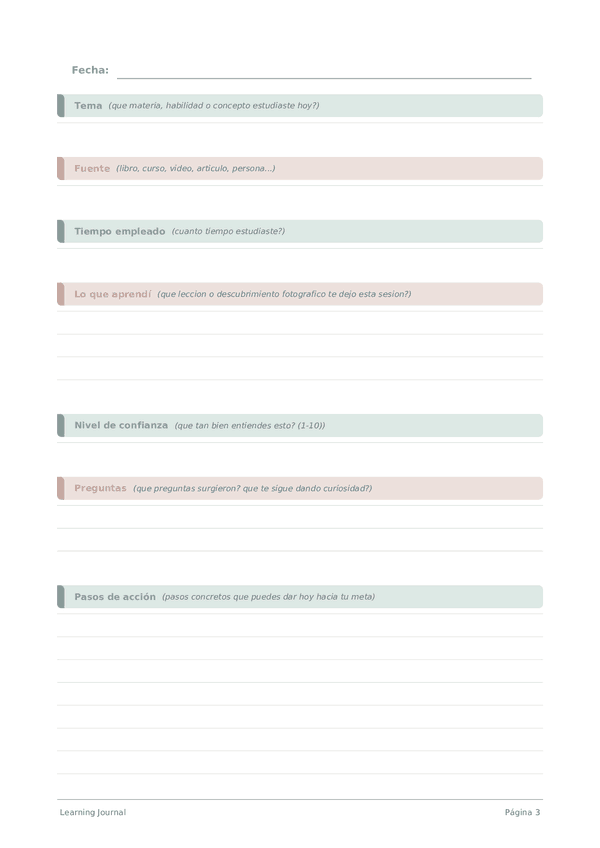
Cada dia encontraras varias secciones etiquetadas con lineas para escribir. Esto es lo que significa cada seccion:
Tema
Que materia, habilidad o concepto estudiaste hoy?
Fuente
Libro, curso, video, articulo, persona...
Tiempo empleado
Cuanto tiempo estudiaste?
Lo que aprendí
Escribe algo nuevo que aprendiste hoy. Puede ser un dato, una habilidad, una perspectiva sobre ti mismo o una leccion de vida. El aprendizaje diario se acumula en sabiduria.
Nivel de confianza
Que tan bien entiendes esto? (1-10)
Preguntas
Que preguntas surgieron? Que te sigue dando curiosidad?
Pasos de acción
Divide tu meta en acciones concretas. Que exactamente haras, cuando y como? Cuanto mas especifico, mejor.
Consejos para el exito
Cuando y con que frecuencia escribir
Write an entry after every study session or significant learning event — the same day, ideally within an hour, when recall is strongest. If you are in a course or structured program, daily entries keep pace with new material. For self-directed learners, three to four entries per week maintain momentum without burnout. Weekly, review your entries and rewrite key concepts from memory as spaced repetition. Monthly, identify which topics need revisiting based on your self-rated understanding scores.
Preguntas frecuentes
¿Qué es la técnica Feynman y cómo la aplica este diario?
La técnica Feynman: elija un tema, explíquelo en lenguaje sencillo como si enseñara a un niño, encuentre las lagunas, refine. La estructura de este diario refleja eso — campo de tema, lo que aprendí en sus propias palabras, nivel de confianza para encontrar lagunas, campo de preguntas para lo que no pudo explicar, pasos de acción para el seguimiento. Cada entrada diaria fuerza el ciclo explicar-encontrar-refinar en una sesión de aprendizaje.
¿Por qué explicar lo que aprendí 'como a un niño'?
Generar una explicación con sus propias palabras es práctica de recuperación — el mecanismo de aprendizaje más fuerte en la ciencia cognitiva. Roediger y Karpicke (2006, Psychological Science, 17(3), 249-255) mostraron que la recuperación produce una retención a largo plazo dramáticamente mejor que volver a leer. Simplificar para un no experto expone las palabras que está repitiendo frente a las ideas que realmente comprende.
¿Cómo uso el campo de nivel de confianza para encontrar lagunas de conocimiento?
Valore su confianza en el tema del día inmediatamente después de escribir la explicación. La baja confianza en un tema que acaba de «aprender» es una advertencia de ilusión de fluidez — reconocer material no es lo mismo que recordarlo o aplicarlo (Bjork & Bjork, 2011, Psychology and the Real World, Worth Publishers). Use esas valoraciones bajas para marcar temas para revisión espaciada en el campo de pasos de acción.
¿Qué va en la sección de preguntas?
Todo lo que no pudo responder en su propia explicación, más lo que el material le hizo sentir curioso. Las tres líneas le obligan a nombrar su ignorancia específicamente — «¿por qué X causa Y?» en lugar de «no entiendo esto». La teoría de carga cognitiva de Sweller (Educational Psychology Review, múltiples artículos) muestra que las preguntas articuladas reducen la carga extraña en las futuras sesiones de estudio porque llega con objetivos enfocados.
¿Cómo conecta el campo de pasos de acción el aprendizaje y la práctica?
Dos líneas para lo que hará — revisar con repetición espaciada, construir un pequeño proyecto, encontrar un ejemplo resuelto, enseñar el tema. Sin este paso, el aprendizaje permanece pasivo. El marco de práctica deliberada de Ericsson et al. (1993, Psychological Review, 100(3), 363-406) requiere aplicación dirigida, no solo exposición. Los pasos de acción más eficaces son pequeños y con plazo: «rehacer el problema 4.2 mañana sin notas».
¿Con qué frecuencia revisar las entradas de aprendizaje antiguas?
Use intervalos espaciados — 1 día, 3 días, 1 semana, 2 semanas, 1 mes. Cepeda et al. (2006, Psychological Bulletin, 132(3), 354-380) encontraron que los intervalos en expansión optimizan la retención a largo plazo. Los campos de fecha y tema del diario lo hacen explorable para revisión. Vuelva a leer su propia explicación primero; si puede ampliarla o corregirla sin notas, el tema se está consolidando.
¿En qué se diferencia de Anki o una app de tarjetas flash?
Anki y las apps SRS (descendientes del SuperMemo de Wozniak, 1985) optimizan el recuerdo factual mediante repetición espaciada. Este diario construye comprensión a través de la explicación y la reflexión — una función complementaria, no redundante. Use ambos: las entradas del diario revelan lo que comprende y lo que no; las tarjetas entrenan los hechos. El campo de preguntas a menudo se convierte en la fuente de sus mejores tarjetas Anki.
¿Funcionará este diario para el aprendizaje técnico, de idiomas o de humanidades?
Sí — la técnica Feynman es neutral en cuanto al dominio. Los ingenieros la usan en algoritmos y pruebas; los estudiantes de idiomas, en reglas gramaticales; los estudiantes de historia, en cadenas causales. Oakley (2014, A Mind for Numbers, Tarcher) aplica explícitamente una explicación similar en lenguaje sencillo a las STEM. El campo de fuente captura el tipo de material para que los patrones entre dominios se vuelvan visibles con el tiempo.
También Te Puede Gustar

Rueda para ampliar, arrastra para mover