Printable Music Journal
Track practice sessions, tempo, and musical growth
A focused music practice journal to log every session with intention. Record the instrument, piece, practice duration, tempo, and rate your overall performance. Reflect on what improved, what still challenges you, and set goals for your next session. Consistent journaling reveals your musical progress over time and sharpens your practice.
Personalizar campos
Activa o desactiva campos. Haz clic en el lápiz para renombrar, o añade tus propios campos.
Beneficios
Cómo Usar
¿Qué es este diario?
A music journal helps you turn every practice session into a purposeful step forward. Instead of sitting down and noodling aimlessly, you set clear intentions, track measurable progress, and reflect on what actually improved. Over time, these notes become a personal coaching log that reveals your strengths, exposes weak spots, and keeps motivation high.
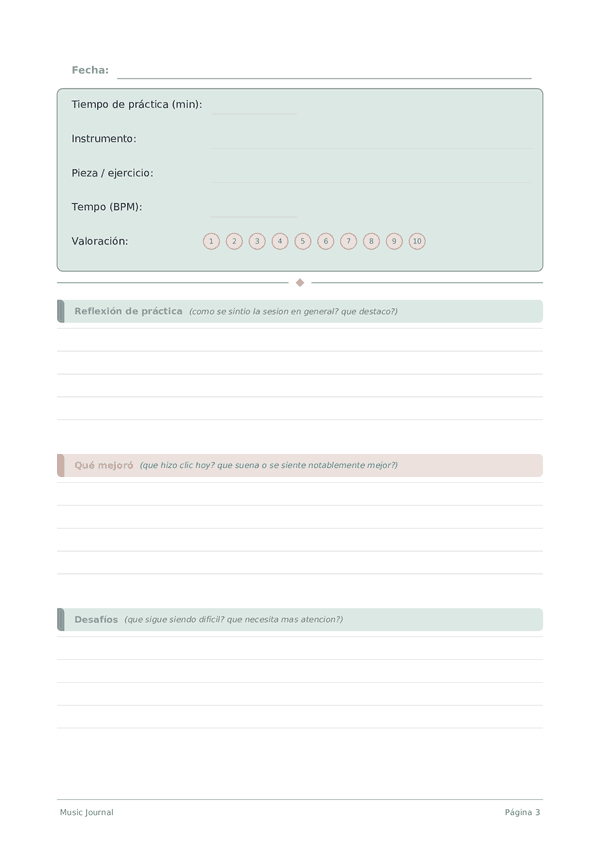
The top section captures quick metrics — how long you practised, which instrument and piece you worked on, the tempo you reached, and an overall session rating. The bottom section is where the real learning happens: you write about what improved, what challenged you, and what you plan to tackle next time.
Whether you are preparing for a recital, learning a new instrument, or simply playing for the love of music, consistent journaling transforms scattered practice into deliberate progress. Fill in the tracker during or right after your session, then spend two minutes writing your reflection while the experience is vivid.
Ejemplo completado
Así es como se ve una entrada típica cuando se rellena:
Cómo rellenar cada campo
La parte superior de cada pagina tiene campos de llenado rapido (calificaciones, casillas, numeros). Debajo hay una seccion con lineas para escribir. Esto es lo que significa cada campo:
Tiempo de práctica (min)
Cuantos minutos practicaste hoy?
Instrumento
Guitarra, piano, violin, voz, bateria...
Pieza / ejercicio
Nombre de la pieza, cancion o ejercicio que trabajaste
Tempo (BPM)
Tempo objetivo o alcanzado en BPM (pulsaciones por minuto)
Valoración
Calificacion general de la experiencia
Reflexión de práctica
Como se sintio la sesion en general? Que destaco?
Qué mejoró
Que hizo clic hoy? Que suena o se siente notablemente mejor?
Desafíos
Que sigue siendo dificil? Que necesita mas atencion?
Metas para la próxima sesión
En que te enfocaras en tu proxima sesion de practica?
Consejos para el exito
Cuando y con que frecuencia escribir
Write after every practice session or meaningful listening experience, even just two or three sentences. For active musicians, daily post-practice entries of five minutes each build a powerful feedback loop — you will see problem areas resolving over weeks instead of guessing. For listeners and collectors, three entries per week capture enough to build a meaningful personal archive. Monthly, read back through your entries to spot patterns in what inspires or frustrates you.
Preguntas frecuentes
¿Qué registra el Diario de Música por sesión de práctica?
Cinco campos del rastreador más reflexión: duración de la práctica (hasta 300 minutos), instrumento, nombre de la pieza, tempo (hasta 300 BPM) y una valoración (0-10). Seis líneas cubren reflexión sobre la práctica, lo que mejoró, desafíos y objetivos para la próxima sesión. La estructura fomenta la práctica deliberada e intencional en lugar de tocar pasivamente — lo que la investigación muestra consistentemente como la diferencia entre músicos que se estancan y los que siguen mejorando.
¿Por qué registrar el tempo (BPM) en cada sesión?
El BPM es el marcador más objetivo del dominio técnico de un pasaje. Rastrearlo a través de sesiones revela un progreso real que la sensación sola no puede. Levitin (2006, This Is Your Brain on Music, Dutton) describe cómo los músicos que cuantifican las ganancias de tempo mantienen la motivación a través de los estancamientos. Use un metrónomo, registre su tempo limpio más alto y establezca el objetivo para la próxima sesión en +2 a +4 BPM.
¿Cuánto debe durar cada sesión diaria de práctica?
30-60 minutos de práctica enfocada producen más ganancias que 2-3 horas de tocar sin foco. Ericsson, Krampe y Tesch-Römer (1993, Psychological Review, 100(3), 363-406) estudiaron a violinistas de conservatorio y encontraron que 3-5 horas deliberadas diarias era el límite superior para la calidad sostenida — y que la calidad caía bruscamente sin descansos. El campo de duración ayuda a medir el tiempo enfocado, no solo el tiempo en el instrumento.
¿Cuál es la diferencia entre la práctica deliberada y simplemente tocar?
La práctica deliberada apunta a una debilidad específica con atención enfocada y retroalimentación (Ericsson, 2016, Peak, Houghton Mifflin Harcourt). Los campos de objetivos para la próxima sesión y desafíos son el andamiaje de la práctica deliberada: le obligan a nombrar en qué está trabajando, no solo a tocar. Tocar de manera casual mantiene la habilidad; la práctica deliberada la construye. Ambas tienen su lugar, pero solo una impulsa el crecimiento.
¿Cómo uso eficazmente las preguntas de 'lo que mejoró' y 'desafíos'?
Sea específico al compás, técnica o pasaje — «compases 17-24 limpios a 100 BPM» supera a «mejoré». La especificidad hace concretos los objetivos para la próxima sesión. Roediger y Karpicke (2006, Psychological Science, 17(3), 249-255) muestran que articular lo que sabe fortalece la retención. El campo de desafíos es igualmente valioso: un problema no resuelto nombrado hoy a menudo se resuelve en días.
¿Mantener un diario de práctica realmente me hace mejor músico?
Sí — cuando la reflexión se combina con la práctica enfocada. El marco de «dificultades deseables» de Bjork (Bjork & Bjork, 2011, Psychology and the Real World, Worth Publishers) muestra que la recuperación esforzada y la práctica variada producen habilidades duraderas. La valoración de la sesión crea retroalimentación; el campo de objetivos crea señales de recuperación para la próxima vez. Los músicos que llevan diario identifican y corrigen las debilidades más rápido.
¿En qué se diferencia de una app de metrónomo o un temporizador de práctica?
Las apps miden; el diario interpreta. Los campos de nombre de pieza y reflexión conectan el número de BPM de hoy con el contexto musical — por qué un pasaje se siente más difícil un día, qué digitación ayudó, en qué tempo se derrumbó todo. Según la investigación metacognitiva de Bjork (2011), la interpretación y el establecimiento de objetivos transfieren la habilidad a la actuación más que el tiempo bruto registrado.
Practico varios instrumentos — ¿debo mantener diarios separados?
Un diario funciona si completa el campo de instrumento en cada sesión. Revisar a través de instrumentos a menudo revela problemas compartidos (ritmo, dinámica, escucha) y logros transferibles. Si enseña o actúa principalmente en un instrumento, considere un diario dedicado para él más este para los secundarios. El formato escala de cualquier manera; la consistencia importa más que la separación.
También Te Puede Gustar
Rueda para ampliar, arrastra para mover