Printable Workout Journal
Track every set, rep, and weight — see your strength grow over time
A structured workout log that helps you record exercises, sets, reps, weights, and duration for each training session. Built for gym-goers and home athletes alike, this journal keeps your progress visible and your motivation high.
Personalizar campos
Activa o desactiva campos. Haz clic en el lápiz para renombrar, o añade tus propios campos.
Beneficios
Cómo Usar
¿Qué es este diario?
A workout journal is a structured training log where you record every exercise you perform — the type, target muscle group, sets, reps, weights, and duration. It serves as both a detailed record of what you did and a planning tool for progressive overload, helping you ensure that your training is moving forward rather than staying stagnant.
This journal is designed for anyone who exercises regularly and wants to train with intention, from gym beginners learning proper programming to experienced lifters tracking periodization cycles. It is equally valuable for people doing bodyweight training, group fitness classes, or rehabilitation exercises — any physical activity where tracking progress leads to better outcomes.
The difference between people who make consistent progress in the gym and those who plateau often comes down to one thing: tracking. When you write down that you bench pressed 60 kg for 3 sets of 8 reps, you know that next session you should aim for 3 sets of 9 or increase the weight. Without a journal, most people repeat the same weights and reps for months without realizing it. Your workout journal transforms each session from an isolated event into part of a coherent, progressive plan.
Ejemplo completado
Así es como se ve una entrada típica cuando se rellena:
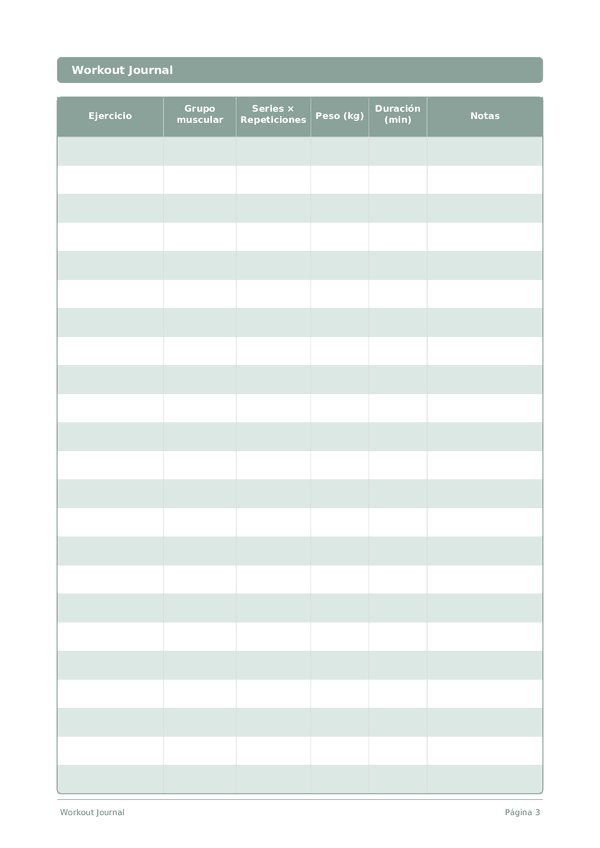
| Ejercicio | Grupo muscular | Series × Repeticiones | Peso (kg) | Duración (min) | Notas |
|---|---|---|---|---|---|
| Barbell Back Squat | Legs / Glutes | 4 x 8 | 80 | 12 | Warm-up: 2x10 at 40kg. Depth was good on all sets. |
| Romanian Deadlift | Hamstrings / Lower Back | 3 x 10 | 60 | 10 | Focused on slow eccentric. Felt stretch in hamstrings. |
| Leg Press | Quads | 3 x 12 | 140 | 8 | Feet placed high and wide |
| Walking Lunges | Legs / Glutes | 3 x 12 each leg | 16 | 8 | Dumbbells, 8kg each hand |
| Leg Curl Machine | Hamstrings | 3 x 12 | 35 | 6 | Last 2 reps were tough |
| Calf Raises (Standing) | Calves | 4 x 15 | 50 | 6 | Full range of motion, 2-sec pause at top |
| Plank | Core | 3 x 60 sec | 0 | 5 | Finished with 3 sets of planks for core stability |
Cómo rellenar cada campo
Cada pagina es una tabla con columnas. Completa una fila por entrada. Esto es lo que significa cada columna:
Ejercicio
Escribe que tipo de ejercicio hiciste (ej. correr, yoga, pesas). La variedad importa: el seguimiento ayuda a asegurar una rutina equilibrada.
Grupo muscular
Pecho, espalda, piernas, hombros, brazos, abdomen...
Series × Repeticiones
Registra series y repeticiones (ej. 3x12). Este es tu registro de entrenamiento de fuerza: la sobrecarga progresiva se hace visible con el tiempo.
Peso (kg)
Registra tu peso si lo estas monitoreando. Pesate a la misma hora cada dia para datos consistentes. Enfocate en las tendencias semanales, no en las fluctuaciones diarias.
Duración (min)
Registra cuanto tiempo hiciste ejercicio o practicaste en minutos. Rastrear la duracion te ayuda a ver crecer tu compromiso y encontrar tu duracion optima de sesion.
Notas
Agrega cualquier contexto o pensamiento adicional. Esta columna general es para cualquier cosa que no encaje en otro lugar pero pueda ser util despues.
Consejos para el exito
Cuando y con que frecuencia escribir
Log every workout in the table format immediately during or after your session: exercise name, sets, reps, weight, and rest periods. On rest days, note recovery activities (stretching, foam rolling, walking) and how your body feels. Weekly, review your training log to ensure progressive overload is happening and no muscle group is neglected. Every 4-6 weeks, compare your current numbers to your starting point — this is where real motivation lives. Deload weeks should also be logged to track how recovery affects subsequent performance.
Preguntas frecuentes
¿Qué es la sobrecarga progresiva y cómo la rastro aquí?
La sobrecarga progresiva —aumentar gradualmente el estímulo de entrenamiento— es el motor fundamental de la fuerza y la hipertrofia, según el ACSM y el British Journal of Sports Medicine (2022, 56(13)). Síguela a través de las columnas de peso y series × Repeticiones: intente añadir 1-2,5 kg o una repetición por sesión para el mismo ejercicio. Revise las tendencias mensuales por movimiento. Los estancamientos indican la necesidad de semanas de descarga o cambios de programa.
¿Cuántas series y repeticiones debo hacer por ejercicio?
El ACSM (2009, Medicine & Science in Sports & Exercise, 41(3)) y el consenso del ISSN recomiendan: 3-5 series de 5-8 reps al 75-85% del 1RM para fuerza; 3-4 series de 8-12 reps al 65-75% para hipertrofia; 2-3 series de 12-20 reps para resistencia. Registre todas las series en series × Repeticiones (p. ej., '4x8'). El volumen total semanal por grupo muscular —series × repeticiones × peso— impulsa la adaptación más que cualquier sesión individual.
¿Por qué registrar el peso corporal en la parte superior de cada página?
El contexto del peso corporal interpreta los cambios de fuerza: ganar fuerza perdiendo peso indica mejora real del rendimiento, mientras que las ganancias de fuerza durante el aumento de peso pueden reflejar parcialmente la masa. El ACSM y las revisiones de Sports Medicine destacan el seguimiento de ambos. El campo peso corporal (kg) en el encabezado de la página ofrece una instantánea semanal sin necesidad de pesadas diarias, útil en fases de definición, volumen o mantenimiento.
¿Cómo registro ejercicios como dominadas o flexiones sin peso externo?
Introduzca 0 en la columna de peso y use el contexto del peso corporal del encabezado de la página. El ACSM acepta la progresión con peso corporal mediante aumento de repeticiones, series o tempo. Para las variantes con peso adicional (p. ej., dominadas lastradas), introduzca solo el peso añadido. La columna de notas puede especificar los supuestos de carga del peso corporal. Siga la progresión por repeticiones y volumen total, no solo por carga.
¿En qué se diferencia de apps como Strong, Jefit o Hevy?
Las apps automatizan cálculos y temporizadores de descanso; los diarios en papel favorecen la reflexión y la planificación intencional. La investigación sobre cambio de conducta del NIH NCCIH (2022) muestra que la programación escrita a mano mejora el cumplimiento y la autoconciencia. La columna de notas capta datos cualitativos —nivel de fatiga, indicaciones de forma, retroalimentación articular— que las apps suelen descartar. Muchos usuarios de pesas usan ambos: la app en el gimnasio, el diario para la planificación semanal y la revisión del programa.
¿Con qué frecuencia debo rotar ejercicios o cambiar mi programa?
El ACSM recomienda cambios de programa cada 4-8 semanas para prevenir el estancamiento. La columna de notas es el lugar adecuado para señalar los ejercicios donde la progresión se ha detenido durante 2-3 sesiones consecutivas. Sports Medicine (2018, 48(4)) sugiere semanas de descarga (50-70% del volumen) cada 4-8 semanas para gestionar la fatiga. Siga la duración total de la sesión junto con el peso para detectar el creciente coste de fatiga por entrenamiento.
¿Cómo deben usar este diario los principiantes?
Según las directrices del ACSM para principiantes, céntrese en 2-3 sesiones de cuerpo completo por semana con 6-8 ejercicios compuestos. Registre cada serie durante las primeras 8-12 semanas para desarrollar la conciencia técnica y la línea base de progresión. El NIH NIA señala que el entrenamiento de resistencia reduce el riesgo de mortalidad por todas las causas; la constancia importa más que la intensidad al principio. Use la columna de notas para las indicaciones de forma de un entrenador o referencia en vídeo.
¿Qué señales indican que estoy sobreentrenando?
Señales de alarma del British Journal of Sports Medicine (2013, 47(8)) y el ACSM: rendimiento en declive durante 2+ semanas, dolor muscular persistente más de 72 horas, alteración del sueño, frecuencia cardíaca en reposo elevada, decline del estado de ánimo, enfermedades leves frecuentes. Regístrelo en la columna de notas. La recuperación requiere 1-2 semanas al 50-70% del volumen, no reposo total. Consulte a un médico deportivo si los síntomas persisten.
También Te Puede Gustar
Rueda para ampliar, arrastra para mover