Printable Journal de tension artérielle
Surveillez votre tension artérielle pour la santé cardiaque
Record systolic, diastolic, and pulse readings with timestamps. Essential for managing hypertension and providing your doctor with accurate blood pressure trends.
Personnaliser les champs
Activez ou désactivez les champs. Cliquez sur le crayon pour renommer, ou ajoutez vos propres champs.
Avantages
Comment utiliser
Qu'est-ce que ce journal ?
A blood pressure journal is a structured daily log designed for anyone who needs to monitor their cardiovascular health. Whether you have been diagnosed with hypertension, are managing pre-hypertension, or simply want to track your readings for wellness purposes, this journal provides a clear, organized way to record every measurement alongside context such as time of day, medications taken, and any symptoms you experience.
Consistent blood pressure tracking is one of the most effective tools for managing heart health. By recording your systolic and diastolic values, pulse rate, and the circumstances around each reading, you create a detailed dataset that reveals patterns your doctor can use to adjust treatment. Many patients discover that certain times of day, activities, or foods correlate with elevated readings — insights that are invisible without a written record.
This journal is especially valuable for those preparing for medical appointments. Instead of relying on a single office reading, you can present weeks of data that paint a complete picture of your cardiovascular health, leading to more informed and personalized care.
Exemple rempli
Voici à quoi ressemble une entrée typique une fois remplie :
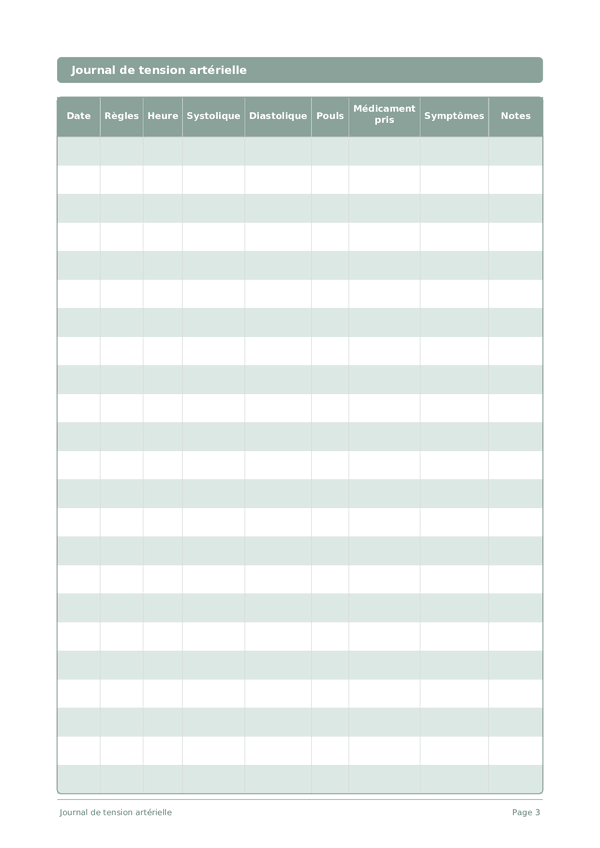
| Date | Règles | Heure | Systolique | Diastolique | Pouls | Médicament pris | Symptômes | Notes |
|---|---|---|---|---|---|---|---|---|
| 2026-03-01 | Morning | 07:15 | 128 | 82 | 72 | Lisinopril 10mg | None | Measured after 5 min rest |
| 2026-03-01 | Evening | 20:30 | 135 | 87 | 78 | Lisinopril 10mg | Mild headache | Stressful day at work |
| 2026-03-02 | Morning | 07:20 | 124 | 80 | 70 | Lisinopril 10mg | None | Slept well, 7.5 hours |
| 2026-03-02 | Evening | 21:00 | 130 | 84 | 74 | Lisinopril 10mg | None | 30 min walk after dinner |
| 2026-03-03 | Morning | 06:50 | 122 | 78 | 68 | Lisinopril 10mg | None | Calm morning, yoga session |
Comment remplir chaque champ
Chaque page est un tableau avec des colonnes. Remplissez une ligne par entrée. Voici à quoi sert chaque colonne :
Date
Inscrivez la date du jour. Cela ancre votre entrée dans le temps et aide lors de la relecture ultérieure.
Règles
Heure
Enregistrez l'heure de la mesure ou de l'événement. Un horaire constant rend les données comparables et révèle des tendances selon le moment de la journée.
Systolique
Enregistrez le chiffre du haut de votre tension artérielle (systolique). Cela mesure la pression lorsque votre cœur bat.
Diastolique
Enregistrez le chiffre du bas de votre tension artérielle (diastolique). Cela mesure la pression lorsque votre cœur est au repos entre les battements.
Pouls
Enregistrez votre fréquence cardiaque en battements par minute. Les tendances du pouls au repos révèlent les changements de forme cardiovasculaire au fil du temps.
Médicament pris
Avez-vous pris vos médicaments aujourd'hui ? Notez lesquels, quand, et les doses oubliées
Symptômes
Listez les symptômes que vous avez ressentis aujourd'hui. Soyez précis quant au type, à la localisation et à la gravité. Les tendances dans les symptômes pointent souvent vers des déclencheurs ou des besoins de traitement.
Notes
Ajoutez tout contexte ou réflexion supplémentaire. Cette colonne fourre-tout est pour tout ce qui ne rentre pas ailleurs mais pourrait être utile plus tard.
Conseils pour réussir
Quand et à quelle fréquence écrire
Measure twice daily: once in the morning before taking medications (this is your «true baseline»), and once in the evening. Take two consecutive readings each time, 1–2 minutes apart, and record both. Before medical appointments, have at least 2 weeks of consistent data to show your doctor. Weekly, review your averages to spot upward or downward trends. If your home readings consistently differ from clinic readings by more than 10 mmHg, discuss «masked hypertension» or «white-coat hypertension» with your provider.
Questions fréquentes
Quelles lectures de pression artérielle sont considérées normales vs élevées ?
Selon l'ESC/ESH (European Society of Cardiology/Hypertension) : Optimale < 120/80 mmHg ; Normale 120–129/80–84 ; Normale-haute 130–139/85–89 ; Hypertension de grade 1 : 140–159/90–99 ; Grade 2 : ≥ 160/100. Une crise hypertensive > 180/120 nécessite une attention médicale immédiate. Enregistrez à la fois la systolique et la diastolique. Suivez toujours les objectifs fixés par votre médecin, qui peuvent différer pour le diabète, les maladies rénales ou l'âge.
Pourquoi prendre deux mesures à 1 à 2 minutes d'intervalle ?
Les recommandations de l'ESC/ESH et de la HAS conseillent de faire la moyenne de 2 mesures car la première est souvent élevée en raison d'une brève activation sympathique. Asseyez-vous tranquillement 5 minutes avant la mesure. Enregistrez la moyenne des deux mesures, ou notez les deux et faites la moyenne plus tard. Les mesures uniques surestiment la prévalence de l'hypertension de 10 à 15 %, conduisant à un surdiagnostic et à des médicaments inutiles.
Quelle est la technique de mesure correcte ?
Technique recommandée : asseyez-vous le dos soutenu, pieds à plat, bras au niveau du cœur, brassard sur le bras nu supérieur de taille correcte (le ballon couvre 80 % de la circonférence du bras). Pas de conversation, de caféine, d'exercice ni de tabac dans les 30 minutes précédentes. Videz la vessie d'abord. Les colonnes period et time vous permettent de maintenir un timing matin/soir cohérent — généralement dans l'heure après le réveil et avant le coucher.
Pourquoi enregistrer des mesures matinales et vespérales ?
La pression artérielle suit un rythme circadien — pic matinal et creux vespéral. Les patients sans baisse nocturne (« non-dippers ») ont un risque cardiovasculaire plus élevé. Les mesures matinales avant les médicaments évaluent le contrôle nocturne ; les mesures vespérales montrent les effets diurnes. La colonne period capture cela — votre cardiologue a besoin des deux pour évaluer le timing et le dosage des médicaments.
Combien de temps suivre avant de partager avec son médecin ?
Les recommandations de la HAS et de l'ESH conseillent au moins 7 jours consécutifs de mesures deux fois par jour pour établir une base fiable ; 14 jours améliorent la précision. Écartez les mesures du premier jour, souvent élevées. Calculez la moyenne des jours restants. Les pages de 15 lignes du journal couvrent facilement 7+ jours. Apportez-les à chaque consultation cardiologique — les mesures à domicile diffèrent souvent significativement des mesures au cabinet (effet blouse blanche).
Qu'est-ce que l'hypertension de la blouse blanche et comment ce journal aide-t-il ?
L'hypertension de la blouse blanche touche 15 à 30 % des patients — mesures élevées au cabinet mais normales à domicile. Sans surveillance à domicile, cela conduit à des médicaments inutiles. Inversement, l'hypertension masquée (normale au cabinet, élevée à domicile) passe inaperçue sans suivi. Les données de journal sur 7+ jours, associées à une surveillance ambulatoire périodique, distinguent ces schémas et informent un diagnostic précis.
Quelles lectures justifient une attention médicale urgente ?
Critères de crise hypertensive : systolique ≥ 180 ou diastolique ≥ 120 mmHg. Avec symptômes (douleur thoracique, essoufflement, troubles visuels, céphalée sévère, symptômes neurologiques) — urgence hypertensive nécessitant une évaluation immédiate aux urgences : appelez le 15 (SAMU) ou le 112. Sans symptômes, attendez 5 minutes, remesourez ; si toujours élevé, contactez votre médecin le jour même. Documentez les symptômes dans la colonne symptoms.
Comment suivre les effets des médicaments sur la pression artérielle ?
Notez le nom du médicament, la dose et le timing dans la colonne médicament pris. Les antihypertenseurs atteignent généralement l'état stable en 2 à 4 semaines. Comparez les moyennes sur 14 jours avant et après le début d'un médicament ou un changement de dose. La colonne pouls importe aussi — les bêta-bloquants réduisent à la fois la PA et la fréquence cardiaque ; les IEC affectent principalement la PA. Partagez les tendances avec votre cardiologue pour l'optimisation des doses.
Vous aimerez aussi
Journal de la douleur
Suivez les schémas de douleur, les déclencheurs et les stratégies de soulagement
Journal de santé
Suivez votre corps, votre esprit et votre bien-être chaque jour
Journal des symptômes
Suivez vos symptômes, déclencheurs et traitements au quotidien
Journal des calories
Suivez les calories et les macros à chaque repas
Molette pour zoomer, glisser pour déplacer