Printable Journal de la douleur
Suivez les schémas de douleur, les déclencheurs et les stratégies de soulagement
A comprehensive daily pain tracker that combines structured metrics with reflective writing. Rate pain intensity, log location and type, track sleep, mood, and stress levels, and write about what triggers your pain and what brings relief. Build a detailed record to share with your healthcare provider for more effective treatment.
Personnaliser les champs
Activez ou désactivez les champs. Cliquez sur le crayon pour renommer, ou ajoutez vos propres champs.
Avantages
Comment utiliser
Qu'est-ce que ce journal ?
A pain journal is a structured daily record where you track the details of your physical pain — its location, intensity, duration, and the factors that influence it. By writing down this information consistently, you create a detailed picture of your pain patterns that can be difficult to recall from memory alone, especially during medical appointments.
This journal is designed for anyone living with chronic pain, recovering from injury, or managing conditions like migraines, arthritis, fibromyalgia, or back pain. It is equally useful if you are experiencing new or unexplained pain and want to identify triggers or patterns before consulting a doctor.
Keeping a pain journal helps you take an active role in your own care. Over time, you will be able to see which activities, foods, sleep habits, or stress levels correlate with flare-ups, and which treatments or strategies provide genuine relief. This data becomes an invaluable tool for conversations with healthcare providers and for making informed decisions about your treatment plan.
Exemple rempli
Voici à quoi ressemble une entrée typique une fois remplie :
Comment remplir chaque champ
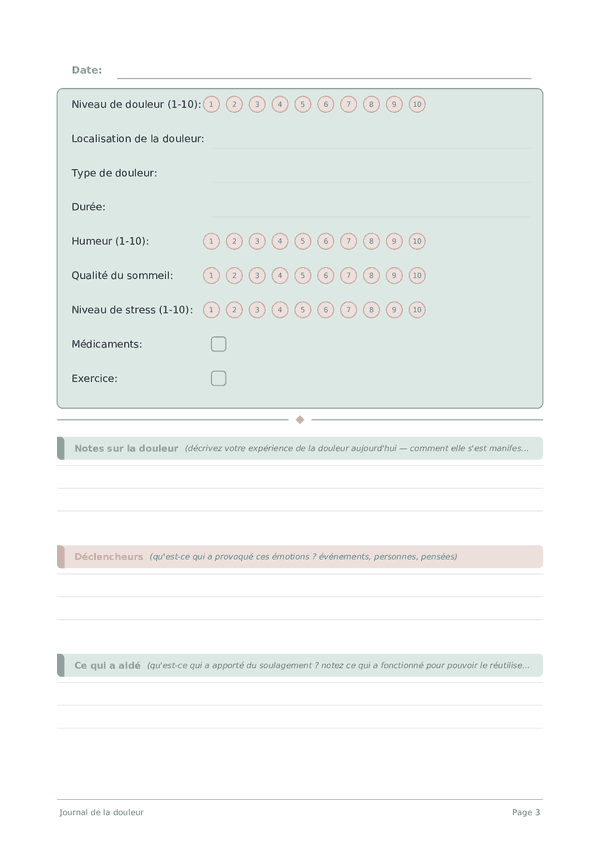
Le haut de chaque page comporte des champs à remplissage rapide (évaluations, cases à cocher, chiffres). En dessous se trouve une section lignée pour écrire. Voici ce que signifie chaque champ :
Niveau de douleur (1-10)
Évaluez l'intensité de votre douleur sur une échelle. Suivre les niveaux de douleur aide à identifier les déclencheurs, évaluer les traitements et communiquer avec les professionnels de santé.
Localisation de la douleur
Où avez-vous mal ? Soyez précis — bas du dos, genou gauche, derrière les yeux, etc.
Type de douleur
Décrivez la sensation — aiguë, sourde, pulsatile, brûlante, lancinante, ou autre chose
Durée
Enregistrez la durée de l'épisode ou de l'événement. Les données de durée aident à identifier les tendances et à évaluer l'efficacité des traitements.
Humeur (1-10)
Évaluez votre état émotionnel général de la journée. 1 signifie très bas ou déprimé, 10 signifie exceptionnellement heureux et positif. Ne réfléchissez pas trop — fiez-vous à votre instinct.
Qualité du sommeil
Évaluez la qualité reposante de votre sommeil. 1 signifie terrible et agité, 5 signifie profond et réparateur. La qualité compte autant que la quantité.
Niveau de stress (1-10)
Évaluez votre stress sur une échelle de 1 à 10. Avec le temps, vous identifierez vos schémas de stress et les stratégies d'adaptation qui fonctionnent le mieux.
Médicaments
Enregistrez les médicaments pris, y compris le nom et le dosage. Un suivi régulier vous aide, vous et votre médecin, à évaluer l'efficacité du traitement.
Exercice
Cochez si vous avez fait de l'exercice aujourd'hui. Même une marche de 10 minutes compte. L'objectif est de prendre conscience de vos habitudes d'activité.
Notes sur la douleur
Décrivez votre expérience de la douleur aujourd'hui — comment elle s'est manifestée, quand elle a commencé, comment elle a évolué
Déclencheurs
Identifiez ce qui a provoqué vos réactions émotionnelles — événements, personnes, pensées, environnements. Reconnaître les déclencheurs vous donne le pouvoir de vous y préparer ou de les éviter.
Ce qui a aidé
Qu'est-ce qui a apporté du soulagement ? Notez ce qui a fonctionné pour pouvoir le réutiliser quand l'anxiété monte.
Impact du jour
Comment la douleur a-t-elle affecté votre activité, votre sommeil, votre humeur ou votre vie sociale aujourd'hui ?
Conseils pour réussir
Quand et à quelle fréquence écrire
Fill in the tracker three times daily: morning (how did you wake up?), midday (how is activity affecting pain?), and evening (how did the day go overall?). Keep the tracker entries brief — just numbers and a few words. Use the writing section when pain is significant or when you notice a new pattern. Bring your weekly summary to medical appointments — doctors consistently report that patients with pain journals receive more targeted treatment. Review monthly to spot seasonal or cyclical patterns.
Questions fréquentes
Que doit contenir un journal de la douleur pour un rendez-vous médical ?
Selon les recommandations du CDC Clinical Practice Guideline (2022, MMWR) et de l'American Chronic Pain Association : évaluation d'intensité 0-10, localisation, caractère (brûlure/élancement/douleur sourde), durée des épisodes, déclencheurs, efficacité des médicaments, plus le sommeil, l'humeur et l'activité. Ce modèle couvre les 9 champs essentiels. Apportez 2 à 4 semaines d'entrées — suffisant pour identifier des schémas cliniquement significatifs.
Comment décrire correctement le caractère de la douleur — brûlure, douleur sourde, pulsation ?
La classification standard est le McGill Pain Questionnaire (Melzack, 1975, Pain, 1(3)). Descripteurs sensoriels : pulsatile, irradiante, lancinante, brûlante, pressante. La brûlure évoque souvent une douleur neuropathique ; la pulsation, une douleur vasculaire (migraine) ; la douleur sourde, une origine musculosquelettique ; l'élancement, un processus inflammatoire. Ces descripteurs aident votre médecin à différencier les types de douleur et à sélectionner le traitement approprié.
Ce journal convient-il à la migraine, la fibromyalgie et l'arthrite ?
Oui. L'American Migraine Foundation, l'American College of Rheumatology et l'Arthritis Foundation recommandent officiellement le journal de la douleur. Pour la migraine, notez l'aura et les déclencheurs (aliments, hormones, météo). Pour la fibromyalgie, suivez la triade sommeil-stress-douleur (critères ACR 2016). Pour l'arthrite, consignez la raideur matinale et les corrélations avec l'activité. Le modèle est flexible — adaptez les champs à votre condition spécifique.
Qu'est-ce que l'échelle de douleur 0-10 et comment l'utiliser ?
La Numeric Rating Scale (NRS-11) est l'outil standard de l'International Association for the Study of Pain (IASP). 0 = pas de douleur, 10 = la pire douleur imaginable. Hjermstad et al. (2011, Journal of Pain and Symptom Management, 41(6)) l'ont validée dans une revue systématique de 19 études. Évaluez « en ce moment », pas une moyenne journalière : les évaluations en temps réel fournissent des données cliniques plus fiables.
À quelle fréquence faut-il remplir un journal de la douleur — une fois par jour ou plus ?
Trois fois par jour : matin, midi, soir. Stone & Broderick (2007, Pain Medicine, 8(suppl 3)) ont montré que les évaluations rétrospectives de la douleur divergent des évaluations en temps réel de 20 à 30 %. Plus l'intervalle entre l'événement et l'entrée est court, plus les données sont fiables. Lors des épisodes aigus ou des poussées, notez immédiatement — consignez l'heure d'apparition, la durée et les interventions utilisées.
Quels déclencheurs de douleur vaut-il la peine de suivre ?
Selon le NIH National Institute of Neurological Disorders and Stroke et l'American Migraine Foundation : météo (pression atmosphérique, humidité), alimentation (tyramine pour la migraine), quantité et qualité du sommeil, stress, activité physique, cycle hormonal, posture, temps d'écran, caféine et alcool. Consignez tout ce qui s'est passé dans les 24 heures précédant un épisode. Les schémas deviennent visibles après 2 à 4 semaines de suivi systématique.
Pourquoi un journal de la douleur en papier est-il meilleur qu'une application ?
Trois raisons. Confidentialité des données médicales : après le règlement FTC avec Flo Health (janvier 2021), il est documenté que les applications de santé peuvent partager des données avec des tiers. Les médecins consultent facilement les notes manuscrites lors des rendez-vous, sans exportation. Le papier fonctionne pendant la photophobie migraineuse et ne nécessite ni batterie ni connexion. Applications et papier ne s'excluent pas mutuellement — beaucoup de patients tiennent les deux.
Un journal de la douleur peut-il aider à identifier la cause d'une douleur inexpliquée ?
Le journal ne pose pas de diagnostic, mais révèle des schémas que les médecins utilisent pour le diagnostic. L'International Association for the Study of Pain (IASP) et l'American Academy of Pain Medicine incluent le journal dans les protocoles d'évaluation clinique de la douleur chronique. Apportez au moins 2 à 4 semaines d'entrées — elles fournissent des données quotidiennes, hebdomadaires et par déclencheur que la mémoire ne peut pas reconstituer.
Vous aimerez aussi
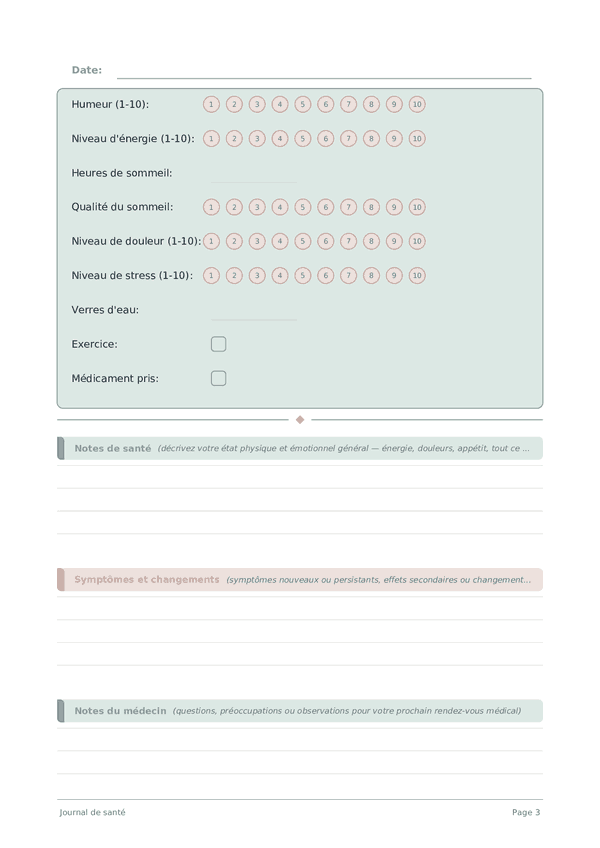
Journal de santé
Suivez votre corps, votre esprit et votre bien-être chaque jour
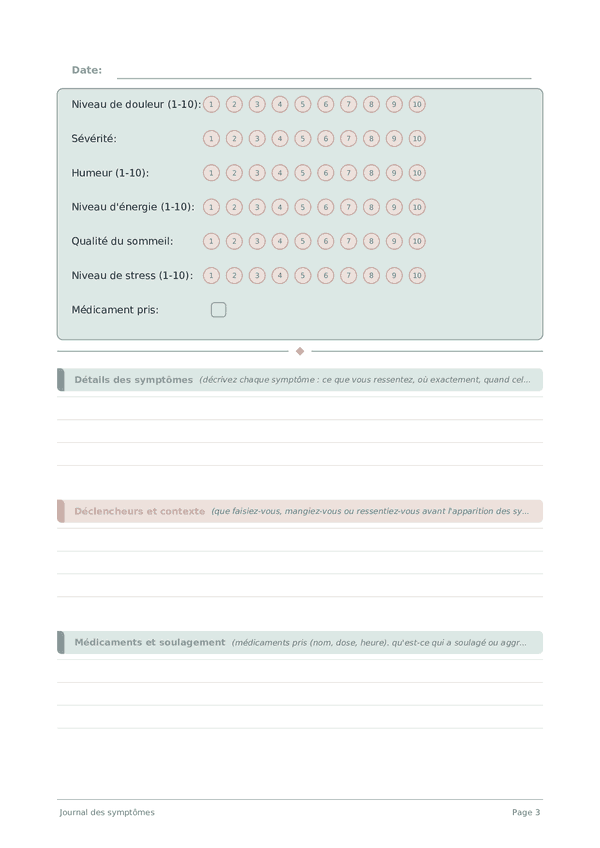
Journal des symptômes
Suivez vos symptômes, déclencheurs et traitements au quotidien
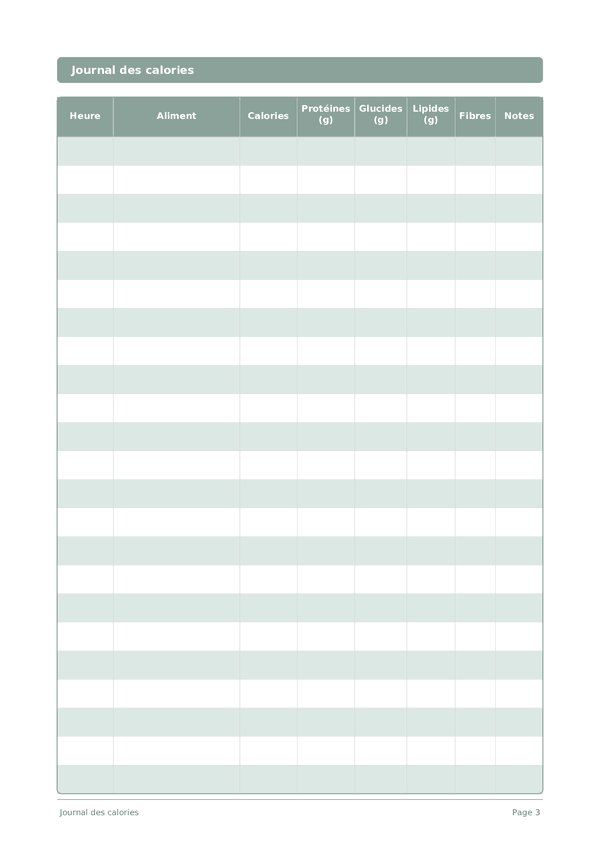
Journal des calories
Suivez les calories et les macros à chaque repas
Journal de course à pied
Suivez chaque course, mesurez vos progrès et atteignez vos objectifs
Molette pour zoomer, glisser pour déplacer