Printable Journal de course à pied
Suivez chaque course, mesurez vos progrès et atteignez vos objectifs
The Running Journal is a structured training log that helps you record key metrics for every run — distance, pace, heart rate, effort level, route, and more. Whether you are training for a race or building a consistent habit, this log gives you the data to analyse trends, identify patterns, and improve over time.
Personnaliser les champs
Activez ou désactivez les champs. Cliquez sur le crayon pour renommer, ou ajoutez vos propres champs.
Avantages
Comment utiliser
Qu'est-ce que ce journal ?
A running journal is a dedicated log where you record the details of every run — distance, duration, pace, heart rate, effort level, route, and conditions. It transforms your running from a series of disconnected outings into a structured training history that reveals trends, celebrates progress, and helps you train smarter.
This journal is for runners of all levels: beginners building up to their first 5K, recreational joggers who want to stay consistent, and experienced runners training for marathons or ultras. It is also valuable for people returning to running after injury, as tracking effort levels and how your body responds helps you avoid doing too much too soon.
Experienced coaches will tell you that a running journal is one of the most important tools a runner can have. By looking back at weeks and months of data, you can see how your pace improves at a given heart rate, identify which training approaches work best for you, and spot warning signs of overtraining before they lead to injury. On days when motivation is low, flipping back through your journal and seeing how far you have come is one of the most powerful reminders of why you run.
Exemple rempli
Voici à quoi ressemble une entrée typique une fois remplie :
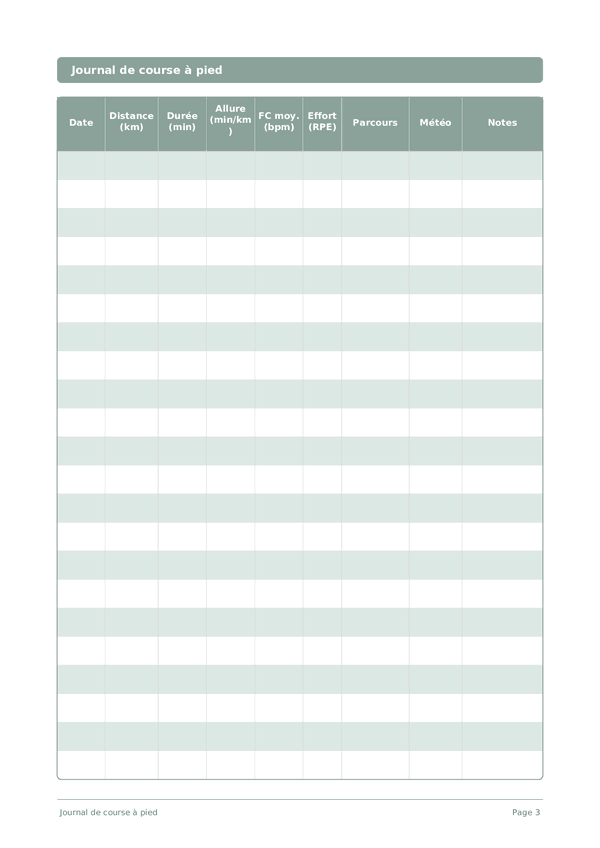
| Date | Distance (km) | Durée (min) | Allure (min/km) | FC moy. (bpm) | Effort (RPE) | Parcours | Météo | Notes |
|---|---|---|---|---|---|---|---|---|
| 2025-01-06 | 5.2 | 28 | 5:23/km | 148 | 6 | River path loop | Overcast, 4°C | Easy recovery run. Legs felt fresh after rest day. |
| 2025-01-08 | 8 | 40 | 5:00/km | 158 | 7 | Park circuit (2 laps) | Sunny, 2°C | Tempo run. Held pace well through km 6, then slowed slightly. |
| 2025-01-10 | 6.5 | 42 | 6:28/km | 135 | 4 | Neighborhood streets | Light rain, 6°C | Easy conversational pace. Practiced nasal breathing. |
| 2025-01-11 | 12 | 65 | 5:25/km | 155 | 8 | Lakeside trail | Cloudy, 3°C | Long run. Felt strong first 10 km, last 2 km were a grind. Fueled with gel at km 8. |
| 2025-01-13 | 5 | 23 | 4:36/km | 172 | 9 | Track (400m) | Clear, 1°C | Interval session: 5 x 1000m at 4:20 pace with 90s rest. Hit all splits. |
| 2025-01-14 | 4 | 24 | 6:00/km | 128 | 3 | Flat neighborhood loop | Overcast, 5°C | Shake-out run after hard intervals. Kept effort very low. |
Comment remplir chaque champ
Chaque page est un tableau avec des colonnes. Remplissez une ligne par entrée. Voici à quoi sert chaque colonne :
Date
Inscrivez la date du jour. Cela ancre votre entrée dans le temps et aide lors de la relecture ultérieure.
Distance (km)
Enregistrez la distance parcourue (en km ou miles). Voir votre distance augmenter au fil des semaines est un puissant facteur de motivation.
Durée (min)
Enregistrez la durée de votre exercice ou de votre pratique en minutes. Suivre la durée vous aide à voir votre engagement grandir et à trouver la durée de séance optimale.
Allure (min/km)
Notez votre allure (par ex., min/km ou min/mile). Suivre l'allure en parallèle de votre ressenti vous aide à trouver votre rythme idéal.
FC moy. (bpm)
Fréquence cardiaque moyenne en battements par minute
Effort (RPE)
Niveau d'effort perçu : 1=très facile, 10=effort maximal
Parcours
Nom du parcours, du quartier ou du sentier
Météo
Ensoleillé, nuageux, pluie, vent — conditions actuelles
Notes
Ajoutez tout contexte ou réflexion supplémentaire. Cette colonne fourre-tout est pour tout ce qui ne rentre pas ailleurs mais pourrait être utile plus tard.
Conseils pour réussir
Quand et à quelle fréquence écrire
Log every run within 15 minutes of finishing, while the details are fresh. Even short recovery jogs deserve an entry — they reveal patterns in how your body responds to training load. At the end of each week, review your total volume and note how it compares to the previous week. A safe progression rule is no more than 10% weekly mileage increase. Monthly, look for pace-at-effort trends: the same heart rate producing faster splits is the clearest sign of fitness gains.
Questions fréquentes
Pourquoi noter la fréquence cardiaque et l'RPE (effort) ensemble pour chaque course ?
Combiner la fréquence cardiaque objective avec l'RPE subjective détecte mieux les gains de condition physique et le surentraînement que l'un ou l'autre séparément. Quand la fréquence cardiaque monte pour le même RPE, la fatigue s'accumule. Quand l'RPE baisse pour la même fréquence cardiaque, la capacité aérobie s'améliore. Le design à deux colonnes de ce modèle soutient les deux signaux.
Comment calculer l'allure à partir de la distance et de la durée ?
Allure (min/km) = durée ÷ distance. Pour 5 km en 30 minutes, l'allure est de 6:00/km. Le modèle fournit distance, durée (min) et une colonne allure dédiée pour vérifier le calcul. Un suivi cohérent de l'allure sur des semaines révèle des tendances de condition physique aérobie invisibles dans des sorties individuelles.
Que signifie réellement l'échelle RPE de 1 à 10 ?
L'échelle de Borg CR-10 ancre 1 sur « très léger » (footing d'échauffement), 5 sur « assez difficile » (allure de conversation), 7 sur « difficile » (seuil), et 10 sur « effort maximal ». La plupart du kilométrage hebdomadaire devrait être à RPE 3–5 (aérobie facile). Réserver RPE 7+ à une ou deux séances par semaine réduit le risque de blessure selon la littérature sur l'entraînement polarisé 80/20.
Combien de courses par semaine suffit-il pour progresser ?
L'OMS recommande 150 minutes d'activité aérobie modérée par semaine. Pour la course, les recommandations suggèrent 3 à 5 séances par semaine avec au moins un jour de repos. Les débutants peuvent progresser avec 3 courses ; les coureurs intermédiaires en font généralement 4 à 5. Utilisez les totaux hebdomadaires du journal pour vérifier le volume — kilomètres totaux et minutes totales sont les variables qui génèrent la plupart des adaptations.
Dans quelle plage de fréquence cardiaque les courses faciles doivent-elles se situer ?
Environ 60 à 70 % de la fréquence cardiaque maximale. Estimez le maximum par la formule 220 moins l'âge (approximation — les valeurs réelles varient). Pour 40 ans, maximum ≈ 180 bpm, donc la zone facile est 108–126 bpm. Des revues montrent que 75 à 80 % du kilométrage hebdomadaire devrait être dans cette zone « conversationnelle ». Utilisez la colonne fC moy. (bpm) pour vérifier que vous ne poussez pas trop les journées faciles.
Comment le journal peut-il m'aider à éviter les blessures de surentraînement ?
Les études montrent que des ratios charge aiguë/chronique supérieurs à 1,5 augmentent fortement le risque de blessure. Suivez les totaux de distance hebdomadaires et comparez à votre moyenne glissante sur 4 semaines — des augmentations de plus de 10 % par semaine sont des signaux d'alarme. Une fréquence cardiaque croissante à allure inchangée, couplée à un RPE croissant, signale une accumulation de fatigue. La colonne notes est l'endroit idéal pour signaler tôt les douleurs et la fatigue.
En quoi ce journal diffère-t-il de Strava ou Garmin Connect ?
Les applications GPS automatisent la distance et la fréquence cardiaque mais capturent rarement le contexte qualitatif. Les colonnes notes et météo permettent d'enregistrer le vent de face, les dénivelés, la qualité du sommeil et l'alimentation — des variables qui expliquent une course lente quand les données brutes seules suggèrent une perte de forme. Des études de changement de comportement montrent que la relecture manuscrite pendant le retour au calme améliore l'adhésion et l'auto-évaluation mieux que les tableaux de bord passifs.
Faut-il noter les courses faciles et les échauffements, ou seulement les séances clés ?
Notez tout. L'ACSM et les revues sportives soulignent la charge d'entraînement totale, pas seulement les séances difficiles. Les courses faciles constituent la majorité du volume hebdomadaire et génèrent les adaptations aérobies. Les omettre dans votre journal sous-estime la charge et masque le ratio facile/difficile. Une seule ligne de modèle par course — même les footing de récupération de 20 minutes — maintient l'image complète.
Vous aimerez aussi
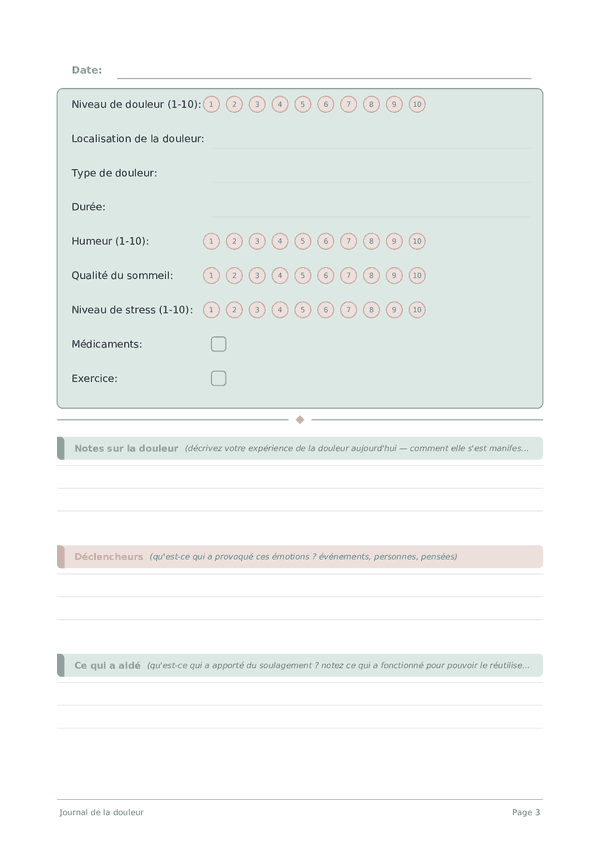
Journal de la douleur
Suivez les schémas de douleur, les déclencheurs et les stratégies de soulagement
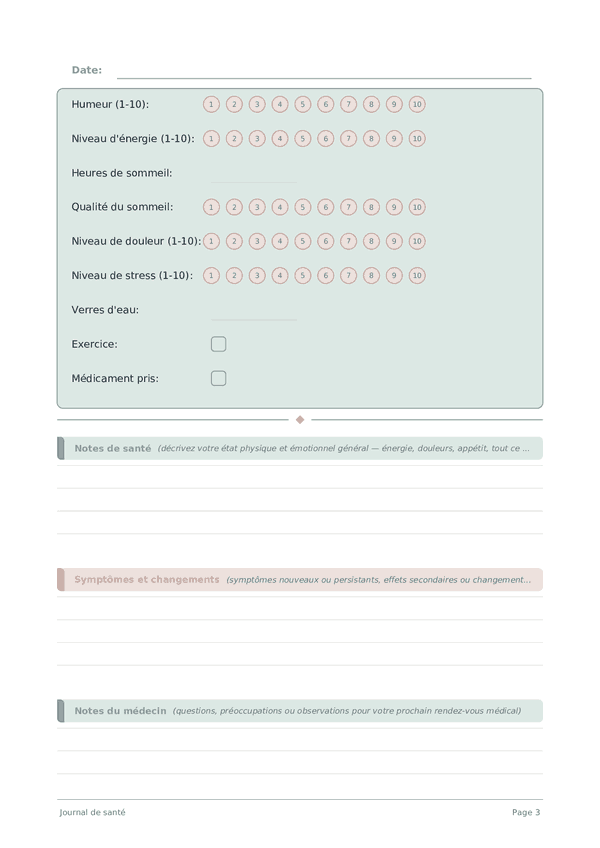
Journal de santé
Suivez votre corps, votre esprit et votre bien-être chaque jour
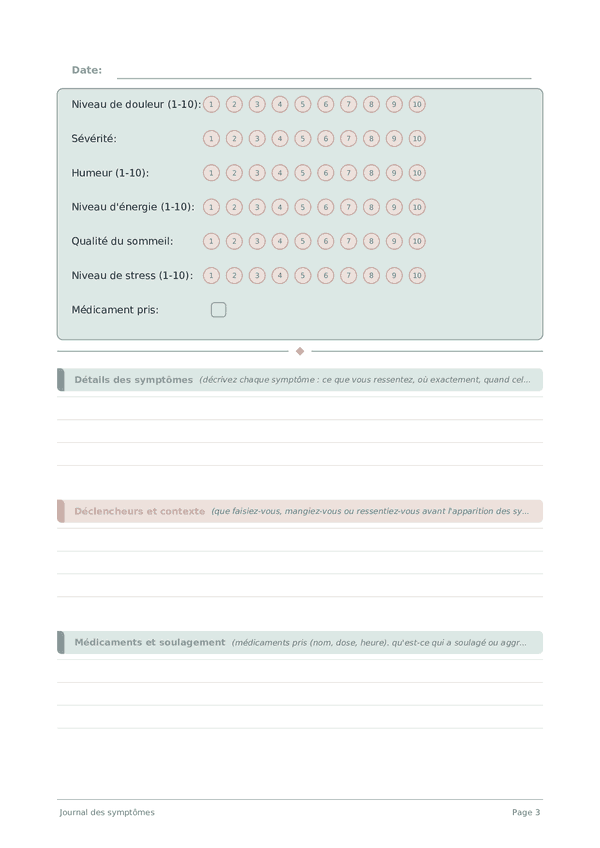
Journal des symptômes
Suivez vos symptômes, déclencheurs et traitements au quotidien
Journal des calories
Suivez les calories et les macros à chaque repas
Molette pour zoomer, glisser pour déplacer