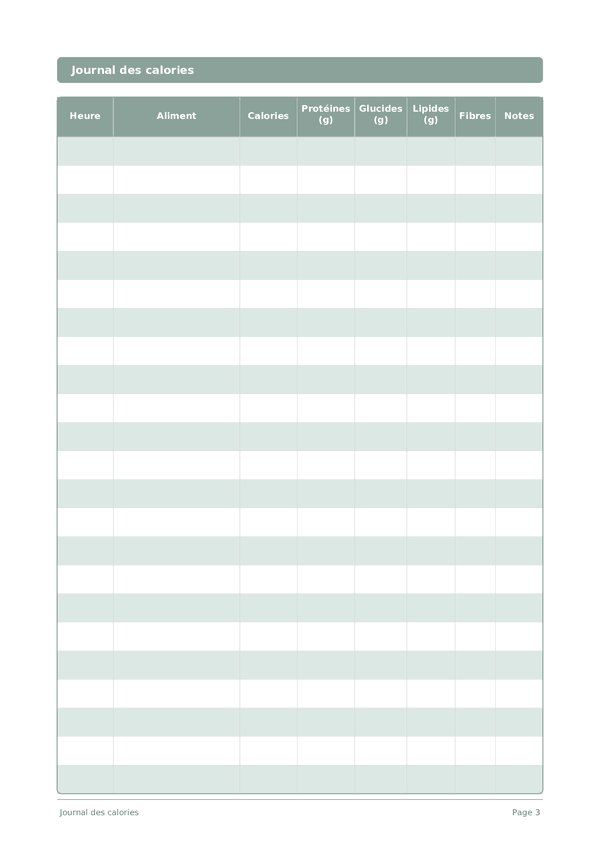
Printable Journal des calories
Suivez les calories et les macros à chaque repas
A structured table log for recording every meal with full macro breakdown — calories, protein, carbs, fat, and fiber. Build awareness of your eating patterns and reach your nutrition goals with data-driven consistency.
Personnaliser les champs
Activez ou désactivez les champs. Cliquez sur le crayon pour renommer, ou ajoutez vos propres champs.
Avantages
Comment utiliser
Qu'est-ce que ce journal ?
A calorie journal is a detailed nutritional log where you track not just the calories in every food item you consume, but also the macronutrient breakdown — protein, carbohydrates, fat, and fiber. This level of detail transforms vague dietary intentions into precise, actionable data that supports specific fitness, health, or body composition goals.
This journal is ideal for people who are serious about understanding their nutrition on a granular level: athletes optimizing performance, individuals following structured meal plans, anyone tracking macros for weight loss or muscle gain, or people managing conditions like diabetes where carbohydrate awareness is essential. It is also an excellent learning tool for anyone who wants to develop an intuitive sense of what is in the food they eat.
By logging each food item with its full nutritional profile, you gain clarity about where your calories actually come from. Many people are surprised to discover how quickly fats add up or how little protein they consume relative to their goals. Over time, this journal helps you make informed adjustments — not through restriction, but through awareness — so that your diet genuinely supports the way you want to feel and perform.
Exemple rempli
Voici à quoi ressemble une entrée typique une fois remplie :
| Heure | Aliment | Calories | Protéines (g) | Glucides (g) | Lipides (g) | Fibres | Notes |
|---|---|---|---|---|---|---|---|
| 7:00 | Scrambled eggs (3 large) | 210 | 18 | 2 | 15 | 0 | Cooked in olive oil spray |
| 7:00 | Whole wheat toast (2 slices) | 180 | 8 | 30 | 3 | 4 | |
| 7:00 | Avocado (half) | 120 | 1 | 6 | 11 | 5 | On toast |
| 10:30 | Protein shake (whey, banana, milk) | 320 | 30 | 35 | 6 | 2 | Post-workout |
| 13:00 | Brown rice (1 cup cooked) | 215 | 5 | 45 | 2 | 3 | |
| 13:00 | Grilled chicken breast (150g) | 230 | 35 | 0 | 9 | 0 | Seasoned with herbs |
| 13:00 | Mixed vegetables, steamed | 85 | 4 | 15 | 1 | 5 | Broccoli, carrots, green beans |
| 16:00 | Almonds (30g) | 175 | 6 | 6 | 15 | 3 | Afternoon snack |
| 19:00 | Pasta with turkey bolognese | 520 | 32 | 60 | 14 | 4 | Whole wheat pasta |
| 19:00 | Side salad with olive oil | 110 | 2 | 5 | 10 | 2 | |
| 21:00 | Greek yogurt with berries | 150 | 12 | 18 | 3 | 2 | Low-fat yogurt |
Comment remplir chaque champ
Chaque page est un tableau avec des colonnes. Remplissez une ligne par entrée. Voici à quoi sert chaque colonne :
Heure
Notez l'heure à laquelle vous avez mangé. L'horaire des repas affecte l'énergie, le sommeil et la digestion. Les tendances deviennent visibles après quelques semaines.
Aliment
Notez ce que vous avez mangé. Soyez suffisamment précis pour que ce soit utile (par ex., « salade de poulet grillé » et non juste « déjeuner »). Cela aide à identifier les sensibilités alimentaires et les tendances.
Calories
Notez votre apport calorique approximatif. Vous n'avez pas besoin de chiffres parfaits — les estimations vous aident à rester attentif à vos habitudes alimentaires.
Protéines (g)
Notez votre apport en protéines en grammes. Un apport adéquat en protéines est crucial pour la récupération et le développement musculaire, généralement 1,6 à 2,2 g par kg de poids corporel.
Glucides (g)
Lipides (g)
Fibres
Notes
Ajoutez tout contexte ou réflexion supplémentaire. Cette colonne fourre-tout est pour tout ce qui ne rentre pas ailleurs mais pourrait être utile plus tard.
Conseils pour réussir
Quand et à quelle fréquence écrire
Log each meal and snack immediately in the table format: food item, portion size, calories, and macros if tracking them. Total your calories at the end of each day. Weekly, calculate your daily average and compare it to your target — this weekly view is more meaningful than any single day. Monthly, assess whether your target needs adjustment based on how your body is responding. If counting starts feeling obsessive, take a 3-day break and rely on your built-up food awareness instead.
Questions fréquentes
Le comptage des calories aide-t-il vraiment à gérer le poids ?
Oui — les revues Cochrane et les recommandations nutritionnelles confirment que la conscience de l'apport énergétique améliore les résultats pondéraux lorsqu'elle est associée à un équilibre en macronutriments. Des études montrent que les personnes qui se suivent perdent environ deux fois plus de poids sur six mois. La présentation en cinq macronutriments (calories, protéines, glucides, lipides, fibres) soutient l'accent sur la qualité alimentaire recommandé par les sociétés de diabétologie, pas seulement la restriction calorique.
À quel point mes estimations de calories et macronutriments doivent-elles être précises ?
Dans ±10–15 %, ce qui suffit pour le suivi des tendances selon les recommandations des diététiciens. Des études montrent que même un suivi imparfait produit un changement de comportement significatif. Utilisez les étiquettes alimentaires, une base de données nutritionnelle officielle (comme Ciqual de l'Anses en France) ou une application de code-barres pour la recherche. La cohérence sur des semaines importe plus que la précision par repas.
Pourquoi le modèle sépare-t-il les fibres des glucides ?
Les recommandations nutritionnelles préconisent 25 à 34 g de fibres par jour, mais la plupart des adultes en consomment bien moins. Les fibres jouent un rôle clé dans le contrôle glycémique et la santé cardiovasculaire. Suivre les fibres séparément des glucides totaux révèle des tendances de qualité alimentaire que le comptage des glucides nets dissimule. Visez une part de fibres élevée dans les glucides totaux — c'est généralement meilleur pour la santé métabolique.
Quelle quantité de protéines viser par repas ?
Les recommandations nutritionnelles préconisent 0,8 g/kg de poids corporel par jour pour les adultes sédentaires ; des recommandations sportives suggèrent 1,4 à 2,0 g/kg pour les personnes actives. La répartition sur 3 à 4 repas de 20 à 40 g par repas optimise la synthèse des protéines musculaires. Utilisez la colonne protéines pour vérifier la distribution — concentrer toutes les protéines au dîner est fréquent mais moins efficace qu'une répartition équitable.
Ce modèle est-il adapté à quelqu'un ayant des antécédents de troubles du comportement alimentaire ?
Avec prudence. Les associations spécialisées avertissent que le comptage détaillé des calories peut aggraver l'alimentation restrictive ou l'orthorexie. Si vous avez des antécédents d'anorexie, de boulimie ou d'hyperphagie boulimique, consultez un diététicien ou un thérapeute avant de tenir ce journal. La variante sans calories (food-journal) est généralement plus sûre. Le suivi est un outil, pas une mesure morale.
En quoi diffère-t-il de MyFitnessPal ou Cronometer ?
Les applications automatisent la recherche mais encouragent une utilisation continue du téléphone ; ce tableau imprimable impose une saisie brève et intentionnelle aux repas. Le NIH note que les outils de changement de comportement fonctionnent mieux quand la friction est juste suffisante pour susciter la réflexion. Utilisez l'application pour la recherche, puis transférez les chiffres clés dans le journal pour l'enregistrement réel.
Comment utiliser les totaux hebdomadaires du journal ?
Additionnez chaque colonne sur les 7 jours. Comparez les totaux aux recommandations nutritionnelles officielles : calories correspondant aux besoins estimés selon votre BMR, protéines à 0,8–2,0 g/kg, fibres 25–34 g/jour, graisses saturées sous 10 % des calories. Cherchez des tendances jours de semaine vs week-end — elles révèlent souvent le levier d'ajustement le plus efficace pour le poids et les marqueurs métaboliques.
Quelle est l'erreur de suivi la plus fréquente ?
Sous-enregistrer les collations et les boissons. Des études montrent que les gens sous-estiment leur apport de 20 à 40 %, principalement en raison des collations oubliées et des calories liquides (sodas, jus, alcool, cafés au lait). Utilisez la colonne heure pour chaque occasion alimentaire — y compris un seul biscuit ou un café avec de la crème. Enregistrer une estimation vaut mieux que ne rien enregistrer.
Vous aimerez aussi
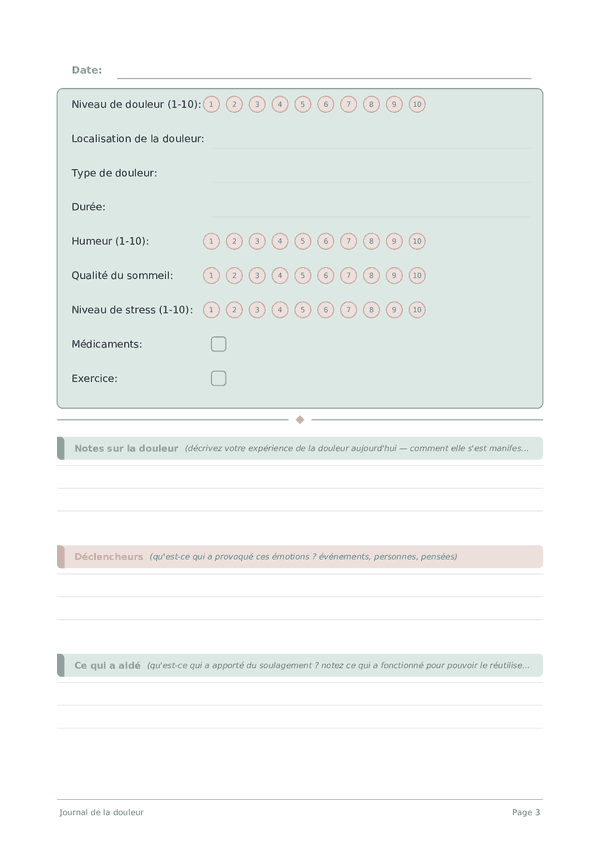
Journal de la douleur
Suivez les schémas de douleur, les déclencheurs et les stratégies de soulagement
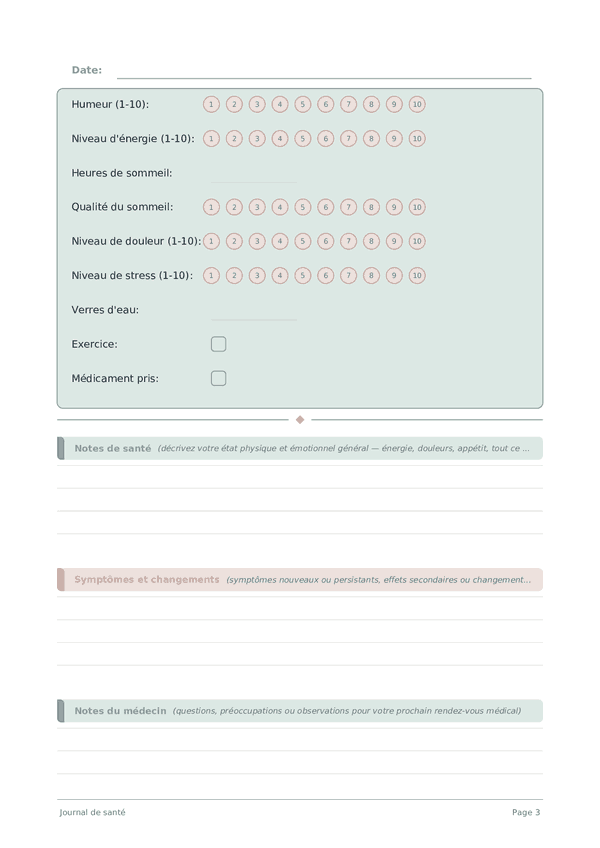
Journal de santé
Suivez votre corps, votre esprit et votre bien-être chaque jour
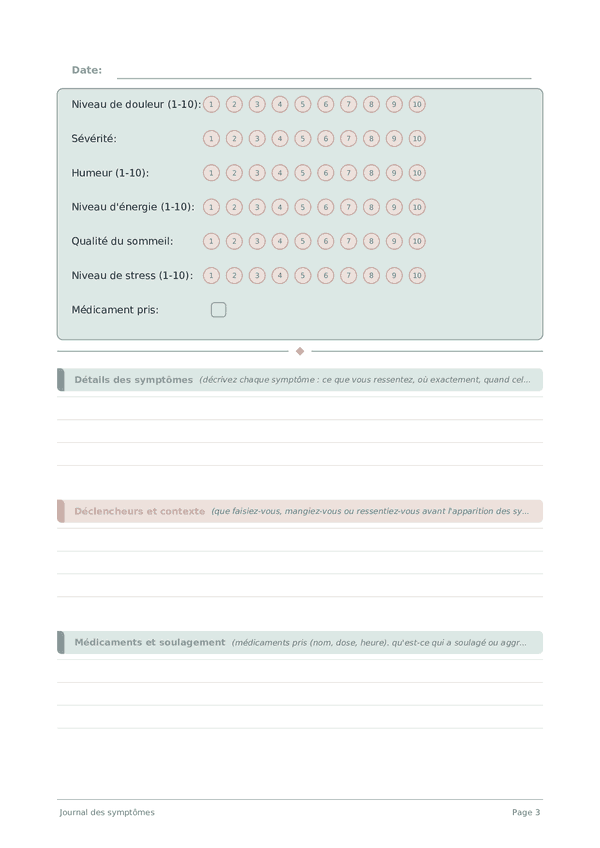
Journal des symptômes
Suivez vos symptômes, déclencheurs et traitements au quotidien
Journal de course à pied
Suivez chaque course, mesurez vos progrès et atteignez vos objectifs
Molette pour zoomer, glisser pour déplacer