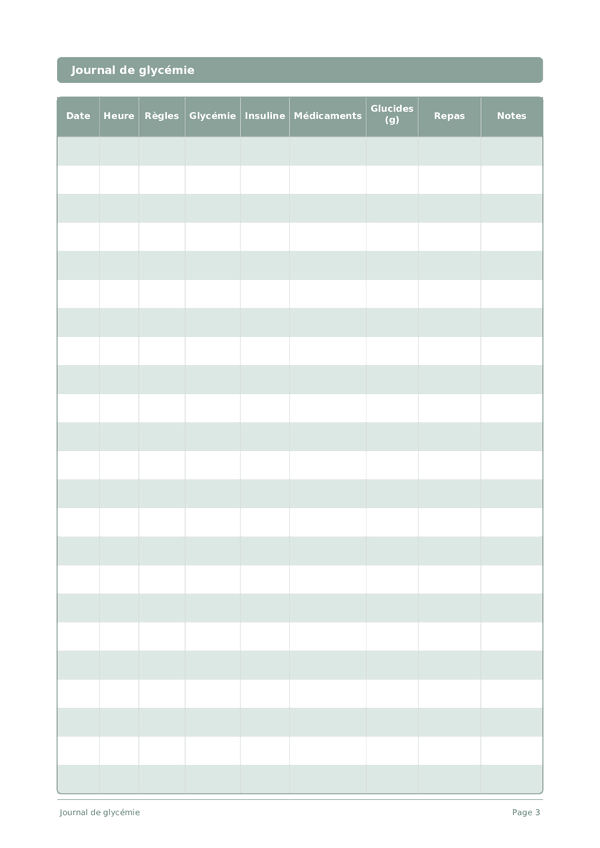
Printable Journal de glycémie
Gérez le diabète avec un suivi précis du glucose
Log blood sugar levels, insulin doses, meals, and notes to maintain tight glucose control. An essential tool for diabetics and pre-diabetics managing their condition.
Personnaliser les champs
Activez ou désactivez les champs. Cliquez sur le crayon pour renommer, ou ajoutez vos propres champs.
Avantages
Comment utiliser
Qu'est-ce que ce journal ?
A blood sugar journal is an essential tool for anyone managing diabetes or pre-diabetes. By recording your glucose levels throughout the day alongside insulin doses, carbohydrate intake, meals, and medications, you build a comprehensive picture of how your body responds to food, activity, and treatment. This journal is designed to make daily tracking simple and consistent.
Understanding blood sugar patterns is the foundation of effective diabetes management. A written log allows you and your healthcare team to identify trends — such as post-meal spikes, dawn phenomenon, or the impact of exercise — that fingerstick readings alone cannot reveal. With consistent entries, you gain the ability to make proactive adjustments to diet, medication timing, and lifestyle habits.
Whether you are newly diagnosed and learning how your body reacts, or a long-term diabetic fine-tuning your regimen, this journal transforms scattered data into actionable knowledge. Bring it to your endocrinologist appointments and watch the quality of your consultations improve dramatically.
Exemple rempli
Voici à quoi ressemble une entrée typique une fois remplie :
| Date | Heure | Règles | Glycémie | Insuline | Médicaments | Glucides (g) | Repas | Notes |
|---|---|---|---|---|---|---|---|---|
| 2026-03-01 | 07:00 | Fasting | 105 | 8 | Metformin 500mg | 0 | — | Fasting reading upon waking |
| 2026-03-01 | 09:30 | After breakfast | 148 | 0 | — | 45 | Oatmeal with berries | Slightly higher than target |
| 2026-03-01 | 12:00 | Before lunch | 112 | 6 | — | 0 | — | Returned to normal range |
| 2026-03-01 | 14:30 | After lunch | 156 | 0 | Metformin 500mg | 55 | Grilled chicken sandwich | Need to reduce bread portion |
| 2026-03-01 | 22:00 | Bedtime | 118 | 10 | — | 30 | Light salad | Good evening number |
Comment remplir chaque champ
Chaque page est un tableau avec des colonnes. Remplissez une ligne par entrée. Voici à quoi sert chaque colonne :
Date
Inscrivez la date du jour. Cela ancre votre entrée dans le temps et aide lors de la relecture ultérieure.
Heure
Enregistrez l'heure de la mesure ou de l'événement. Un horaire constant rend les données comparables et révèle des tendances selon le moment de la journée.
Règles
Glycémie
Enregistrez votre mesure de glycémie. Le suivi en parallèle des repas et de l'activité révèle ce qui fait monter ou descendre vos niveaux.
Insuline
Enregistrez les unités d'insuline administrées. Un suivi précis de l'insuline est essentiel pour gérer la glycémie et ajuster les dosages.
Médicaments
Enregistrez les médicaments pris, y compris le nom et le dosage. Un suivi régulier vous aide, vous et votre médecin, à évaluer l'efficacité du traitement.
Glucides (g)
Repas
Décrivez le repas associé à cette entrée. Le contexte autour des repas (avant, après, ce que vous avez mangé) aide à identifier les corrélations avec vos mesures.
Notes
Ajoutez tout contexte ou réflexion supplémentaire. Cette colonne fourre-tout est pour tout ce qui ne rentre pas ailleurs mais pourrait être utile plus tard.
Conseils pour réussir
Quand et à quelle fréquence écrire
Test and log at the times your doctor recommends — typically fasting (morning before eating), before meals, and 2 hours after meals. Record every reading with time, meal context, and any relevant notes (exercise, stress, illness). Weekly, review your patterns: Which meals cause the biggest spikes? Which time of day are readings highest? Monthly, calculate your average fasting and post-meal values to share with your healthcare team. Consistent logging is what transforms raw numbers into actionable treatment guidance.
Questions fréquentes
Quelles valeurs de glycémie viser ?
Selon les recommandations de l'ADA et de la HAS : à jeun 80–130 mg/dL (4,4–7,2 mmol/L) ; 1 à 2 heures après les repas < 180 mg/dL (< 10,0 mmol/L) ; HbA1c < 7 % pour la plupart des adultes. Les objectifs varient selon l'âge, la grossesse, le risque d'hypoglycémie et les comorbidités. Suivez toujours les objectifs individualisés de votre endocrinologue — ces entrées de journal sont une documentation, pas un diagnostic.
Quand tester la glycémie au cours de la journée ?
L'ADA recommande de tester à des horaires cohérents : à jeun (au réveil), avant les repas, 1 à 2 heures après les repas, au coucher, et lors de symptômes. Les patients DT1 sous insuline intensive testent généralement 4 à 8 fois par jour ; les patients DT2 sous médicaments oraux peuvent tester 1 à 2 fois. La colonne period (à jeun/avant repas/après repas/coucher) rend les tendances claires. Discutez de la fréquence optimale avec votre endocrinologue ou infirmier(ère) spécialisé(e).
Comment corréler les glucides avec la réponse glycémique ?
Une élévation de la glycémie postprandiale > 50 mg/dL au-dessus du niveau pré-repas indique une insuffisance d'insuline ou un excès de glucides pour la dose. Les colonnes glucides (g) et glycémie associées sur 2 semaines révèlent vos ratios personnels glucides-glucose et votre sensibilité à l'insuline. Apportez ces données à votre endocrinologue pour l'ajustement des doses — des études montrent que l'examen continu de ces tendances réduit l'HbA1c de 0,5 à 1 %.
Qu'est-ce que l'hypoglycémie et comment y répondre ?
L'ADA définit l'hypoglycémie comme une glycémie < 70 mg/dL (< 3,9 mmol/L), sévère à < 54 mg/dL. Symptômes : tremblements, sueurs, confusion, faim. Traitez avec 15 g de glucides à action rapide (jus, comprimés de glucose), recontrolez dans 15 minutes, répétez si toujours bas. Une hypoglycémie sévère avec altération de la conscience nécessite du glucagon et des soins d'urgence — appelez le 15 (SAMU) ou le 112. Enregistrez tous les épisodes.
En quoi diffère-t-il d'un capteur de glucose en continu (CGM) ?
Les CGM (Dexcom, Libre, Medtronic) fournissent 288 mesures par jour avec des flèches de tendance. Des études montrent que les CGM améliorent l'HbA1c plus que les seules piqûres au doigt. Cependant, le journal capture le contexte — composition des repas, exercice, maladie, stress — que les CGM manquent. Utilisez les deux : CGM pour les données granulaires, journal pour le récit explicatif. L'ADA recommande de plus en plus les CGM pour le DT1 et le DT2 intensivement géré.
Quels types d'insuline enregistrer dans la colonne medication ?
L'ADA distingue : ultra-rapide (lispro, asparte, glulusine) avant les repas ; longue durée d'action (glargine, detemir, degludec) une ou deux fois par jour pour la couverture basale ; mélanges prêts à l'emploi. Enregistrez le nom, les unités et le timing. Apportez 2+ semaines de pages de journal à votre endocrinologue — les ajustements basaux/bolus dépendent des tendances invisibles dans un seul HbA1c ponctuel.
Comment l'exercice et la maladie affectent-ils la glycémie ?
L'exercice aérobie abaisse généralement la glycémie pendant et jusqu'à 24+ heures après ; la musculation peut l'augmenter de façon aiguë. La maladie, l'infection et les corticoïdes augmentent substantiellement la glycémie. Notez-les dans la colonne notes — ils expliquent des lectures qui semblent sinon erratiques. Les protocoles « jours de maladie » (tester toutes les 2 à 4 heures, maintenir l'hydratation, vérifier les cétones si DT1) doivent être revus avec votre équipe diabétologie.
Quand des lectures de glycémie nécessitent-elles une attention médicale urgente ?
Signaux d'alarme : glycémie > 300 mg/dL (> 16,7 mmol/L) avec symptômes (vomissements, douleur abdominale, haleine fruitée, respiration rapide) suggère une ACD — urgence absolue, appelez le 15 ou le 112. Des lectures persistantes > 250 avec cétones positives (DT1) nécessitent également des soins d'urgence. Une hypoglycémie sévère avec confusion nécessite du glucagon et des soins d'urgence. Documentez tous les épisodes.
Vous aimerez aussi
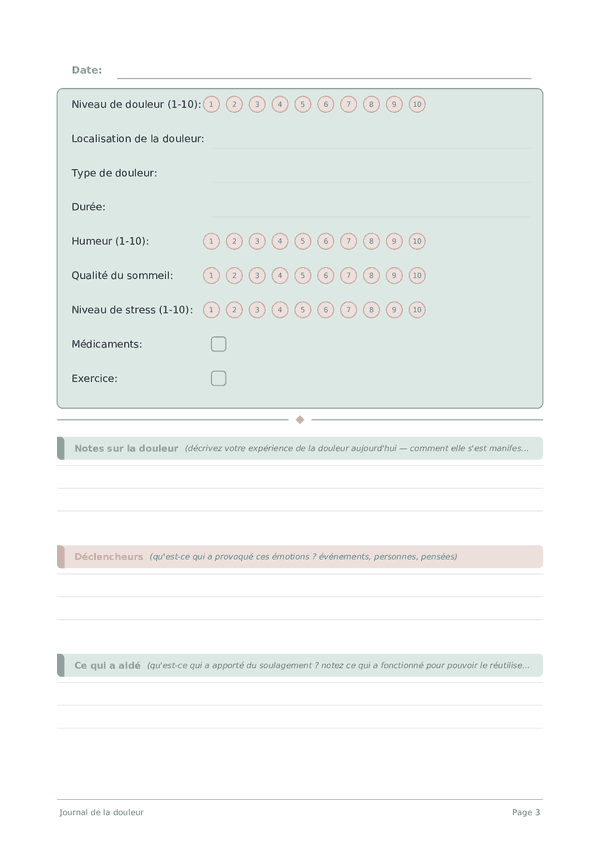
Journal de la douleur
Suivez les schémas de douleur, les déclencheurs et les stratégies de soulagement
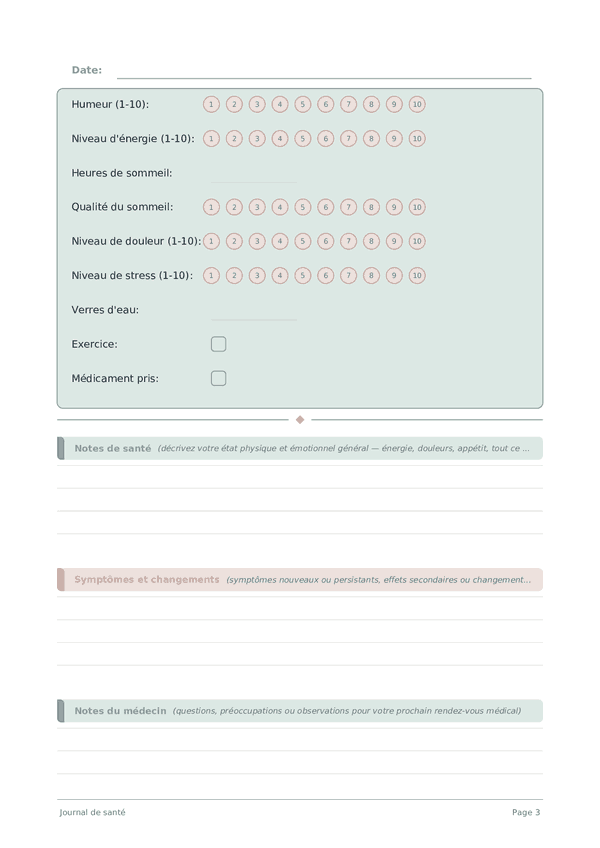
Journal de santé
Suivez votre corps, votre esprit et votre bien-être chaque jour
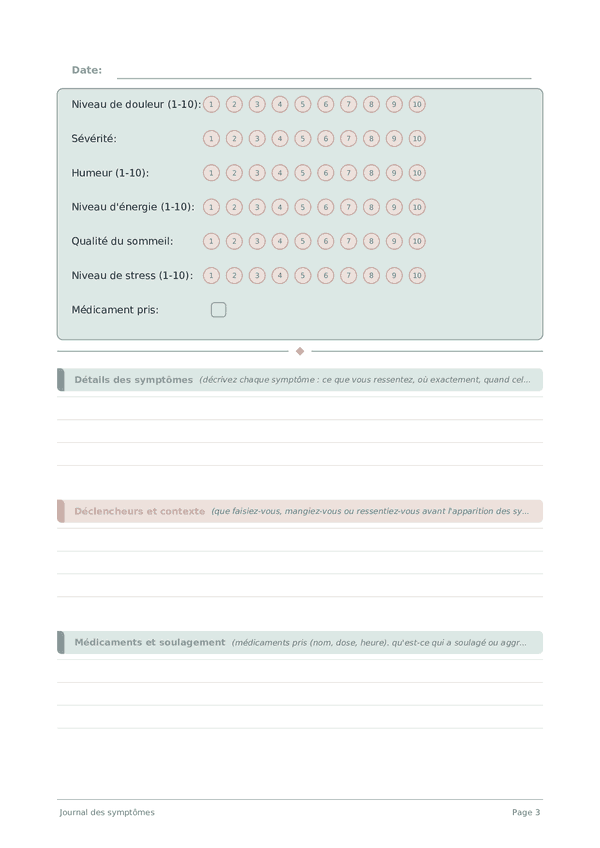
Journal des symptômes
Suivez vos symptômes, déclencheurs et traitements au quotidien
Journal des calories
Suivez les calories et les macros à chaque repas
Molette pour zoomer, glisser pour déplacer