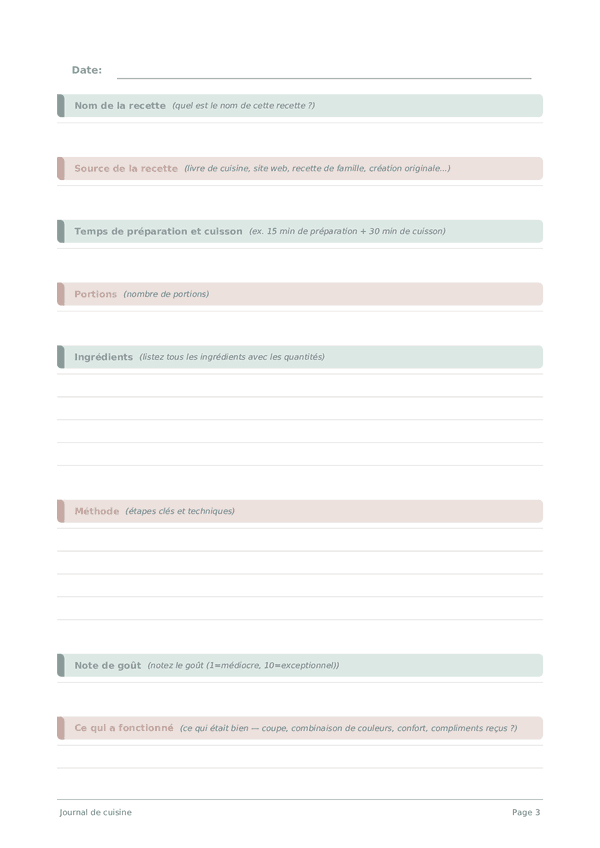
Printable Journal de cuisine
Tests de recettes et carnet de notes culinaires
Document your culinary adventures with detailed recipe notes, ingredient lists, and technique observations. Rate dishes, note improvements, and build a personalized cookbook of your greatest hits.
Personnaliser les champs
Activez ou désactivez les champs. Cliquez sur le crayon pour renommer, ou ajoutez vos propres champs.
Qu'est-ce que ce journal ?
A cooking journal is where your kitchen experiments stop being one-off events and start becoming a personal recipe archive enriched with honest notes on what actually happened. Cookbooks tell you what should work; your journal tells you what did work — and what did not — in your kitchen, with your ingredients, on your stove. That first-hand knowledge is irreplaceable.
Each entry captures the recipe name and source, prep and cook time, servings, a full ingredient list, your method notes, a taste rating, what worked well, and whether you would make it again. Writing these details down right after cooking preserves the small adjustments — an extra pinch of salt, two minutes less in the oven — that make the difference between good and great.
Over time your journal becomes a living cookbook tailored to your palate, your pantry, and your skill level. It is also the fastest way to improve: when you review past entries you spot repeating mistakes, identify techniques that reliably produce great results, and build confidence to improvise rather than follow every recipe to the letter.
Exemple rempli
Voici à quoi ressemble une entrée typique une fois remplie :
Comment remplir chaque champ
Chaque jour, vous trouverez plusieurs sections étiquetées avec des lignes pour écrire. Voici à quoi sert chaque section :
Nom de la recette
Quel est le nom de cette recette ?
Source de la recette
Livre de cuisine, site web, recette de famille, création originale...
Temps de préparation et cuisson
ex. 15 min de préparation + 30 min de cuisson
Portions
Nombre de portions
Ingrédients
Listez tous les ingrédients avec les quantités
Méthode
Étapes clés et techniques
Note de goût
Notez le goût (1=médiocre, 10=exceptionnel)
Ce qui a fonctionné
Ce qui était bien — coupe, combinaison de couleurs, confort, compliments reçus ?
À refaire ?
Oui, Non, ou Peut-être avec des ajustements
Conseils pour réussir
Quand et à quelle fréquence écrire
Make an entry every time you cook something noteworthy — a new recipe, a significant modification, or an interesting failure. For daily home cooks, three to four entries per week capture enough to build a useful personal cookbook without turning meals into homework. Write immediately after eating while taste memory is still acute. Weekly, plan your next cooking experiments based on journal insights. Seasonally, review your entries and compile your greatest hits into a personal recipe collection. Over a year, you will have a cookbook that no store can sell you — one perfectly tuned to your life.
Questions fréquentes
Que consigne le Journal de cuisine par plat ?
Neuf champs par recette : nom recette, source recette, temps préparation cuisson, portions, ingrédients (5 lignes), méthode (5 lignes), note goût, ce qui a marché (2 lignes) et referais je. La structure transforme chaque tentative culinaire en expérience documentée plutôt qu'en coup isolé — avec le temps tu construis un livre de cuisine personnel réglé sur ton vrai goût, tes ingrédients et ton équipement.
Pourquoi consigner les ingrédients quand la source de la recette les a déjà ?
Tu consignes ce que tu as réellement utilisé, pas ce que la recette spécifiait. Substitutions, morceaux disponibles, degré de maturité des produits et ajustements de quantité affectent tous le résultat. Enregistrer tes vrais ingrédients transforme un succès ponctuel en quelque chose de reproductible — et un échec en problème diagnosticable. Les 5 lignes d'ingrédients accueillent un plat de complexité modérée ; les recettes complexes peuvent s'étendre sur des pages.
En quoi est-ce différent de sauvegarder des recettes en ligne ?
Les recettes sauvegardées sont des signets ; ce journal est un registre personnel de ta version. Les recettes en ligne supposent une cuisine idéale et des ingrédients moyens ; ton journal enregistre ce qui s'est passé dans ta cuisine avec ta cuisinière, ton sel, les points chauds de ton four. Après 20 à 30 entrées, le journal devient plus utile que n'importe quel livre de cuisine parce qu'il est calibré à ton environnement et à tes préférences spécifiques.
Que mettre dans la section ce qui a marché ?
Des observations techniques spécifiques : « réduit le bouillon de moitié avant d'ajouter la crème — la sauce nappait le dos d'une cuillère », « saisir 60 secondes a donné une meilleure croûte que 90 ». La précision compte : les entrées vagues (« super rendu ») s'estompent ; les concrètes construisent une intuition culinaire transférable. D'une cuisine et méthode à l'autre, la colonne ce qui a marché devient ta collection personnelle de petites techniques apprises à la dure.
Comment utiliser le champ note goût honnêtement ?
Note par rapport à ton attente pour ce plat, pas par rapport à un standard Michelin. De bonnes pâtes du soir en semaine notées 7/10 par rapport à « bonnes pâtes du soir » est plus utile que 4/10 par rapport à un idéal irréaliste. Associe la note à des remarques — un 5/10 avec « trop salé » est actionnable ; un 5/10 seul n'est que découragement. Avec le temps, les schémas de notes révèlent les cuisines et méthodes qui fonctionnent constamment pour toi.
Faut-il consigner les plats cuisinés souvent, ou seulement les nouvelles recettes ?
Les deux, mais pour des raisons différentes. Les nouvelles recettes ont besoin du modèle complet — tu apprends. Les plats répétés bénéficient d'entrées périodiques pour suivre le raffinement : les changements apportés, ce qui s'est amélioré, ce qui a plafonné. Beaucoup de cuisiniers à domicile atteignent un plafond confortable sur les plats familiers sans remarquer qu'ils ont arrêté d'itérer. Le journal interrompt cette dérive en faisant de chaque répétition une opportunité pour un petit changement.
Tenir un journal de cuisine me rend-il vraiment meilleur cuisinier ?
Oui, quand les entrées incluent des observations spécifiques et des révisions. La cuisine s'améliore par le même mécanisme de pratique délibérée qu'Ericsson (2016, Peak, Houghton Mifflin Harcourt) documente dans d'autres domaines de compétence — attention ciblée sur des techniques spécifiques avec retour d'information. La note goût fournit le retour ; ce qui a marché fournit l'attention spécifique. Sans écriture, la plupart des cuisiniers répètent les mêmes plats sans les améliorer consciemment.
Comment utiliser le journal pour la planification des repas ou les courses ?
Feuillette les entrées marquées referais je = oui pour construire le plan de la semaine, puis compile une liste de courses à partir des sections ingrédients. Cela évite le piège courant d'acheter pour des repas ambitieux qui ne seront jamais cuisinés. La révision trimestrielle des notes de goût révèle quelles catégories d'aliments atterrissent constamment bien — utile à la fois pour la planification et pour améliorer les recettes que tu cuisines le plus souvent.
Vous aimerez aussi
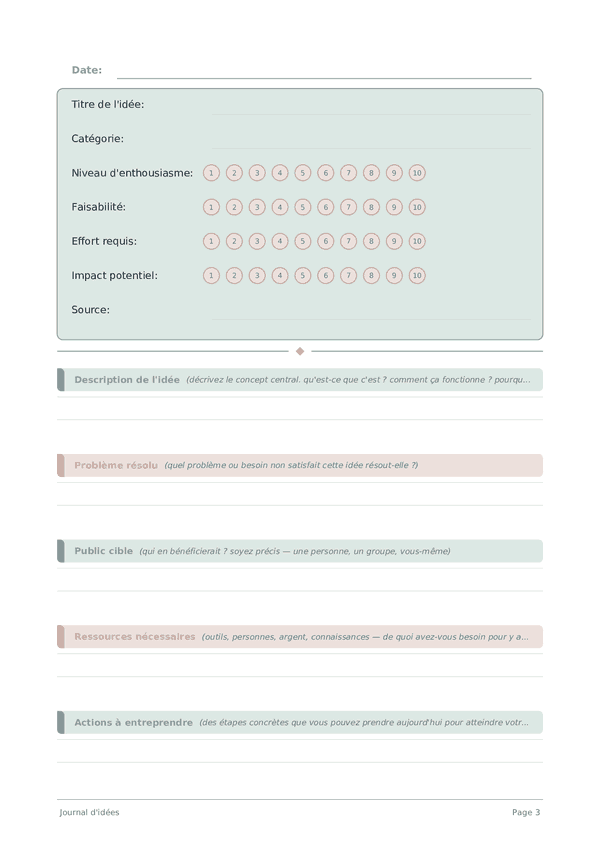
Journal d'idées
Capturez, évaluez et développez vos meilleures idées
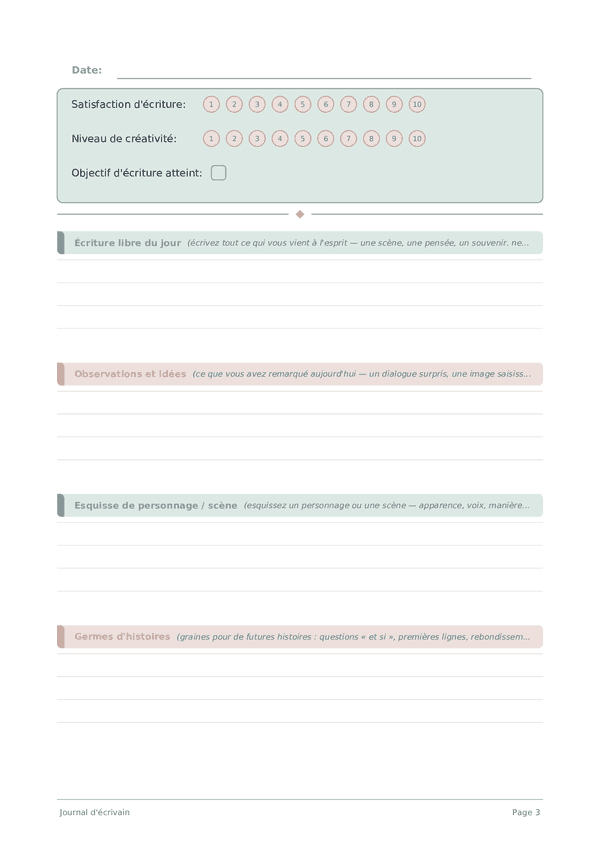
Journal d'écrivain
Pratique quotidienne d'écriture créative et développement du style
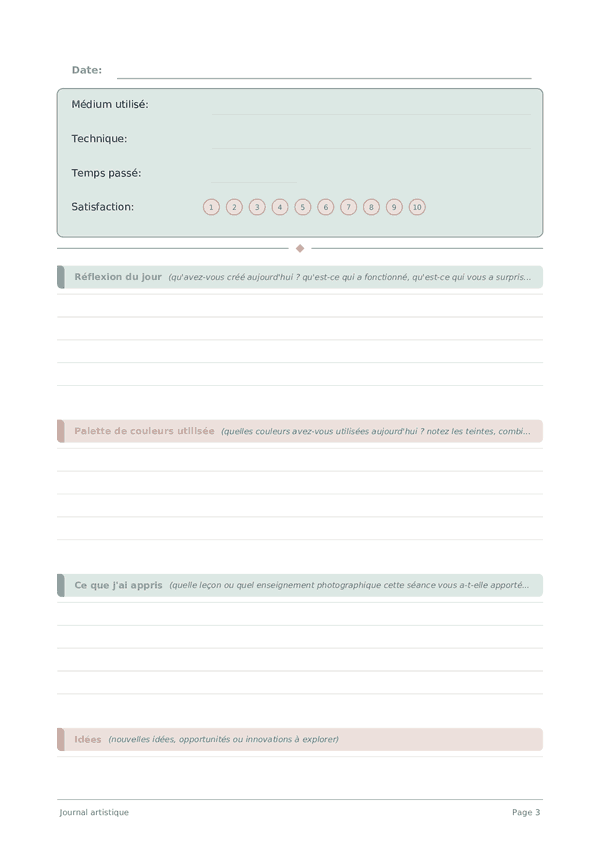
Journal artistique
Documentez votre processus créatif et votre évolution artistique
Journal de croquis
Pages à grille de points ouvertes pour le croquis, le dessin et l'exploration visuelle

Molette pour zoomer, glisser pour déplacer