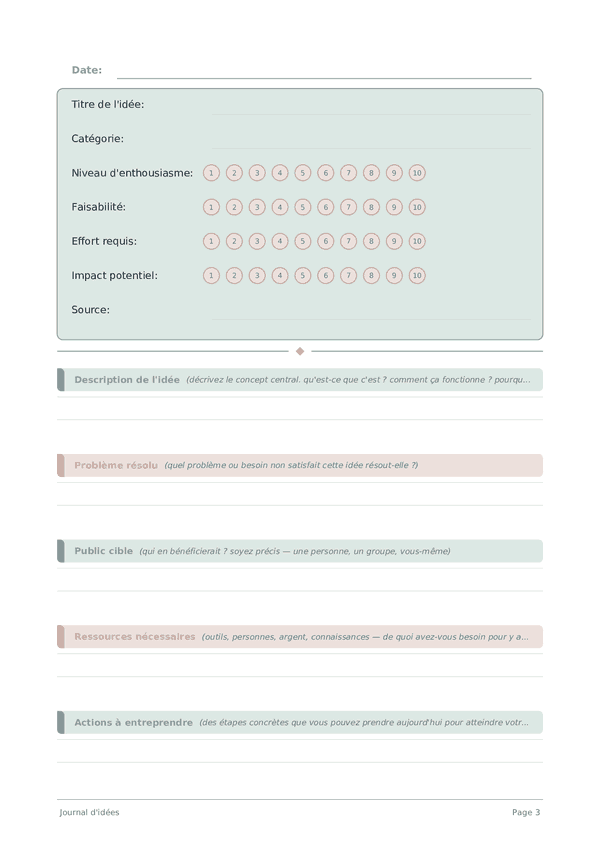
Printable Journal d'idées
Capturez, évaluez et développez vos meilleures idées
A structured journal for capturing creative ideas and evaluating their potential. Each page combines quick-rating fields for excitement, feasibility, effort, and impact with guided writing prompts to flesh out the concept. Turn fleeting thoughts into actionable plans.
Personnaliser les champs
Activez ou désactivez les champs. Cliquez sur le crayon pour renommer, ou ajoutez vos propres champs.
Avantages
Comment utiliser
Qu'est-ce que ce journal ?
An Idea Journal is a hybrid capture tool that helps you evaluate and develop ideas systematically instead of letting them vanish. The top section lets you rate each idea on excitement, feasibility, effort required, and potential impact, along with a title, category, and source. The bottom section provides space to describe the idea in detail, define the problem it solves, identify the target audience, list needed resources, outline action steps, and note related ideas.
Great ideas are fragile — they appear at unexpected moments and disappear just as quickly if not recorded. But capturing ideas is only the first step. The real power of this journal is in the structured evaluation: by rating each idea against consistent criteria, you can objectively compare them later and decide which ones deserve your time and energy.
Carry this journal everywhere or keep it on your desk. When an idea strikes, fill in the top ratings immediately to capture your initial gut feeling. Then, when you have a quiet moment, flesh out the bottom section with details. Review your collected ideas monthly to spot patterns, combine related concepts, and choose the most promising ones to pursue.
Exemple rempli
Voici à quoi ressemble une entrée typique une fois remplie :
Comment remplir chaque champ
Le haut de chaque page comporte des champs à remplissage rapide (évaluations, cases à cocher, chiffres). En dessous se trouve une section lignée pour écrire. Voici ce que signifie chaque champ :
Titre de l'idée
Donnez à votre idée un nom clair et mémorable que vous pourrez retrouver facilement
Catégorie
Attribuez une catégorie à cette entrée (par ex., alimentation, transport, loisirs). Des catégories cohérentes facilitent l'analyse de vos données.
Niveau d'enthousiasme
À quel point êtes-vous enthousiaste pour cette idée ? 1 = bof, 10 = vous ne pensez qu'à ça
Faisabilité
Est-ce réaliste à mettre en œuvre ? 1 = utopique, 10 = vous pourriez commencer aujourd'hui
Effort requis
Combien de temps, d'énergie et de ressources cela demanderait-il ? 1 = minimal, 10 = considérable
Impact potentiel
Si ça marche, quel est le bénéfice ? 1 = petit gain, 10 = ça change la vie
Source
Livre, cours, vidéo, article, personne...
Description de l'idée
Décrivez le concept central. Qu'est-ce que c'est ? Comment ça fonctionne ? Pourquoi est-ce important ?
Problème résolu
Quel problème ou besoin non satisfait cette idée résout-elle ?
Public cible
Qui en bénéficierait ? Soyez précis — une personne, un groupe, vous-même
Ressources nécessaires
Outils, personnes, argent, connaissances — de quoi avez-vous besoin pour y arriver ?
Actions à entreprendre
Décomposez votre objectif en actions concrètes. Que ferez-vous exactement, quand et comment ? Plus c'est précis, mieux c'est.
Idées connexes
Cette idée est-elle liée à d'autres ? La pollinisation croisée engendre des percées
Conseils pour réussir
Quand et à quelle fréquence écrire
Capture ideas whenever they strike — this journal should be always accessible, not confined to a scheduled time. However, set a weekly 20-minute session to review, rate, and expand on ideas captured during the week. Many will seem less exciting on second look, and that is valuable filtering. Monthly, review all ideas from the past 30 days and select one or two to develop further or act on. The goal is not to have more ideas but to systematically surface the best ones.
Questions fréquentes
À quoi sert le Journal d'idées ?
Ce journal capture les idées créatives fugaces avant qu'elles ne s'évaporent et t'aide à les évaluer objectivement. Chaque page comporte un tracker avec le titre de l'idée, la catégorie et quatre notes (enthousiasme, faisabilité, effort, impact potentiel, chacune sur une échelle de 0 à 10), plus une section d'écriture pour le problème résolu, la cible, les ressources nécessaires, les étapes d'action et les idées connexes. Il transforme l'inspiration dispersée en une archive structurée.
Comment utiliser les quatre notes (enthousiasme, faisabilité, effort, impact) ?
Note chacune sur une échelle de 0 à 10 immédiatement après avoir capturé l'idée. L'enthousiasme reflète ta motivation intrinsèque, qui selon Amabile (2011, The Progress Principle, Harvard Business Review Press) prédit la concrétisation créative. La faisabilité et l'effort estiment le coût ; l'impact potentiel estime le gain. Les idées avec un enthousiasme et un impact élevés, mais un effort modéré, méritent d'être traitées en premier. Réévalue après une semaine — l'enthousiasme initial s'estompe souvent.
Écrire ses idées aide-t-il vraiment la créativité ?
Oui. Csikszentmihalyi (1996, Creativity, HarperCollins) a constaté que les personnes créatives capturent et revisitent systématiquement leurs idées plutôt que de compter sur leur mémoire. Externaliser les idées libère la mémoire de travail pour la combinaison et l'élaboration — le mécanisme central de l'innovation. Les champs structurés du journal (source, catégorie, étapes d'action) rendent les idées récupérables, et les anciennes entrées peuvent générer de nouvelles connexions lors des révisions.
En quoi est-ce différent d'une appli comme Notion ou Evernote ?
Les applis stockent des idées ; ce journal les évalue. Les échelles fixes (0 à 10) forcent une comparaison entre les idées, et les questions structurées (problème résolu, cible, ressources nécessaires) évitent les formulations vagues qui remplissent la plupart des boîtes de réception numériques. Le papier réduit aussi le changement de contexte et le bruit des notifications pendant l'idéation. Utilise le journal pour l'évaluation et l'élaboration, une appli pour le stockage si tu le souhaites.
Pourquoi le modèle demande-t-il la source de l'idée ?
Le champ source (livre, conversation, observation, problème) rend les schémas visibles sur plusieurs mois. Tu découvres quels environnements produisent tes meilleures idées — un principe clé de la recherche sur le flux de Csikszentmihalyi (1990, Flow, Harper). Tracer la source reconnaît aussi honnêtement les influences et t'aide à retourner aux sources fécondes. Écris une courte étiquette comme « podcast / douche / appel client » plutôt qu'une longue citation.
À quelle fréquence réviser les anciennes entrées ?
Hebdomadairement pour la capture active, mensuellement pour identifier les schémas. La révision exploite l'effet d'espacement documenté par Cepeda et al. (2006, Psychological Bulletin, 132(3), 354-380) — la réexposition distribuée renforce le rappel et fait émerger des combinaisons inattendues. Marque les entrées sur lesquelles tu veux agir ; archive ou raye le reste. La plupart des idées ne survivront pas à la révision, et c'est là tout l'intérêt : le journal filtre les quelques-unes qui méritent d'être poursuivies.
Quelle est l'erreur la plus courante avec un journal d'idées ?
Enregistrer le titre sans remplir les champs problème résolu, cible et étapes d'action. Une idée que tu ne peux pas reformuler clairement six mois plus tard est effectivement perdue. Passe 3 à 5 minutes par entrée — assez pour la rendre récupérable, pas au point de bloquer l'idée suivante. L'enthousiasme seul s'évanouit rapidement ; les questions structurées forcent le type d'élaboration qui distingue une idée utilisable d'une pensée passagère.
Ce journal convient-il aux entrepreneurs, aux écrivains et aux scientifiques ?
Oui — la structure est neutre par rapport au domaine. Un fondateur utilise la catégorie et la cible pour les produits ; un romancier les utilise pour les prémisses de ses histoires ; un chercheur les utilise pour les hypothèses. Les notes effort/impact fonctionnent comme une matrice de priorisation légère similaire à celle décrite dans la recherche sur la créativité au travail d'Amabile (2011, The Progress Principle, Harvard Business Review Press). Adapte le champ source à ta discipline.
Vous aimerez aussi
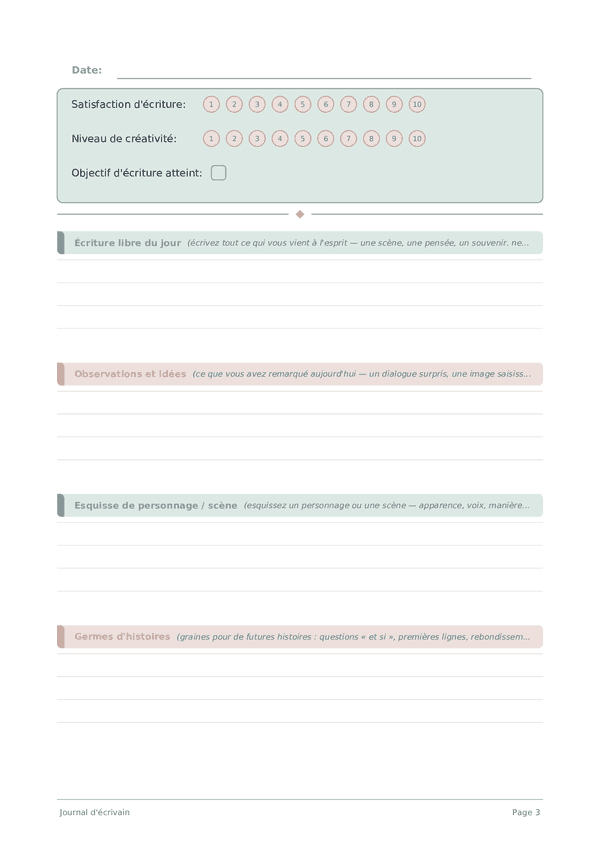
Journal d'écrivain
Pratique quotidienne d'écriture créative et développement du style
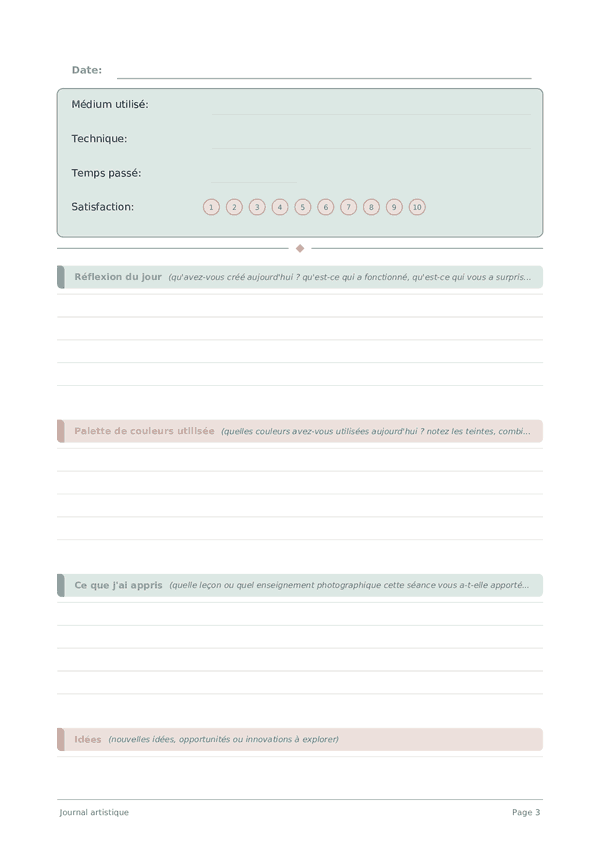
Journal artistique
Documentez votre processus créatif et votre évolution artistique
Journal de croquis
Pages à grille de points ouvertes pour le croquis, le dessin et l'exploration visuelle

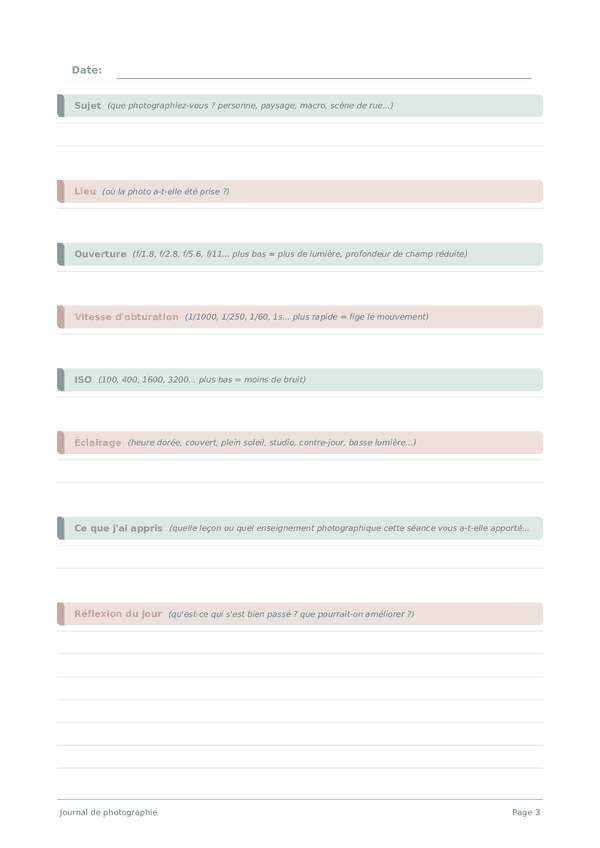
Journal de photographie
Notez vos prises de vue, réglages et réflexions créatives après chaque séance
Molette pour zoomer, glisser pour déplacer