Printable Journal artistique
Documentez votre processus créatif et votre évolution artistique
A structured art journal that combines quick session tracking with reflective writing. Log your medium, technique, time spent, and satisfaction for each creative session, then reflect on what you created, the colors you used, and what you learned. Perfect for artists, illustrators, and anyone exploring visual expression.
Personnaliser les champs
Activez ou désactivez les champs. Cliquez sur le crayon pour renommer, ou ajoutez vos propres champs.
Avantages
Comment utiliser
Qu'est-ce que ce journal ?
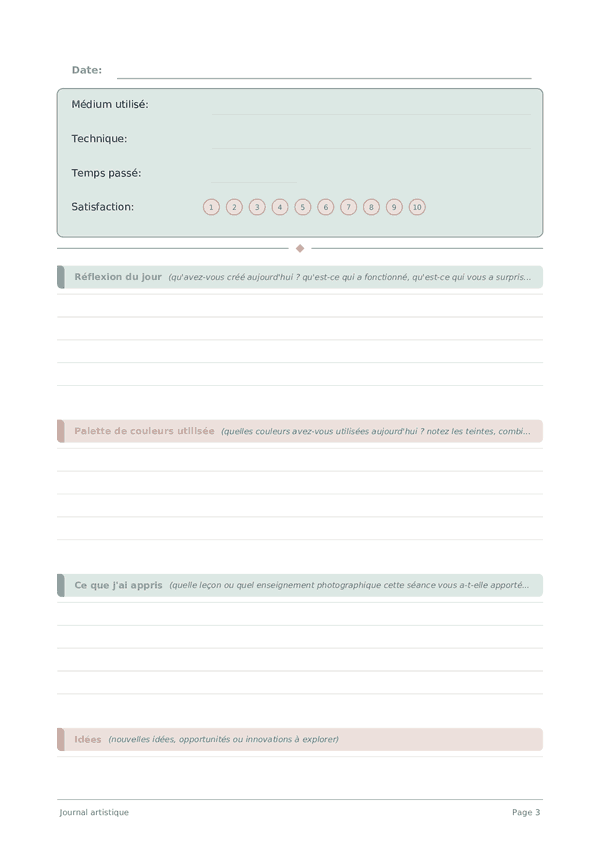
An Art Journal is a hybrid reflection tool for visual artists who want to grow intentionally. The top section tracks the medium used, technique practiced, time spent, and your satisfaction with the session. The bottom section provides space for written reflection, documenting your color palette, noting what you learned, and capturing ideas for future work. Together, they create a complete record of your artistic development.
Making art is inherently experiential, and much of what you learn in a session gets lost if you do not take a moment to articulate it. This journal bridges the gap between doing and understanding. When you write about why a certain color combination worked or why a technique felt awkward, you accelerate your learning in ways that practice alone cannot achieve.
Fill in the tracker immediately after each art session while the experience is still vivid. In the reflection section, write honestly about what went well and what frustrated you. Document the specific colors you mixed and the techniques you tried. Over months, this journal becomes an invaluable reference — a personal art education textbook written by the only teacher who knows exactly what you need to learn next: yourself.
Exemple rempli
Voici à quoi ressemble une entrée typique une fois remplie :
Comment remplir chaque champ
Le haut de chaque page comporte des champs à remplissage rapide (évaluations, cases à cocher, chiffres). En dessous se trouve une section lignée pour écrire. Voici ce que signifie chaque champ :
Médium utilisé
Quel médium avez-vous utilisé aujourd'hui ? ex. aquarelle, huile, crayon, fusain, numérique
Technique
Quelle technique avez-vous pratiquée ou expérimentée ? ex. pinceau sec, superposition, hachures croisées
Temps passé
Combien de temps avez-vous étudié ?
Satisfaction
Êtes-vous satisfait(e) de la séance d'aujourd'hui ? (1=frustré, 5=très satisfait)
Réflexion du jour
Revenez sur votre journée honnêtement. Qu'est-ce qui s'est bien passé ? Qu'est-ce qui pourrait être amélioré ? Il ne s'agit pas de juger — il s'agit d'apprendre et de grandir.
Palette de couleurs utilisée
Quelles couleurs avez-vous utilisées aujourd'hui ? Notez les teintes, combinaisons ou choix qui vous ont paru justes
Ce que j'ai appris
Écrivez une chose nouvelle que vous avez apprise aujourd'hui. Cela peut être un fait, une compétence, une prise de conscience sur vous-même ou une leçon de vie. L'apprentissage quotidien se compose en sagesse.
Idées
Capturez vos idées avant qu'elles ne disparaissent. Aucune idée n'est trop petite ou trop bête. Certaines des meilleures percées commencent comme des pensées brutes et à moitié formées.
Conseils pour réussir
Quand et à quelle fréquence écrire
Aim for two to three sessions per week, each 20 to 45 minutes. Daily practice is wonderful but can create pressure that kills spontaneity — art journaling thrives on desire, not obligation. Keep your journal accessible (on your desk, not in a drawer) so you can grab it whenever inspiration strikes. Once a month, flip through the entire journal without judgment, just noticing which pages pull your eye. This review often sparks new ideas and reminds you how far your visual vocabulary has come.
Questions fréquentes
Que suit le Journal d'art ?
Chaque page enregistre une séance créative : médium utilisé, technique, temps passé (jusqu'à 480 minutes) et satisfaction (0 à 10), avec huit lignes pour la réflexion — palette de couleurs utilisée, ce que tu as appris, et idées. Il s'adresse aux artistes, illustrateurs et à toute personne documentant sa pratique visuelle. Contrairement à un portfolio, il capture le processus : les choix, les erreurs et les petites découvertes qui s'accumulent en style au fil des mois.
Comment utiliser les champs médium et technique de façon significative ?
Sois précis — « aquarelle, mouillé sur mouillé » vaut mieux que « peinture ». Le cadre de pratique délibérée d'Ericsson et al. (1993, Psychological Review, 100(3), 363-406) exige d'identifier la compétence exacte qui est entraînée. Des entrées spécifiques médium/technique te permettent de répondre plus tard : « Quelle technique je note le mieux ? » ou « Qu'est-ce que je n'ai jamais essayé ? » Après trois mois, le champ devient un programme d'autoformation de tes forces et lacunes.
Pourquoi noter la satisfaction après chaque séance ?
La note crée une boucle de rétroaction reliant effort, conditions et résultat. Csikszentmihalyi (1990, Flow, Harper) a constaté que les artistes qui réfléchissent à la qualité de leurs séances entrent plus facilement dans des états de flux. Note immédiatement après — la mémoire amplifie les bonnes séances et efface les médiocres. Des schémas émergent en 4 à 6 semaines : les séances à haute satisfaction partagent souvent des conditions communes (heure, durée, médium, humeur) que tu peux délibérément recréer.
Tenir un journal d'art améliore-t-il vraiment mon travail ?
La réflexion combinée à la pratique délibérée, oui. Ericsson (2016, Peak, Houghton Mifflin Harcourt) montre que les artistes qui articulent ce qui a fonctionné et ce qui a échoué progressent plus vite que ceux qui se contentent de produire. Le champ ce que j'ai appris est la composante de pratique délibérée ; le tracker de satisfaction est le signal de rétroaction. Sans réflexion, les heures produisent de la répétition plutôt que de l'amélioration — un résultat cohérent dans les domaines artistiques et athlétiques.
En quoi est-ce différent d'un simple carnet de croquis ?
Un carnet de croquis contient le travail ; ce journal contient le processus derrière le travail. Les champs structurés t'obligent à nommer ton médium, ta technique et ta palette — une habitude métacognitive qui, selon la recherche de Bjork sur les « difficultés désirables » (Bjork & Bjork, 2011, Psychology and the Real World, Worth Publishers), renforce la rétention et le transfert. Tu peux tenir les deux : dessine ailleurs, consigne ici. Les 8 lignes de réflexion sont la couche manquante dans la plupart des carnets.
Que faut-il écrire dans la section palette de couleurs ?
Liste les pigments réels ou les codes hex utilisés (ex. : « outremer, terre de Sienne brûlée, blanc de titane »). Sur 30 à 50 entrées, tu verras ta palette habituelle et tes couleurs inexplorées. Cela fait du journal une bibliothèque personnelle de référence de couleurs. Note les combinaisons qui ont fonctionné et celles qui semblaient boueuses — cela capture le savoir tacite que les artistes ne construisent habituellement qu'à travers des années d'essais et d'erreurs.
À quelle fréquence tenir le journal — chaque séance, ou seulement les grands projets ?
Chaque séance, même celles de 10 minutes. L'effet d'espacement documenté par Cepeda et al. (2006, Psychological Bulletin, 132(3), 354-380) montre que les entrées courtes fréquentes surpassent les longues rares pour la rétention. Les séances courtes sont aussi là où la plupart des micro-découvertes se produisent — un geste au pinceau, un mélange de couleurs, une observation d'éclairage. Les ignorer fait perdre les données granulaires qui permettent de trouver des schémas plus tard.
Je ne suis pas un « vrai » artiste — ce journal m'est-il quand même utile ?
Oui — le journal est pour la pratique, pas pour les diplômes. La recherche sur le mindset de Dweck (Mindset, 2006, Random House) montre que se concentrer sur le processus et l'amélioration (mindset de croissance) plutôt que sur le talent inné (mindset fixe) prédit le développement de compétences à long terme. La note de satisfaction et les questions ce que j'ai appris sont conçues pour mesurer la croissance, pas la qualité de la production. Les débutants en bénéficient le plus car une réflexion précoce prévient la formation de mauvaises habitudes.
Vous aimerez aussi
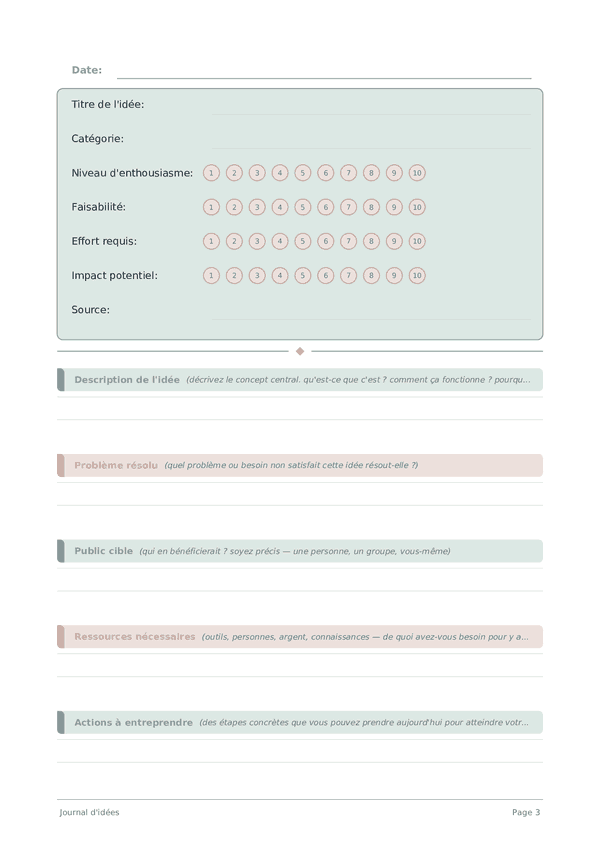
Journal d'idées
Capturez, évaluez et développez vos meilleures idées
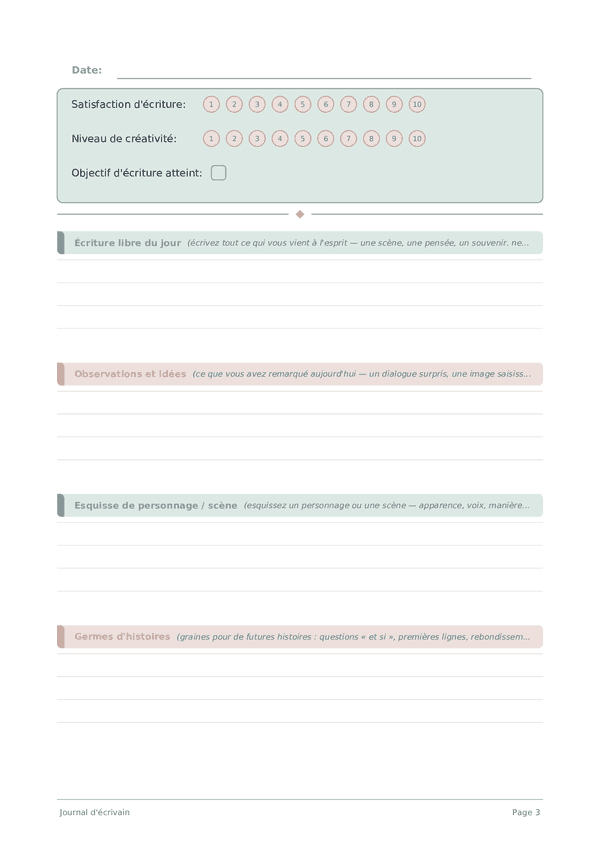
Journal d'écrivain
Pratique quotidienne d'écriture créative et développement du style
Journal de croquis
Pages à grille de points ouvertes pour le croquis, le dessin et l'exploration visuelle

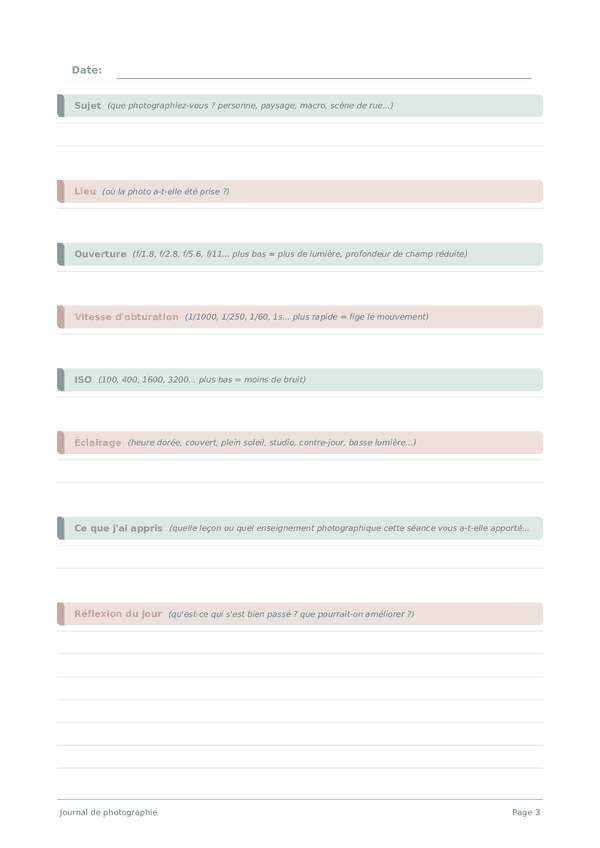
Journal de photographie
Notez vos prises de vue, réglages et réflexions créatives après chaque séance
Molette pour zoomer, glisser pour déplacer