Printable Journal d'écrivain
Pratique quotidienne d'écriture créative et développement du style
A structured daily journal for writers of all levels. Each page combines quick satisfaction and creativity trackers with generous writing space for freewriting, character sketches, story seeds, and craft reflection. Whether you write fiction, poetry, memoir, or essays — this journal builds the daily habit that transforms aspiring writers into practicing ones.
Personnaliser les champs
Activez ou désactivez les champs. Cliquez sur le crayon pour renommer, ou ajoutez vos propres champs.
Avantages
Comment utiliser
Qu'est-ce que ce journal ?
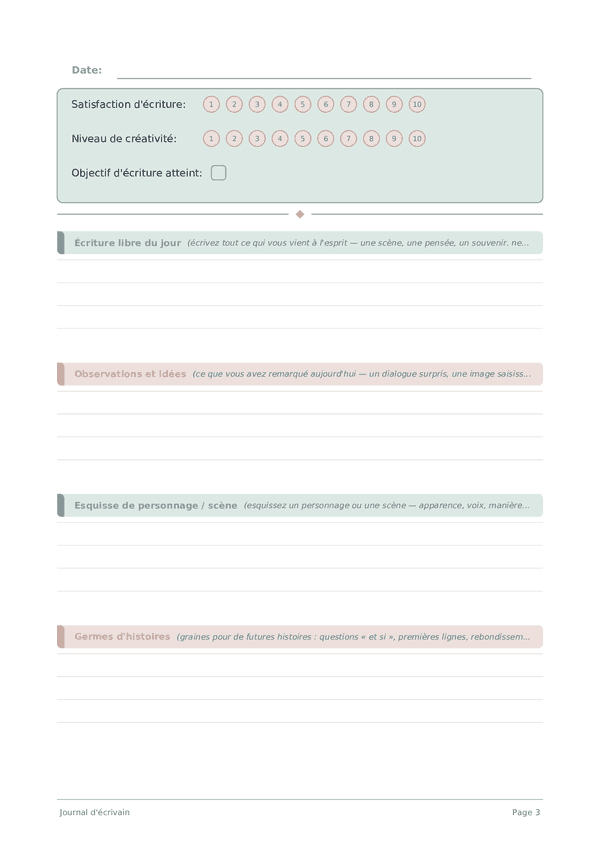
A Writer's Journal is a hybrid tool that pairs daily writing metrics with creative reflection. The top section tracks your writing satisfaction, creativity level, and whether you met your writing goal. The bottom section provides generous space for freewriting, capturing observations and ideas, sketching characters or scenes, planting story seeds, and reflecting on your writing practice. It is both a log and a creative incubator.
Every published author will tell you that consistency matters more than inspiration. This journal supports that consistency by making your writing practice visible and measurable. The tracker section takes the guesswork out of progress — you can see at a glance whether your satisfaction and creativity are trending up or down over weeks. The writing sections keep your creative muscles engaged even on days when the main project feels stuck.
Use the freewrite section first thing each morning to warm up your writing brain. Do not edit, do not censor — just let words flow for ten minutes. Then fill in observations, character sketches, or story seeds throughout the day as they occur to you. At the end of the day, complete the tracker and write a brief reflection on what worked and what did not. Over months, this journal becomes a goldmine of raw material for your larger projects.
Exemple rempli
Voici à quoi ressemble une entrée typique une fois remplie :
Comment remplir chaque champ
Le haut de chaque page comporte des champs à remplissage rapide (évaluations, cases à cocher, chiffres). En dessous se trouve une section lignée pour écrire. Voici ce que signifie chaque champ :
Satisfaction d'écriture
Êtes-vous satisfait de votre écriture aujourd'hui ? 1 = frustré, 10 = profondément épanoui
Niveau de créativité
À quel point vous êtes-vous senti créatif aujourd'hui ? 1 = complètement bloqué, 10 = les idées fusent
Objectif d'écriture atteint
Avez-vous atteint votre objectif d'écriture aujourd'hui — nombre de mots, temps ou pages ? Oui, non ou partiellement
Écriture libre du jour
Écrivez tout ce qui vous vient à l'esprit — une scène, une pensée, un souvenir. Ne corrigez pas, laissez les mots couler
Observations et idées
Ce que vous avez remarqué aujourd'hui — un dialogue surpris, une image saisissante, une idée de récit
Esquisse de personnage / scène
Esquissez un personnage ou une scène — apparence, voix, manières, détails du décor
Germes d'histoires
Graines pour de futures histoires : questions « et si », premières lignes, rebondissements inattendus
Réflexion sur l'écriture
Qu'avez-vous appris sur votre écriture aujourd'hui ? Qu'est-ce qui a fonctionné, où vous êtes-vous retrouvé bloqué ?
Conseils pour réussir
Quand et à quelle fréquence écrire
Write daily, ideally at the same time to build a routine. Morning pages work best for clearing mental clutter; evening sessions suit reflective and narrative writing. Aim for a minimum of 15-20 minutes or 300 words — enough to warm up and produce something real. Weekly, reread the week’s entries and highlight any phrases, ideas, or scenes worth developing. Monthly, review your word count trends and satisfaction ratings to see if your practice is growing or stagnating, and adjust your routine accordingly.
Questions fréquentes
Qu'est-ce que le Journal de l'écrivain et à qui s'adresse-t-il ?
C'est un journal quotidien pour les écrivains de tous niveaux — fiction, poésie, mémoires, essais. Chaque page combine un court tracker (satisfaction d'écriture, niveau de créativité, case à cocher d'objectif) avec dix lignes d'écriture libre pour les observations quotidiennes, les esquisses de personnages ou de scènes, les germes d'histoires et la réflexion sur le métier. L'objectif est de construire la pratique régulière qu'Anne Lamott (1994, Bird by Bird, Anchor) et Stephen King (2000, On Writing, Scribner) décrivent tous deux comme le vrai travail de l'écriture.
Combien de temps écrire librement sur chaque page ?
Quinze à vingt minutes est la pratique standard — assez longtemps pour dépasser les pensées superficielles. Les protocoles d'écriture expressive de Pennebaker (utilisés dans des dizaines d'études publiées sur l'écriture et le bien-être) utilisent systématiquement des séances de 15 à 20 minutes. Écris sans t'arrêter ni corriger ; si tu bloques, répète ta dernière phrase. Les dix lignes offrent approximativement ce volume à la main.
Comment utiliser efficacement les notes de satisfaction et de créativité ?
Note immédiatement après l'écriture, pas avant. Sur plusieurs semaines, les deux scores révèlent quand tu travailles le mieux — heure de la journée, niveau de sommeil, après l'exercice, avant les e-mails. Csikszentmihalyi (1990, Flow, Harper) a souligné que les créateurs ne sont pas en flux constant ; le suivi expose les conditions qui le produisent. La case à cocher d'objectif sépare l'effort de la production : atteindre un objectif quotidien importe plus que se sentir brillant.
La pratique quotidienne améliore-t-elle vraiment le métier ?
Oui — les principes de pratique délibérée d'Ericsson, Krampe et Tesch-Römer (1993, Psychological Review, 100(3), 363-406) s'appliquent à l'écriture lorsque les séances incluent des objectifs spécifiques et une réflexion. Le Journal de l'écrivain construit cette boucle : un objectif clair en haut, une pratique ciblée dans l'écriture libre, et une réflexion sur le métier en bas. Le livre Peak d'Ericsson (2016, Houghton Mifflin Harcourt) étend ces principes aux domaines créatifs.
Que mettre dans la section esquisse de personnage ou de scène ?
Un court paragraphe — détail physique, voix, geste, une action révélatrice. Lamott (1994, Bird by Bird, Anchor) appelle ces exercices des « courtes missions » et soutient que les livres s'écrivent exactement ainsi : pas en arcs narratifs, mais en petits morceaux concrets. Utilise des détails sensoriels plutôt que des abstractions. L'esquisse de deux lignes d'aujourd'hui peut devenir le chapitre de demain, mais son premier rôle est d'entraîner ton œil aux détails.
En quoi est-ce différent des morning pages ou des applis de journal ?
Les morning pages (trois pages de flux de conscience) libèrent l'encombrement mental ; ce journal est dédié au métier. Le tracker impose la mesure, les questions supplémentaires (germes d'histoires, esquisse de personnage) forcent une production générative, et la ligne de réflexion développe la métacognition sur ta propre écriture. Les applis manquent de la résistance qui, selon Zinsser (2006, On Writing Well, Harper Perennial), force une pensée plus claire — l'écriture lente à la main produit souvent une prose plus précise.
Que faire quand on a le blocage de l'écrivain ?
Utilise les questions dans l'ordre : observations du jour, une phrase entendue, un détail sensoriel, un geste d'un personnage. Le blocage signifie généralement qu'on essaie d'écrire la mauvaise chose — Lamott (1994, Bird by Bird, Anchor) recommande l'approche du « cadre d'un pouce » : n'écris que ce qui tient dans une toute petite scène. La section d'écriture libre est conçue exactement pour cela — génération à faible enjeu, pas de prose achevée.
Combien de temps avant de voir une vraie amélioration ?
Espère un changement notable en 8 à 12 semaines de pratique régulière et une croissance mesurable du métier en 6 à 12 mois. La recherche d'Ericsson et al. (1993, Psychological Review, 100(3)) montre que la pratique ciblée et réflexive — pas les heures brutes — produit des gains. Vingt minutes par jour avec le tracker de satisfaction et les questions de réflexion est plus efficace que deux heures non ciblées par semaine. Révise les entrées mensuellement pour confirmer le progrès.
Vous aimerez aussi
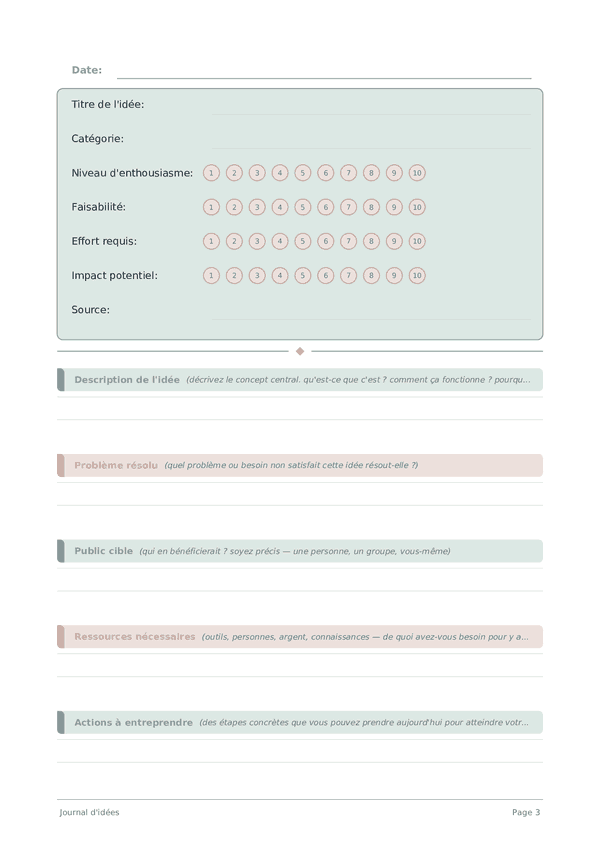
Journal d'idées
Capturez, évaluez et développez vos meilleures idées
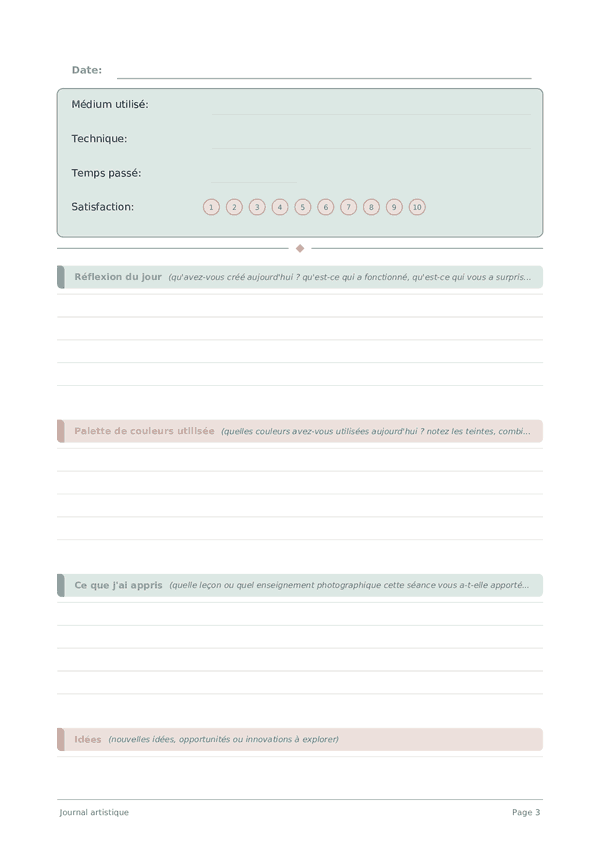
Journal artistique
Documentez votre processus créatif et votre évolution artistique
Journal de croquis
Pages à grille de points ouvertes pour le croquis, le dessin et l'exploration visuelle
Journal de photographie
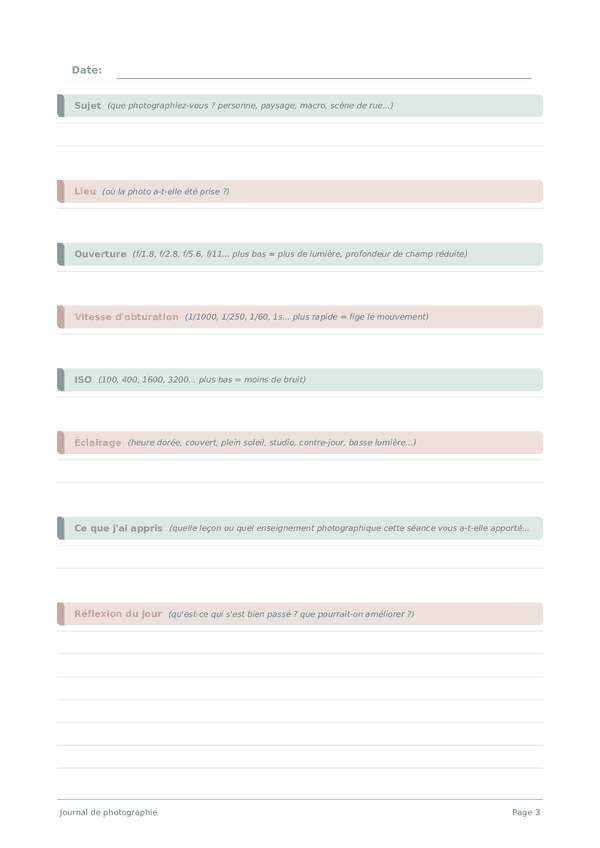
Notez vos prises de vue, réglages et réflexions créatives après chaque séance
Molette pour zoomer, glisser pour déplacer