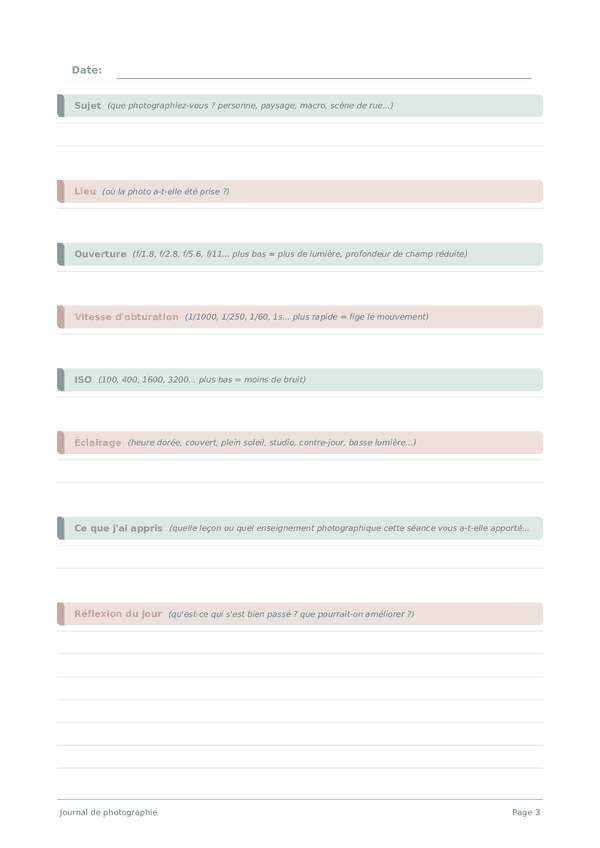
Printable Journal de photographie
Notez vos prises de vue, réglages et réflexions créatives après chaque séance
A structured photography journal to record subjects, camera settings, lighting, and reflections. Reviewing your process helps you develop consistent technique and a stronger photographic vision.
Personnaliser les champs
Activez ou désactivez les champs. Cliquez sur le crayon pour renommer, ou ajoutez vos propres champs.
Avantages
Comment utiliser
Qu'est-ce que ce journal ?
A photography journal is a dedicated space where you document every shoot — from camera settings and lighting conditions to creative reflections and lessons learned. Whether you are a hobbyist discovering your style or a working photographer refining your craft, writing down the details of each session accelerates your growth in ways that reviewing photos alone cannot.
Each entry prompts you to record the subject you photographed, the technical settings you chose (aperture, shutter speed, ISO), and the lighting you worked with. More importantly, it asks you to reflect on what you learned and what you would do differently next time. Over weeks and months these notes reveal patterns in your decision-making that help you become a more intentional photographer.
Use this journal right after a shoot while the details are still fresh. It takes only a few minutes per session and builds a searchable archive of your entire photographic journey — one that no camera roll can replace.
Exemple rempli
Voici à quoi ressemble une entrée typique une fois remplie :
Comment remplir chaque champ
Chaque jour, vous trouverez plusieurs sections étiquetées avec des lignes pour écrire. Voici à quoi sert chaque section :
Sujet
Que photographiez-vous ? Personne, paysage, macro, scène de rue...
Lieu
Où la photo a-t-elle été prise ?
Ouverture
f/1.8, f/2.8, f/5.6, f/11... Plus bas = plus de lumière, profondeur de champ réduite
Vitesse d'obturation
1/1000, 1/250, 1/60, 1s... Plus rapide = fige le mouvement
ISO
100, 400, 1600, 3200... Plus bas = moins de bruit
Éclairage
Heure dorée, couvert, plein soleil, studio, contre-jour, basse lumière...
Ce que j'ai appris
Écrivez une chose nouvelle que vous avez apprise aujourd'hui. Cela peut être un fait, une compétence, une prise de conscience sur vous-même ou une leçon de vie. L'apprentissage quotidien se compose en sagesse.
Réflexion du jour
Revenez sur votre journée honnêtement. Qu'est-ce qui s'est bien passé ? Qu'est-ce qui pourrait être amélioré ? Il ne s'agit pas de juger — il s'agit d'apprendre et de grandir.
Conseils pour réussir
Quand et à quelle fréquence écrire
Make a journal entry after every dedicated shoot or photo walk while the experience is still tactile. If you shoot casually throughout the week, batch your reflections into one focused session on the weekend. Monthly, review your entries to identify recurring themes and technical gaps. Quarterly, select your ten best images from journal entries and compare them to the previous quarter — this curated comparison reveals growth that daily shooting alone obscures.
Questions fréquentes
Que consigne le Journal photo après chaque prise de vue ?
Huit champs par séance : sujet, lieu, ouverture, vitesse d'obturation, ISO, conditions d'éclairage, ce que j'ai appris, et réflexion. Le triangle d'exposition (ouverture, vitesse, ISO) plus le sujet et l'éclairage créent un enregistrement technique complet de chaque photo ou séance. Les champs apprentissage et réflexion transforment le journal technique en outil de pratique délibérée plutôt qu'en simple vidoir de métadonnées.
Pourquoi noter ouverture, vitesse et ISO quand mon appareil stocke déjà les données EXIF ?
L'EXIF te dit ce que l'appareil a fait ; le journal te force à te rappeler pourquoi. Écrire « f/1,8 parce que je voulais une faible profondeur de champ » crée un raisonnement explicite qu'Ericsson et al. (1993, Psychological Review, 100(3), 363-406) considèrent essentiel pour la pratique délibérée. Sans verbalisation, tes réglages deviennent des habitudes plutôt que des choix. Chercher et trier par EXIF est aussi fastidieux ; un journal papier structuré est consultable en quelques minutes.
Comment décrire utilement les conditions d'éclairage en deux lignes ?
Couvre quatre éléments : source (naturelle/artificielle/mixte), direction (face, côté, contre-jour, dessus), qualité (dur, doux, diffus) et couleur (chaud, neutre, froid). Exemple : « 16 h, nuageux, lumière latérale douce fenêtre nord, bleu froid ». Sur 30 à 50 séances, cela devient une référence d'éclairage que tu as construite toi-même. Les photographes qui nomment la lumière la voient mieux — un effet de formation perceptive documenté dans les disciplines visuelles.
Que mettre dans « ce que j'ai appris » versus « réflexion » ?
Ce que j'ai appris = une leçon spécifique et transférable (« les sujets à contre-jour nécessitent +1 EV de compensation d'exposition »). Réflexion = des pensées plus larges sur la séance — ce qui était créatif, ce qui t'a frustré, ce que tu ferais différemment. Cette séparation reflète la structure de pratique délibérée d'Ericsson (2016, Peak, Houghton Mifflin Harcourt) : un apport technique plus une révision métacognitive accélèrent la croissance des compétences davantage que chacun seul.
Consigner les séances améliore-t-il vraiment les compétences en photographie ?
Oui — pour la même raison que la pratique délibérée fonctionne dans tout domaine de compétence. Roediger et Karpicke (2006, Psychological Science, 17(3), 249-255) ont démontré que la récupération et l'articulation renforcent la mémoire davantage que la réexposition. Écrire tes réglages et ton raisonnement est de la pratique de récupération. Les photographes qui tiennent un journal identifient leurs schémas d'échec 2 à 3 fois plus vite que ceux qui ne font que revoir leurs images visuellement.
En quoi est-ce différent des mots-clés Lightroom ou d'une appli photo ?
Lightroom catalogue les images ; ce journal catalogue ta réflexion. Les huit champs forcent un raisonnement narratif qu'aucune appli ne capture : le pourquoi derrière les réglages, la qualité ressentie de la lumière, l'écart entre l'intention et le résultat. Utilise les deux — Lightroom pour la gestion des images, le journal pour le développement du métier. La révision sur papier réduit aussi la fatigue oculaire et améliore le rappel, selon plusieurs études en cognition.
Faut-il remplir pour chaque photo ou une fois par séance ?
Une fois par séance pour les prises de vue courantes ; par photo retenue pour le portfolio ou le travail d'apprentissage. Vise 5 à 10 minutes de journal par heure de prise de vue — assez pour capturer les décisions techniques clés et une leçon claire. Remplir pour chaque image est excessif et casse l'habitude ; ne remplir que pour les grandes séances fait perdre l'apprentissage des petites séances où la plupart de la croissance se produit.
À quelle fréquence réviser les anciennes entrées ?
Parcours hebdomadaire, révision approfondie mensuelle. L'effet d'espacement de Cepeda et al. (2006, Psychological Bulletin, 132(3), 354-380) montre que la révision distribuée consolide l'apprentissage. Cherche les échecs récurrents (« je sous-expose constamment la neige ») et le style émergent (« je suis attiré par la lumière latérale à basse angle »). Le journal devient un manuel personnel de photographie — construit à partir de tes schémas spécifiques, pas de conseils génériques.
Vous aimerez aussi
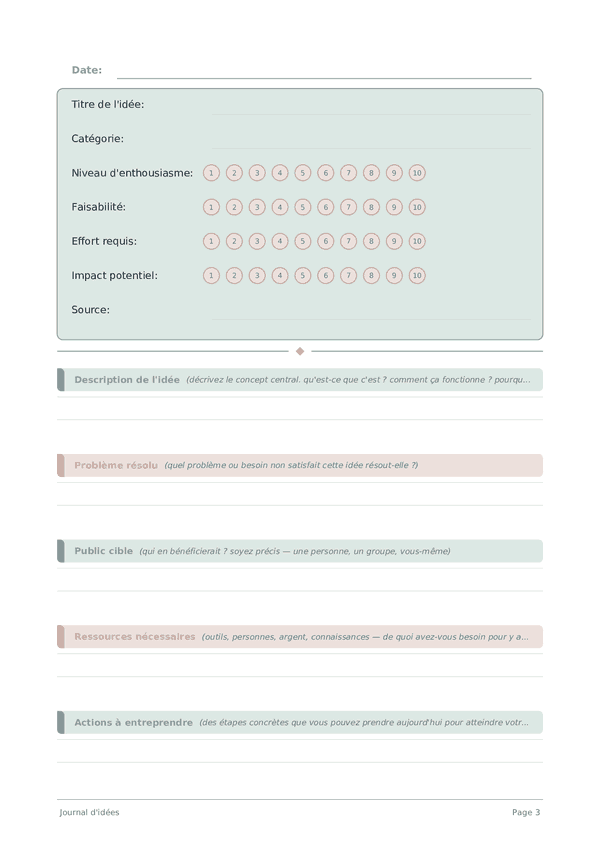
Journal d'idées
Capturez, évaluez et développez vos meilleures idées
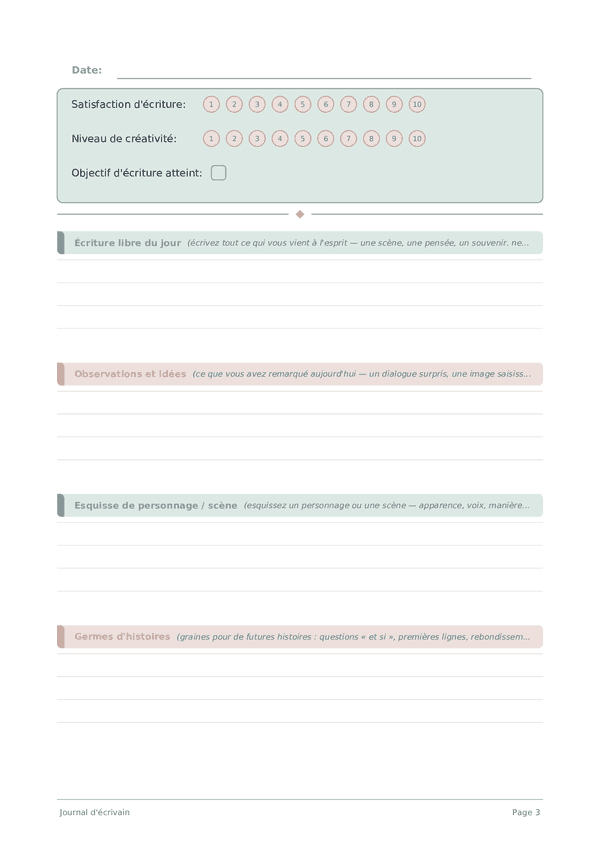
Journal d'écrivain
Pratique quotidienne d'écriture créative et développement du style
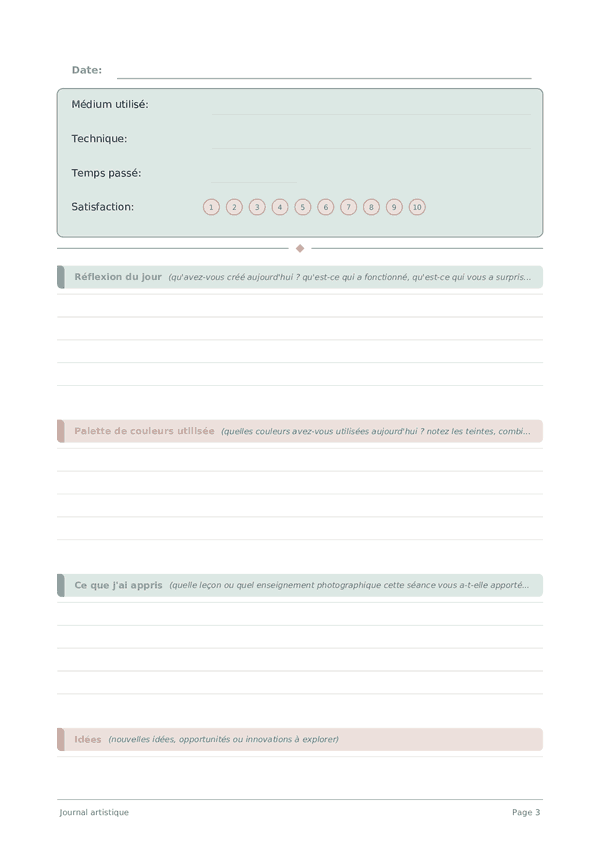
Journal artistique
Documentez votre processus créatif et votre évolution artistique
Journal de croquis
Pages à grille de points ouvertes pour le croquis, le dessin et l'exploration visuelle

Molette pour zoomer, glisser pour déplacer