Printable Journal de loisirs créatifs
Suivi de projets créatifs et journal de passe-temps
Document your craft projects with session logs, material notes, and technique observations. Track progress, capture what works, and build a creative reference library for all your handmade projects.
Personnaliser les champs
Activez ou désactivez les champs. Cliquez sur le crayon pour renommer, ou ajoutez vos propres champs.
Qu'est-ce que ce journal ?
A craft journal documents every making session — the materials you chose, the techniques you tried, and the discoveries that only come from working with your hands. Whether you knit, carve, sew, or build, the gap between what you planned and what actually happened is where learning lives. This journal captures that gap before it fades from memory.
The tracker section logs the project name, craft type, time spent, and a satisfaction rating so you can spot trends in productivity and enjoyment at a glance. The writing section records your progress, materials used, technique notes, and ideas for what to adjust next time. Together these create a maker's logbook that grows more valuable with every entry.
Fill in the tracker during or right after your session and take a few minutes to write about what you noticed. These notes compound: months from now, when you start a similar project, you will have a detailed record of what worked, what to avoid, and exactly which materials and settings produced the results you loved.
Exemple rempli
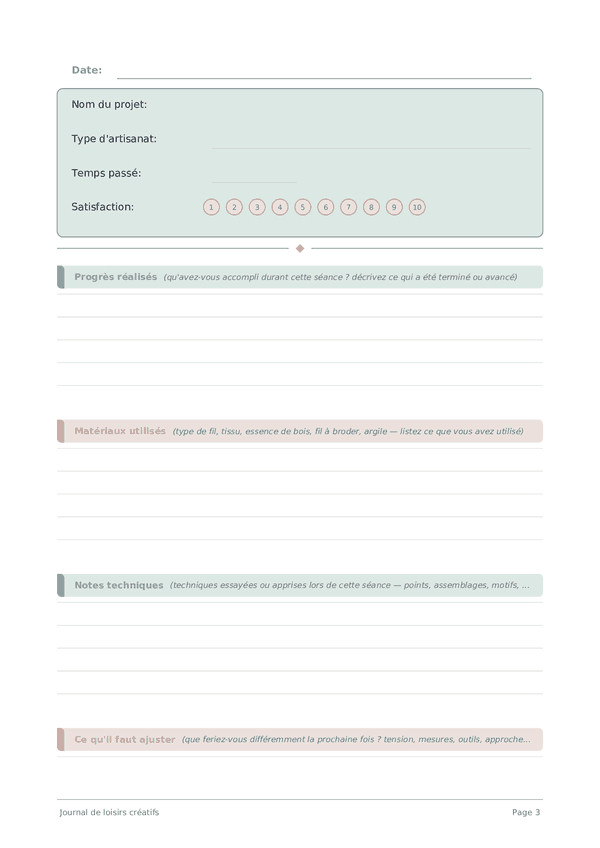
Voici à quoi ressemble une entrée typique une fois remplie :
Comment remplir chaque champ
Le haut de chaque page comporte des champs à remplissage rapide (évaluations, cases à cocher, chiffres). En dessous se trouve une section lignée pour écrire. Voici ce que signifie chaque champ :
Nom du projet
Sur quel projet travaillez-vous aujourd'hui ?
Type d'artisanat
ex. Tricot, Couture, Menuiserie, Broderie, Crochet, Poterie...
Temps passé
Combien de temps avez-vous étudié ?
Satisfaction
Êtes-vous satisfait(e) de la séance d'aujourd'hui ? (1=frustré, 5=très satisfait)
Progrès réalisés
Qu'avez-vous accompli durant cette séance ? Décrivez ce qui a été terminé ou avancé
Matériaux utilisés
Type de fil, tissu, essence de bois, fil à broder, argile — listez ce que vous avez utilisé
Notes techniques
Techniques essayées ou apprises lors de cette séance — points, assemblages, motifs, méthodes spéciales
Ce qu'il faut ajuster
Que feriez-vous différemment la prochaine fois ? Tension, mesures, outils, approche...
Conseils pour réussir
Quand et à quelle fréquence écrire
Make entries during and after each crafting session while details are fresh. For multi-session projects, write brief notes at the end of each session and a fuller reflection when the project is complete. Aim for at least two entries per week to maintain skill momentum — crafts are motor skills that degrade without regular practice. Monthly, review your completed projects and identify one technique to deepen next month. Seasonal reviews are especially valuable for crafters: they help you plan around seasonal materials, holidays, and gift-giving occasions.
Questions fréquentes
Que suit le Journal d'artisanat par séance ?
Un tracker à 4 champs — nom projet, type artisanat, temps passé, satisfaction (0 à 10) — plus 5 lignes pour progrès réalisé avec des questions pour matériaux utilisés, notes technique et ce_à_ajuster. La structure supporte le tricot, la couture, la broderie, la poterie, la menuiserie, la bijouterie, l'artisanat en papier et toute pratique manuelle. Il transforme des séances dispersées en un registre de projet cohérent.
Pourquoi le champ type artisanat est-il utile si je ne pratique qu'un seul type ?
Il prépare le journal à l'expansion des intérêts. Beaucoup de créateurs se diversifient avec le temps — une tricoteuse se met à la broderie, un menuisier essaie le cuir. Le champ type artisanat permet à un seul journal de supporter plusieurs artisanats sans perdre de valeur analytique. Filtrer par type révèle plus tard la distribution du temps, les schémas de satisfaction et quels artisanats produisent un engagement soutenu par rapport à une curiosité passagère.
Comment rendre les entrées matériaux utilisés utiles plusieurs mois plus tard ?
Poids de laine spécifique et numéro de lot, largeur et fibre du tissu, essence de bois, codes d'émail, types de fils. Les entrées génériques (« laine bleue ») échouent au moment où tu en as le plus besoin — quand tu n'en as plus et que tu dois en trouver pour le deuxième manchon. Les entrées spécifiques (« poids DK, Cascade 220, couleur 9477, lot 1224 ») te permettent de recommander ou de substituer en connaissance de cause. C'est la pratique professionnelle d'atelier adaptée à l'artisanat domestique.
Que mettre dans notes technique versus ce_à_ajuster ?
Notes technique enregistre ce que tu as fait — « maille kitchener sur le bout du pied », « coupe en onglet à 22,5° ». Ce_à_ajuster enregistre ce qu'il faut changer la prochaine fois — « commencer le gousset 2 rangs plus tôt », « poncer le bois avant de teindre, pas après ». La séparation distingue la documentation de l'apprentissage. Sans ce_à_ajuster, les projets répétés répètent les mêmes petites erreurs ; avec lui, chaque pièce s'améliore sur la précédente.
Tenir un journal aide-t-il vraiment à développer les compétences artisanales ?
Oui — par la même boucle de pratique délibérée qu'Ericsson (2016, Peak, Houghton Mifflin Harcourt) décrit pour tout domaine de compétence : attention ciblée sur des techniques spécifiques avec retour d'information. Les champs notes technique et ce_à_ajuster sont la boucle de rétroaction ; la note de satisfaction fournit le signal. Les artisans qui tiennent un journal terminent des projets plus ambitieux plus rapidement parce qu'ils ne résolvent pas les mêmes problèmes à chaque fois.
En quoi est-ce différent de Ravelry ou d'une appli de suivi de projets ?
Ravelry est spécifique à l'artisanat (tricot/crochet) et optimisé pour le partage de modèles. Les applis de suivi se concentrent sur le statut d'achèvement. Ce journal capture la connaissance du processus — les matériaux que tu as réellement utilisés, les adaptations de technique, les petits ajustements. Utilise Ravelry pour les modèles et la communauté ; ce journal pour ton registre privé de comment tu as vraiment fait chaque pièce. Les deux ont un rôle pour les créateurs sérieux.
Faut-il tenir un journal à chaque séance ou seulement en finissant un projet ?
À chaque séance pour les projets de plus de quelques heures. Les artisanats multi-séances (pulls, courtepointes, meubles) accumulent de petites décisions qui déterminent le résultat final. La consignation uniquement en fin de projet perd 80 % des données utiles. Pour les projets courts (une carte, une petite réparation), une seule entrée à la fin suffit. Le champ temps passé s'agrège de toute façon, rendant l'effort total du projet visible à travers les séances.
Comment réviser les anciennes entrées utilement ?
La révision projet par projet à la fin révèle les gains de technique. La révision inter-projets tous les 3 à 6 mois révèle les schémas — les artisanats auxquels tu reviens, les heures qui supportent la meilleure satisfaction, les matériaux qui reviennent dans les projets bien notés. Cepeda et al. (2006, Psychological Bulletin, 132(3), 354-380) documentent que la révision distribuée consolide l'apprentissage — ici cela signifie transformer des séances dispersées en savoir artisanal transférable.
Vous aimerez aussi
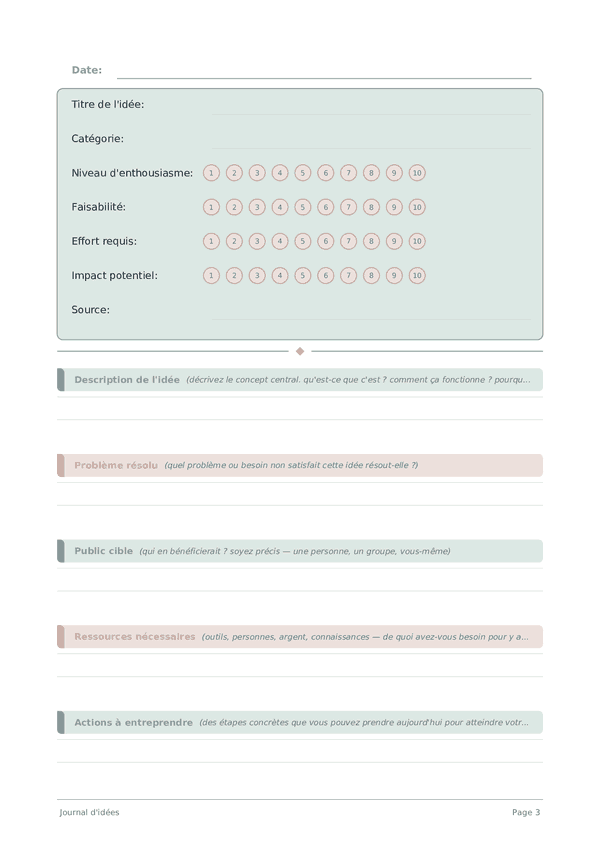
Journal d'idées
Capturez, évaluez et développez vos meilleures idées
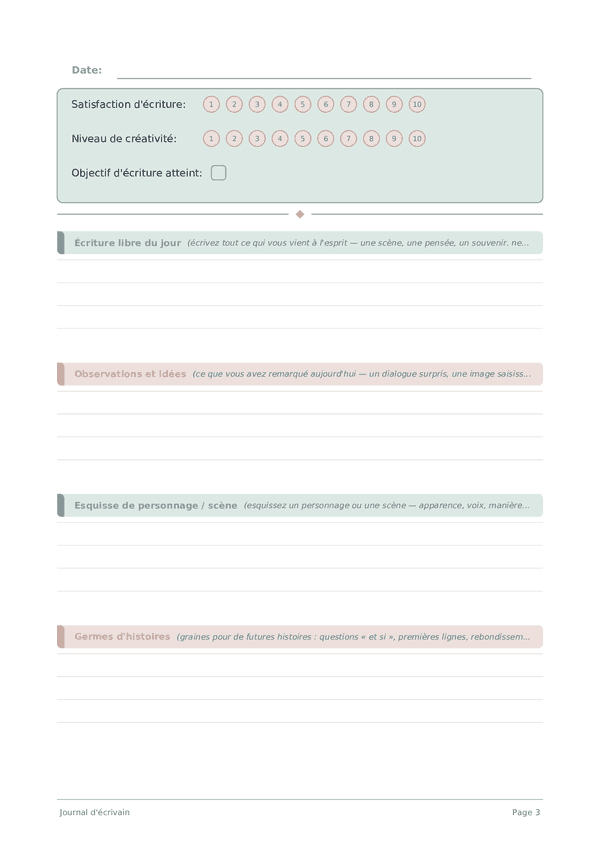
Journal d'écrivain
Pratique quotidienne d'écriture créative et développement du style
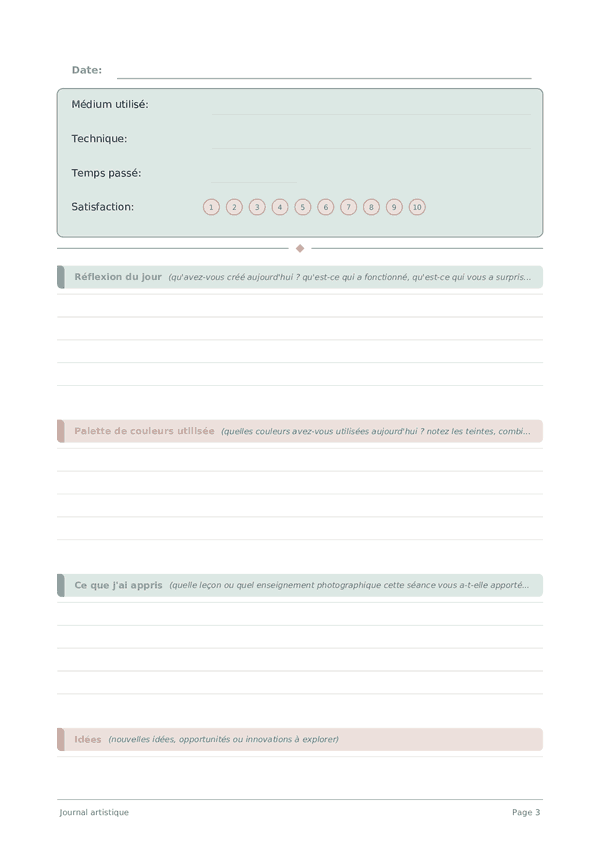
Journal artistique
Documentez votre processus créatif et votre évolution artistique
Journal de croquis
Pages à grille de points ouvertes pour le croquis, le dessin et l'exploration visuelle
Molette pour zoomer, glisser pour déplacer