Printable Journal de jeûne
Suivi du jeûne intermittent et carnet d'énergie
Track your fasting practice with detailed logs of fasting windows, energy levels, mental clarity, and hunger patterns. Build an evidence base for what protocols work best for your body and goals.
Personnaliser les champs
Activez ou désactivez les champs. Cliquez sur le crayon pour renommer, ou ajoutez vos propres champs.
Qu'est-ce que ce journal ?
A fasting journal is a daily companion for anyone practicing intermittent fasting, extended fasts, or any time-restricted eating protocol. The tracker section captures the essential metrics — your fasting protocol, start and end times, total hours fasted, energy, mental clarity, and hunger levels — while the writing section provides space to reflect on how you felt, what you ate to break your fast, and what insights emerged.
Fasting affects every person differently, and what works as a sustainable protocol for one individual may be unsustainable for another. By tracking your experience consistently, you discover your optimal fasting window, learn which factors make fasting easier or harder, and build the self-awareness needed to adjust your approach. Many people find that journaling during their fast helps manage hunger by redirecting attention from food cravings to personal reflection.
Whether you are fasting for weight management, metabolic health, mental clarity, or longevity, this journal helps you go beyond simply watching the clock. It transforms fasting from a willpower exercise into a mindful practice grounded in data and self-knowledge, making it easier to sustain long-term and adapt as your body and goals evolve.
Exemple rempli
Voici à quoi ressemble une entrée typique une fois remplie :
Comment remplir chaque champ
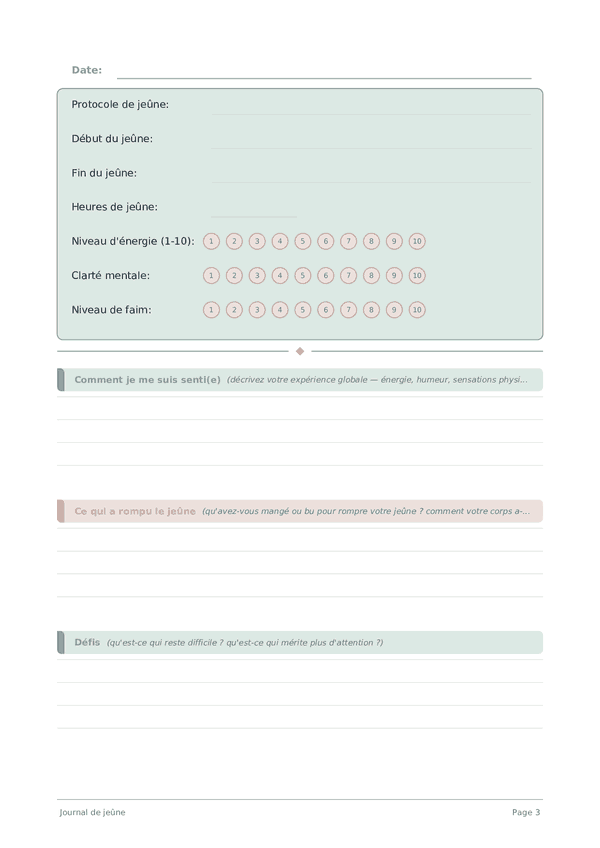
Le haut de chaque page comporte des champs à remplissage rapide (évaluations, cases à cocher, chiffres). En dessous se trouve une section lignée pour écrire. Voici ce que signifie chaque champ :
Protocole de jeûne
ex. 16:8, 18:6, 20:4, 24h, OMAD, 5:2 — quelle méthode de jeûne avez-vous suivie aujourd'hui ?
Début du jeûne
À quelle heure votre jeûne a-t-il commencé ? (ex. 20h00)
Fin du jeûne
À quelle heure avez-vous rompu le jeûne ? (ex. 12h00)
Heures de jeûne
Enregistrez le nombre d'heures de jeûne. Le suivi en parallèle de l'énergie et de l'humeur vous aide à trouver votre fenêtre de jeûne optimale.
Niveau d'énergie (1-10)
Évaluez votre niveau d'énergie physique et mentale. 1 signifie épuisé et vidé, 10 signifie plein d'énergie et alerte. Cela vous aide à identifier quelles activités stimulent ou drainent votre énergie.
Clarté mentale
À quel point votre esprit était-il vif et concentré ? 1=brumeux et dispersé, 5=parfaitement clair
Niveau de faim
Quel était votre niveau de faim global aujourd'hui ? 1 = pas du tout faim, 10 = affamé
Comment je me suis senti(e)
Décrivez votre expérience globale — énergie, humeur, sensations physiques pendant le jeûne
Ce qui a rompu le jeûne
Qu'avez-vous mangé ou bu pour rompre votre jeûne ? Comment votre corps a-t-il réagi ?
Défis
Qu'est-ce qui reste difficile ? Qu'est-ce qui mérite plus d'attention ?
Réflexions
Des prises de conscience, de la clarté ou des moments de calme à retenir ?
Conseils pour réussir
Quand et à quelle fréquence écrire
Log every fasting day in real time — mark the start when you begin and the end when you break the fast, not from memory later. On rest or non-fasting days, still make a short entry noting how you feel; this creates contrast data that proves whether fasting is actually helping. Review your entries weekly to adjust your protocol. Monthly, compare average energy, hunger curves, and weight trends across different fasting windows to find your optimal schedule.
Questions fréquentes
Que disent les preuves sur les bienfaits du jeûne intermittent ?
Une revue du NEJM résume que le jeûne intermittent peut améliorer les marqueurs métaboliques, la tension artérielle et la sensibilité à l'insuline. Le NIH note que les preuves sont les plus consistantes pour les protocoles 16:8 et 5:2 chez les adultes en bonne santé. Des études JAMA ont trouvé une perte de poids similaire à la restriction calorique. Les effets sont individuels — suivez vos heures de jeûne, énergie et clarté mentale pour construire des preuves personnelles. Consultez votre médecin avant de commencer, surtout en cas de maladies chroniques.
Quel protocole de jeûne enregistrer ?
Protocoles courants : 16:8 (16 heures de jeûne, 8 heures de repas — le plus populaire), 18:6 ou 20:4 (jeûnes quotidiens étendus), 5:2 (5 jours normaux + 2 jours à ~500–600 kcal), jeûnes de 24 heures 1 à 2 fois par semaine, jeûne alterné. Documentez dans le champ protocole de jeûne. Comparez les évaluations d'énergie et de clarté mentale entre protocoles sur 4 à 8 semaines pour trouver ce qui convient à votre physiologie et mode de vie.
Comment suivre l'adaptation au jeûne au fil du temps ?
L'adaptation métabolique prend généralement 2 à 4 semaines. L'évaluation niveau de faim chute substantiellement après 2 semaines pour la plupart ; clarté mentale s'améliore souvent aux semaines 3 à 4. Le prompt challenges capture les difficultés initiales (irritabilité, maux de tête, fatigue) qui se résolvent généralement. Des symptômes sévères persistants au-delà de 4 semaines justifient une réévaluation avec votre médecin — le JI ne convient pas à tout le monde.
Qui ne devrait pas pratiquer le jeûne intermittent ?
Contre-indications : diabète de type 1 (risque d'hypoglycémie), grossesse/allaitement, antécédents de troubles du comportement alimentaire, insuffisance pondérale (IMC < 18,5), adolescents et enfants, certains médicaments (insuline, sulfonylurées). Les patients diabétiques sous médicaments ont besoin d'une surveillance médicale pour ajuster les doses. L'APA déconseille fortement le JI pour toute personne souffrant d'anorexie, de boulimie ou d'hyperphagie boulimique.
Que peut-on consommer pendant la fenêtre de jeûne ?
Eau pure, café noir, thé nature, tisanes — ceux-ci ne déclenchent pas de réponse insulinique significative et préservent l'état de jeûne. Tout avec des calories (crème, sucre, lait, jus) rompt le jeûne. Le prompt ce qui a rompu le jeûne suit quand vous avez mangé, ce qui importe plus que la pureté rigide. L'hydratation pendant les jeûnes est critique — la déshydratation imite les symptômes de fatigue du jeûne.
Comment savoir si le jeûne fonctionne pour vous ?
Suivez 4+ semaines de données cohérentes. Les marqueurs objectifs incluent : poids, tour de taille, glycémie à jeun, tension artérielle. Les marqueurs subjectifs dans ce journal : les évaluations d'énergie se stabilisent ou s'améliorent, clarté mentale augmente, niveau de faim baisse par rapport au niveau de base. Si les marqueurs s'aggravent ou restent mauvais sur 6 à 8 semaines, le protocole peut ne pas convenir à votre physiologie — essayez une approche différente ou consultez un diététicien.
En quoi le jeûne intermittent diffère-t-il de la restriction calorique ?
Le JI restreint quand vous mangez ; la restriction calorique restreint combien. Les deux peuvent produire une perte de poids ; le JI peut produire des effets métaboliques supplémentaires via des processus cellulaires induits par le jeûne (autophagie, cétose), bien que les preuves chez l'humain soient préliminaires. Le champ heures de jeûne suit la dimension temporelle ; envisagez aussi de suivre les calories de la fenêtre alimentaire dans les notes pour comparaison directe.
Quand devrais-je arrêter le jeûne et consulter un médecin ?
Signaux d'alarme : vertiges persistants, évanouissements, faiblesse sévère, arythmie cardiaque, troubles de l'humeur, perte de cheveux, absence de règles, ou aggravation de toute maladie chronique. Suivez-les dans le prompt challenges — des tendances indiquant un stress physiologique justifient l'arrêt immédiat et une évaluation médicale. Des pensées liées aux troubles du comportement alimentaire émergent lors du JI (envies de boulimie, préoccupation pour la nourriture, obsession de l'image corporelle) nécessitent une consultation avec un professionnel de santé mentale.
Vous aimerez aussi
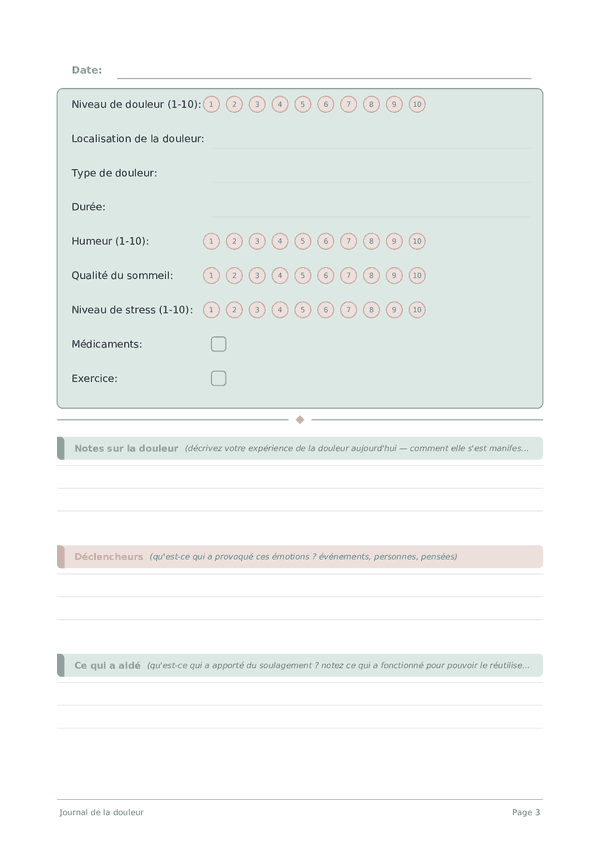
Journal de la douleur
Suivez les schémas de douleur, les déclencheurs et les stratégies de soulagement
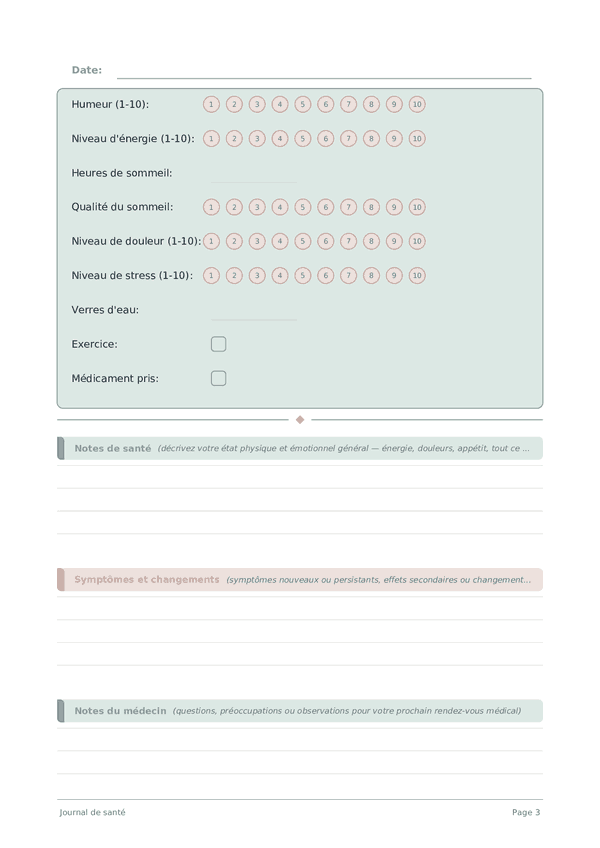
Journal de santé
Suivez votre corps, votre esprit et votre bien-être chaque jour
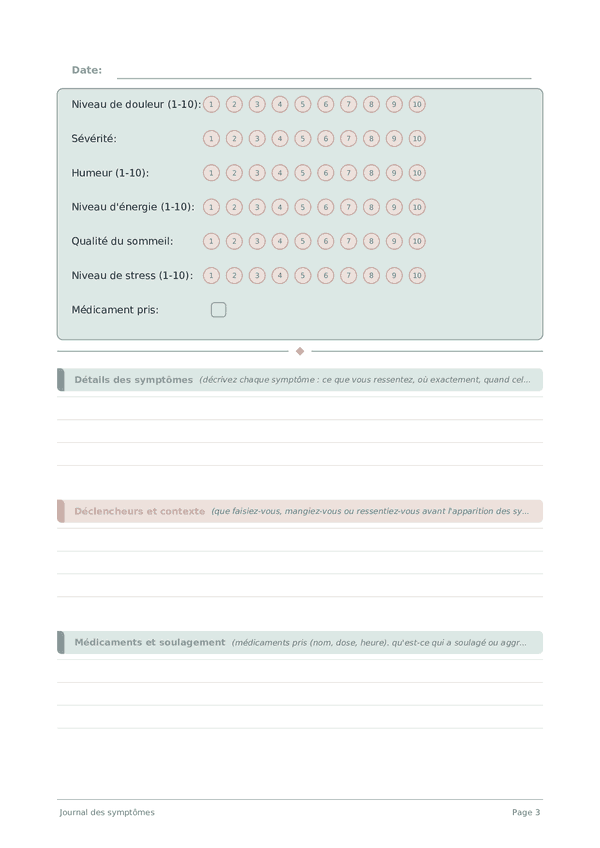
Journal des symptômes
Suivez vos symptômes, déclencheurs et traitements au quotidien
Journal des calories
Suivez les calories et les macros à chaque repas
Molette pour zoomer, glisser pour déplacer