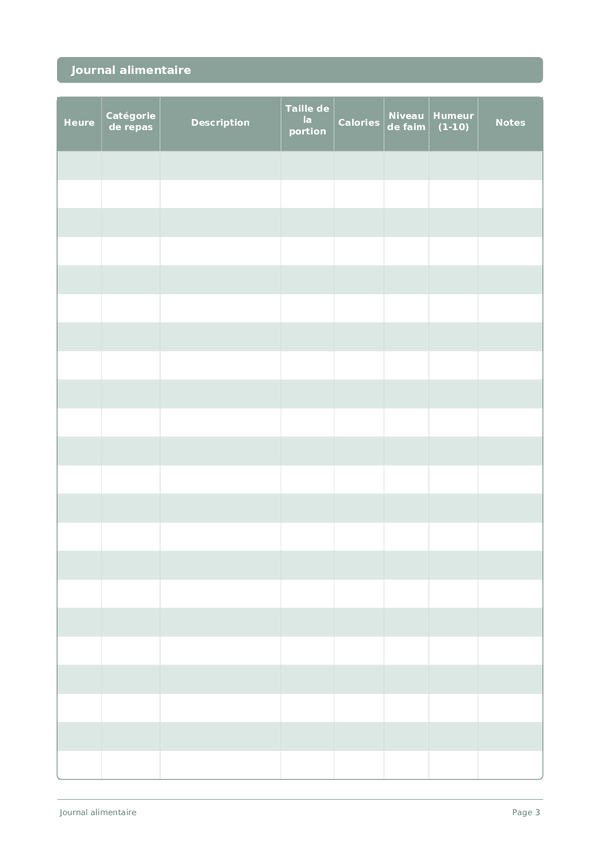
Printable Journal alimentaire
Suivez chaque repas avec pleine conscience et intention
A structured daily food log to record meals, portions, calories, hunger cues, and mood. Build awareness of your eating patterns, spot nutritional gaps, and make more intentional choices for better health.
Personnaliser les champs
Activez ou désactivez les champs. Cliquez sur le crayon pour renommer, ou ajoutez vos propres champs.
Avantages
Comment utiliser
Qu'est-ce que ce journal ?
A food journal is a daily log where you record everything you eat and drink, along with contextual details like meal timing, portion sizes, hunger levels, and how food makes you feel. It goes beyond simple calorie counting by helping you understand your relationship with food — the emotional, physical, and situational factors that shape your eating habits.
This journal is for anyone who wants to develop healthier eating patterns, manage food sensitivities or allergies, support a weight management goal, or simply become more mindful about what they consume. Nutritionists, dietitians, and doctors often recommend food journaling as one of the most effective tools for understanding and improving dietary habits.
Research consistently shows that people who keep food journals are more successful at reaching their nutrition goals. Writing down what you eat creates a natural pause for reflection — you become more aware of mindless snacking, emotional eating, and portion sizes. Over weeks and months, your journal reveals clear patterns: which foods give you energy, which leave you sluggish, and how your mood and hunger interact with your choices.
Exemple rempli
Voici à quoi ressemble une entrée typique une fois remplie :
| Heure | Catégorie de repas | Description | Taille de la portion | Calories | Niveau de faim | Humeur (1-10) | Notes |
|---|---|---|---|---|---|---|---|
| 7:30 | Breakfast | Oatmeal with blueberries, walnuts, and honey. Black coffee. | 1 bowl, 1 cup | 420 | 7 | Rested, calm | Felt satisfied until mid-morning |
| 10:15 | Snack | Greek yogurt with a drizzle of honey | 150g | 130 | 4 | Focused | Light snack before a meeting |
| 13:00 | Lunch | Grilled chicken salad with mixed greens, cherry tomatoes, cucumber, feta, olive oil dressing. Whole wheat roll. | Large bowl, 1 roll | 580 | 8 | Hungry, slightly stressed | Ate at my desk, felt rushed |
| 16:00 | Snack | Apple with almond butter | 1 medium apple, 1 tbsp | 195 | 5 | Afternoon slump | Craving something sweet |
| 19:30 | Dinner | Baked salmon with roasted sweet potatoes and steamed broccoli. Glass of white wine. | 150g salmon, 1 potato, 1 cup broccoli | 720 | 7 | Relaxed | Cooked at home, enjoyed the meal slowly |
| 21:00 | Snack | Chamomile tea and two dark chocolate squares | 1 cup, 20g | 110 | 2 | Content | Not really hungry, just a habit |
Comment remplir chaque champ
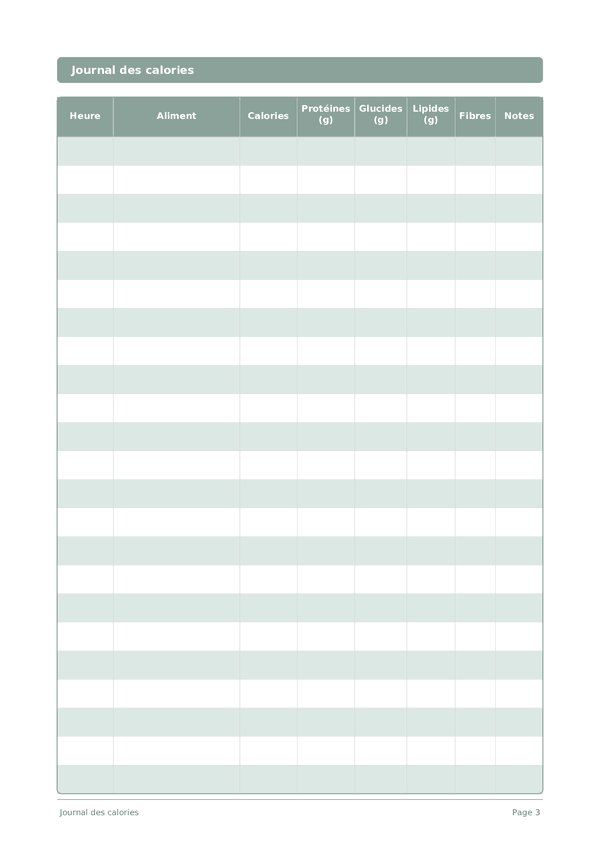
Chaque page est un tableau avec des colonnes. Remplissez une ligne par entrée. Voici à quoi sert chaque colonne :
Heure
Notez l'heure à laquelle vous avez mangé. L'horaire des repas affecte l'énergie, le sommeil et la digestion. Les tendances deviennent visibles après quelques semaines.
Catégorie de repas
Description
Rédigez une brève description du sujet de cette entrée. Le vous du futur remerciera le vous du présent pour ce contexte.
Taille de la portion
Calories
Notez votre apport calorique approximatif. Vous n'avez pas besoin de chiffres parfaits — les estimations vous aident à rester attentif à vos habitudes alimentaires.
Niveau de faim
Quel était votre niveau de faim global aujourd'hui ? 1 = pas du tout faim, 10 = affamé
Humeur (1-10)
Évaluez votre état émotionnel général de la journée. 1 signifie très bas ou déprimé, 10 signifie exceptionnellement heureux et positif. Ne réfléchissez pas trop — fiez-vous à votre instinct.
Notes
Ajoutez tout contexte ou réflexion supplémentaire. Cette colonne fourre-tout est pour tout ce qui ne rentre pas ailleurs mais pourrait être utile plus tard.
Conseils pour réussir
Quand et à quelle fréquence écrire
Log every meal and snack as close to real-time as possible — this is a table-based journal, so each entry is quick: food, portion, time. Aim for completeness over detail; a simple entry is better than a skipped one. Review your food log weekly to spot patterns: late-night eating, skipped meals, emotional triggers. Share your monthly summary with a nutritionist if you are working on dietary goals. Most people see their biggest insights after 2-3 weeks of consistent logging.
Questions fréquentes
Comment l'échelle niveau de faim 1–10 soutient-elle l'alimentation en pleine conscience ?
Les diététiciens recommandent l'échelle faim-satiété (1 = affamé, 5 = neutre, 10 = trop plein) pour distinguer la faim physique de l'alimentation émotionnelle. Évaluer avant chaque repas interrompt l'alimentation automatique. Des études montrent que les mangeurs conscients consomment moins de calories avec plus de satisfaction. La colonne faim avant repas du modèle convertit un signal interne en habitude enregistrable, soutenant les objectifs de poids sans restriction.
Pourquoi noter l'humeur en même temps que les repas ?
Des études sur l'obésité montrent que 30 à 60 % des épisodes de suralimentation sont émotionnellement motivés (stress, ennui, tristesse, fête). Enregistrer l'humeur à côté de l'alimentation révèle des tendances invisibles au seul comptage des calories. Après 2 à 3 semaines, la plupart des personnes identifient 1 à 3 déclencheurs émotionnels — une connaissance qui permet des interventions ciblées comme le test HALT (Hungry/Faim, Angry/Colère, Lonely/Solitude, Tired/Fatigue) avant de manger.
En quoi un journal alimentaire diffère-t-il d'un compteur de calories ?
Un journal alimentaire met l'accent sur le contexte — timing du repas, faim, humeur, portion — plutôt que sur les chiffres précis. Ce modèle inclut l'estimation calorique comme une seule colonne parmi huit, dé-soulignant intentionnellement la précision numérique. Cela fonctionne mieux pour les personnes sujettes aux troubles du comportement alimentaire ou qui trouvent le comptage strict des calories non viable.
Faut-il peser les portions ou les estimer à l'œil ?
Pour la précision, peser sur une balance de cuisine pendant les 1 à 2 premières semaines calibre vos estimations de portions — les valeurs à l'œil sont typiquement décalées de 20 à 40 %. Après calibration, les mesures à la main (paume = protéines, poing = glucides, pouce = lipides) fonctionnent pour la plupart des repas. La colonne taille de la portion accepte n'importe quelle unité cohérente — grammes, tasses, poignées.
Ce journal peut-il aider à identifier les sensibilités alimentaires ?
Oui, utilisé de façon systématique. Les allergologues recommandent un régime d'élimination de 2 à 4 semaines avec un suivi alimentaire détaillé pour identifier les sensibilités. Utilisez la colonne notes pour suivre les symptômes (ballonnements, maux de tête, fatigue, réactions cutanées) dans les 24 à 48 heures suivant les repas. Pour les allergies suspectées (anaphylaxie, urticaire), consultez un allergologue — ceci est un dépistage, pas un diagnostic.
Quelles catégories de repas utiliser ?
Catégories standard : Petit-déjeuner, Déjeuner, Dîner, Collation. Certains ajoutent « Boisson » pour les boissons caféinées ou alcoolisées. La colonne catégorie de repas accepte du texte libre — la cohérence importe plus que l'étiquette exacte. Suivre 3 repas + 2 collations par jour révèle les tendances de fréquence alimentaire ; les études en diabétologie lient un timing irrégulier des repas à une plus grande variabilité glycémique.
Combien de temps avant de voir des tendances dans mon journal alimentaire ?
La plupart identifient des tendances claires en 2 à 3 semaines. La recherche sur le comportement montre que 21 jours de suivi régulier constituent le seuil typique pour les auto-insights. Faites une revue hebdomadaire : regroupez les repas par catégorie, cherchez les repas tardifs, identifiez les moments de grande faim, reliez l'humeur à des aliments spécifiques. Apportez 4+ semaines à un diététicien pour une analyse personnalisée.
La tenue d'un journal alimentaire est-elle sans risque pour quelqu'un ayant des antécédents de troubles du comportement alimentaire ?
Utilisez-le avec la guidance d'un clinicien. Les associations spécialisées notent que le suivi alimentaire détaillé peut aggraver l'anorexie, la boulimie, l'hyperphagie boulimique ou l'orthorexie en renforçant la préoccupation pour la nourriture. Si vous avez de tels antécédents, envisagez de vous concentrer sur les évaluations de faim et d'humeur sans compter les calories, ou utilisez uniquement la colonne notes. Un diététicien ou un spécialiste peut adapter le journal de façon sûre.
Vous aimerez aussi
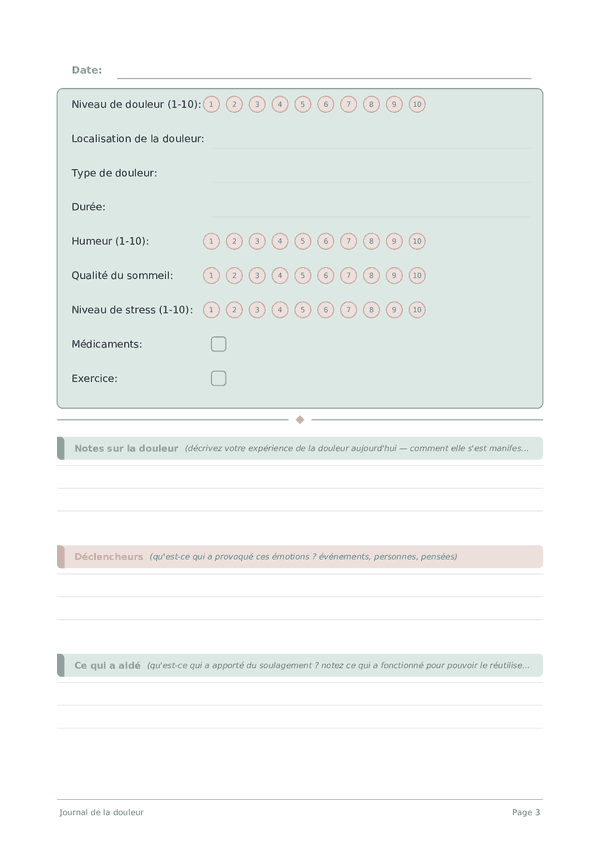
Journal de la douleur
Suivez les schémas de douleur, les déclencheurs et les stratégies de soulagement
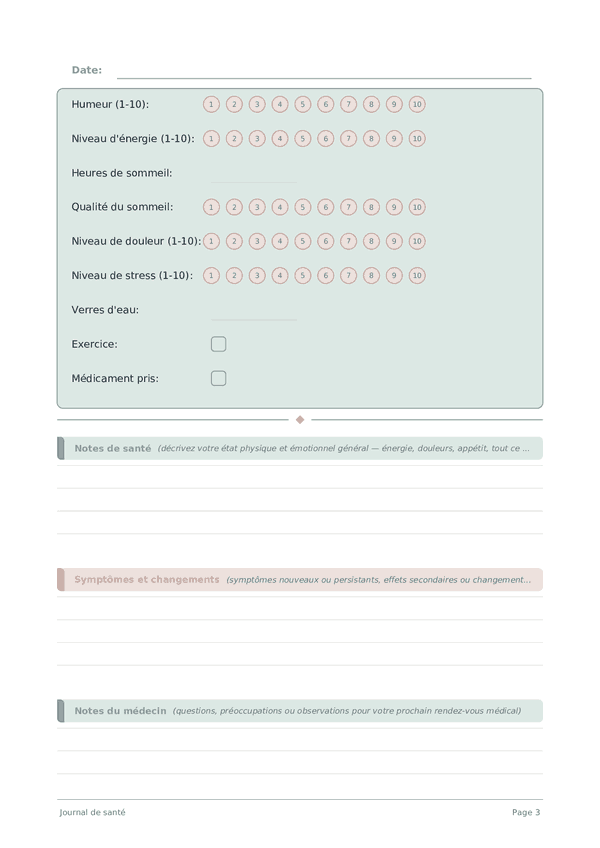
Journal de santé
Suivez votre corps, votre esprit et votre bien-être chaque jour
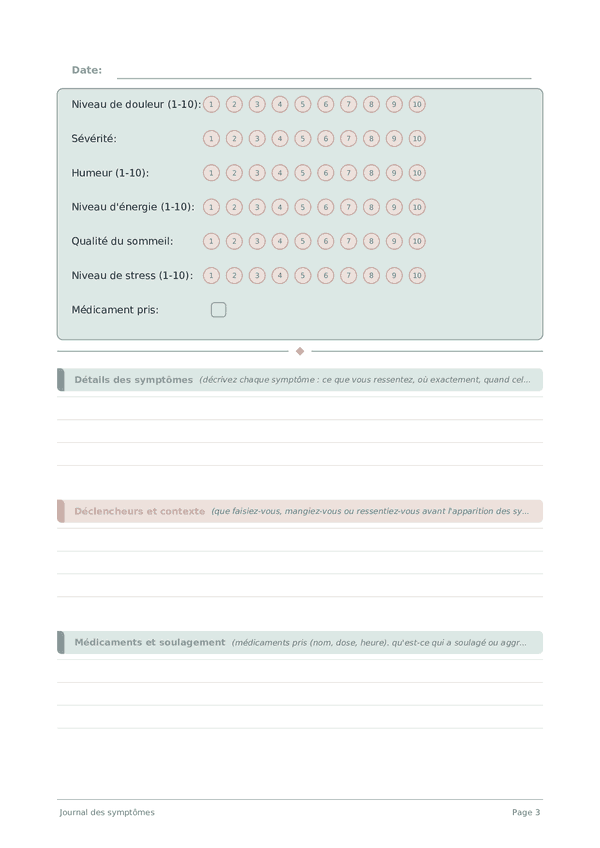
Journal des symptômes
Suivez vos symptômes, déclencheurs et traitements au quotidien
Journal des calories
Suivez les calories et les macros à chaque repas
Molette pour zoomer, glisser pour déplacer