Printable Journal de musique
Suivez vos séances de pratique, le tempo et votre progression musicale
A focused music practice journal to log every session with intention. Record the instrument, piece, practice duration, tempo, and rate your overall performance. Reflect on what improved, what still challenges you, and set goals for your next session. Consistent journaling reveals your musical progress over time and sharpens your practice.
Personnaliser les champs
Activez ou désactivez les champs. Cliquez sur le crayon pour renommer, ou ajoutez vos propres champs.
Avantages
Comment utiliser
Qu'est-ce que ce journal ?
A music journal helps you turn every practice session into a purposeful step forward. Instead of sitting down and noodling aimlessly, you set clear intentions, track measurable progress, and reflect on what actually improved. Over time, these notes become a personal coaching log that reveals your strengths, exposes weak spots, and keeps motivation high.
The top section captures quick metrics — how long you practised, which instrument and piece you worked on, the tempo you reached, and an overall session rating. The bottom section is where the real learning happens: you write about what improved, what challenged you, and what you plan to tackle next time.
Whether you are preparing for a recital, learning a new instrument, or simply playing for the love of music, consistent journaling transforms scattered practice into deliberate progress. Fill in the tracker during or right after your session, then spend two minutes writing your reflection while the experience is vivid.
Exemple rempli
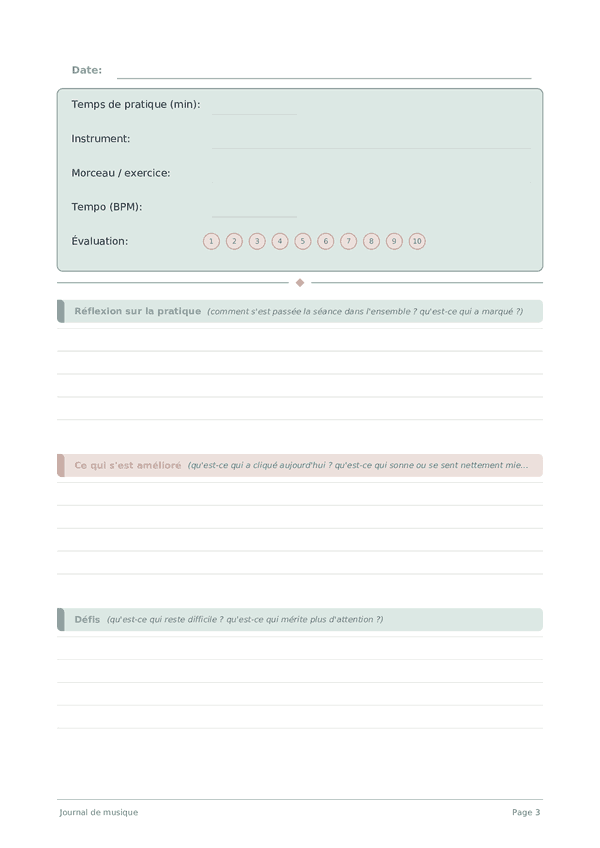
Voici à quoi ressemble une entrée typique une fois remplie :
Comment remplir chaque champ
Le haut de chaque page comporte des champs à remplissage rapide (évaluations, cases à cocher, chiffres). En dessous se trouve une section lignée pour écrire. Voici ce que signifie chaque champ :
Temps de pratique (min)
Combien de minutes avez-vous pratiqué aujourd'hui ?
Instrument
Guitare, piano, violon, voix, batterie...
Morceau / exercice
Nom du morceau, de la chanson ou de l'exercice travaillé
Tempo (BPM)
Tempo visé ou atteint en BPM (battements par minute)
Évaluation
Note globale de l'expérience
Réflexion sur la pratique
Comment s'est passée la séance dans l'ensemble ? Qu'est-ce qui a marqué ?
Ce qui s'est amélioré
Qu'est-ce qui a cliqué aujourd'hui ? Qu'est-ce qui sonne ou se sent nettement mieux ?
Défis
Qu'est-ce qui reste difficile ? Qu'est-ce qui mérite plus d'attention ?
Objectifs prochaine séance
Sur quoi allez-vous vous concentrer lors de votre prochaine séance ?
Conseils pour réussir
Quand et à quelle fréquence écrire
Write after every practice session or meaningful listening experience, even just two or three sentences. For active musicians, daily post-practice entries of five minutes each build a powerful feedback loop — you will see problem areas resolving over weeks instead of guessing. For listeners and collectors, three entries per week capture enough to build a meaningful personal archive. Monthly, read back through your entries to spot patterns in what inspires or frustrates you.
Questions fréquentes
Que suit le Journal de musique par séance de pratique ?
Cinq champs de suivi plus réflexion : durée pratique (jusqu'à 300 minutes), instrument, titre pièce, tempo (jusqu'à 300 BPM) et note (0 à 10). Six lignes couvrent la réflexion, ce qui s est amélioré, difficultés et objectifs séance suivante. La structure force une pratique délibérée et intentionnelle plutôt qu'un jeu passif — ce que la recherche désigne constamment comme la différence entre les musiciens qui plafonnent et ceux qui continuent à progresser.
Pourquoi consigner le tempo (BPM) pour chaque séance ?
Le BPM est le marqueur le plus objectif de la maîtrise technique d'un passage. Le suivre d'une séance à l'autre révèle un vrai progrès là où les sensations seules trompent. Levitin (2006, This Is Your Brain on Music, Dutton) décrit comment les musiciens qui quantifient les gains de tempo restent motivés à travers les plateaux. Utilise un métronome, consigne ton tempo propre maximal, et fixe l'objectif de la prochaine séance à +2 ou +4 BPM. Sur plusieurs semaines, la colonne devient une courbe de maîtrise visible.
Combien de temps durer chaque séance de pratique quotidienne ?
30 à 60 minutes de pratique ciblée produisent davantage de gains que 2 à 3 heures de jeu non ciblé. Ericsson, Krampe et Tesch-Römer (1993, Psychological Review, 100(3), 363-406) ont étudié des violonistes de conservatoire et ont constaté que 3 à 5 heures délibérées quotidiennes étaient la limite supérieure de qualité soutenue — et que la qualité chutait brusquement sans pauses. Le champ durée t'aide à mesurer le temps ciblé, pas seulement le temps à l'instrument.
Quelle est la différence entre pratique délibérée et simple jeu ?
La pratique délibérée cible une faiblesse spécifique avec attention focalisée et retour d'information (Ericsson, 2016, Peak, Houghton Mifflin Harcourt). Les champs objectifs séance suivante et difficultés sont l'échafaudage de la pratique délibérée : ils t'obligent à nommer ce sur quoi tu travailles, pas seulement à jouer en entier. Le jeu informel maintient les compétences ; la pratique délibérée les construit. Les deux ont leur place, mais seule l'une stimule la croissance.
Comment utiliser efficacement les questions « ce qui s'est amélioré » et « difficultés » ?
Sois précis par mesure, technique ou passage — « mesures 17-24 propres à 100 BPM » vaut mieux que « ça s'est amélioré ». La précision rend les objectifs de la prochaine séance concrets. Roediger et Karpicke (2006, Psychological Science, 17(3), 249-255) montrent que formuler ce que tu sais renforce la rétention. Le champ difficultés est tout aussi précieux : un problème non résolu nommé aujourd'hui se résout souvent en quelques jours, tandis que « c'était difficile » ne le fait pas.
Tenir un journal de pratique me rend-il vraiment meilleur musicien ?
Oui — quand la réflexion est couplée à une pratique ciblée. Le cadre des « difficultés désirables » de Bjork (Bjork & Bjork, 2011, Psychology and the Real World, Worth Publishers) montre que la récupération par l'effort et la pratique variée produisent des compétences durables. La note de séance crée un retour d'information ; le champ objectifs crée des repères de récupération pour la prochaine fois. Les musiciens qui tiennent un journal identifient et corrigent leurs faiblesses plus vite que ceux qui se contentent de jouer.
En quoi est-ce différent d'une appli métronome ou d'un minuteur de pratique ?
Les applis mesurent ; le journal interprète. Les champs titre de la pièce et réflexion relient le BPM du jour au contexte musical — pourquoi un passage semble plus difficile un jour, quel doigté a aidé, à quel tempo tout s'est désagrégé. Selon la recherche de Bjork sur la métacognition (Bjork & Bjork, 2011), l'interprétation et la fixation d'objectifs transfèrent davantage les compétences à la performance que le temps brut consigné. Utilise les deux — appli pour les données objectives, journal pour le sens.
Je pratique plusieurs instruments — faut-il garder des journaux séparés ?
Un seul journal fonctionne si tu remplis le champ instrument à chaque séance. La révision entre instruments révèle souvent des problèmes partagés (rythme, dynamique, écoute) et des succès transférables. Si tu enseignes ou te produis principalement sur un instrument, envisage un journal dédié pour lui et celui-ci pour les instruments secondaires. Le format s'adapte aux deux cas ; la régularité importe plus que la séparation.
Vous aimerez aussi
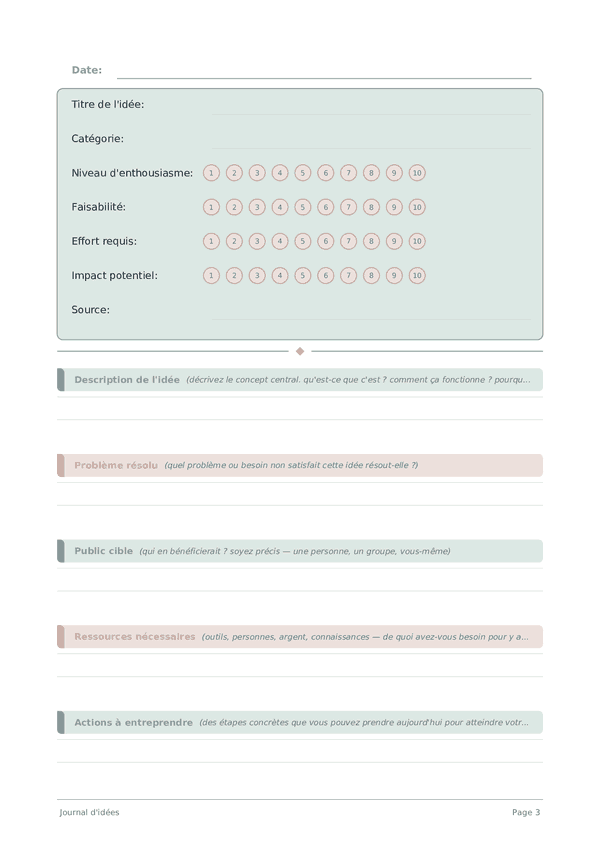
Journal d'idées
Capturez, évaluez et développez vos meilleures idées
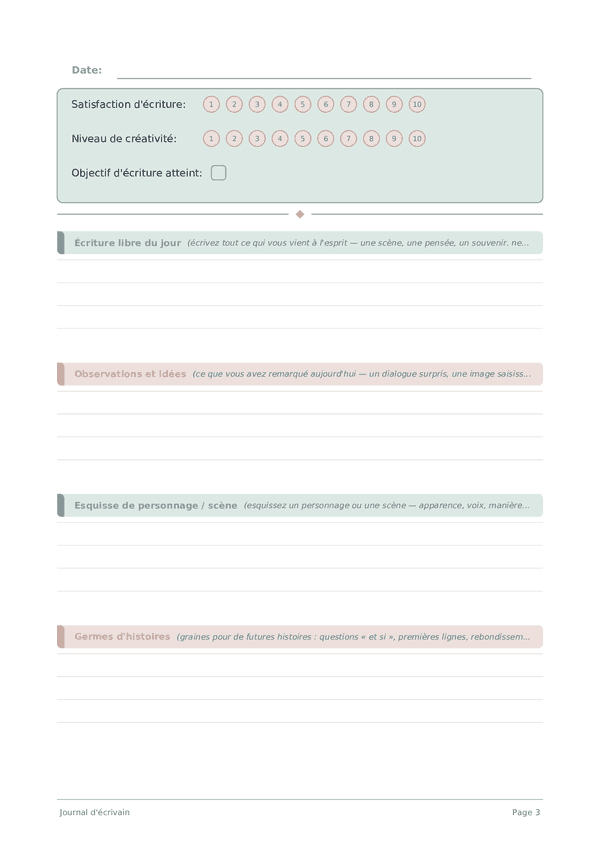
Journal d'écrivain
Pratique quotidienne d'écriture créative et développement du style
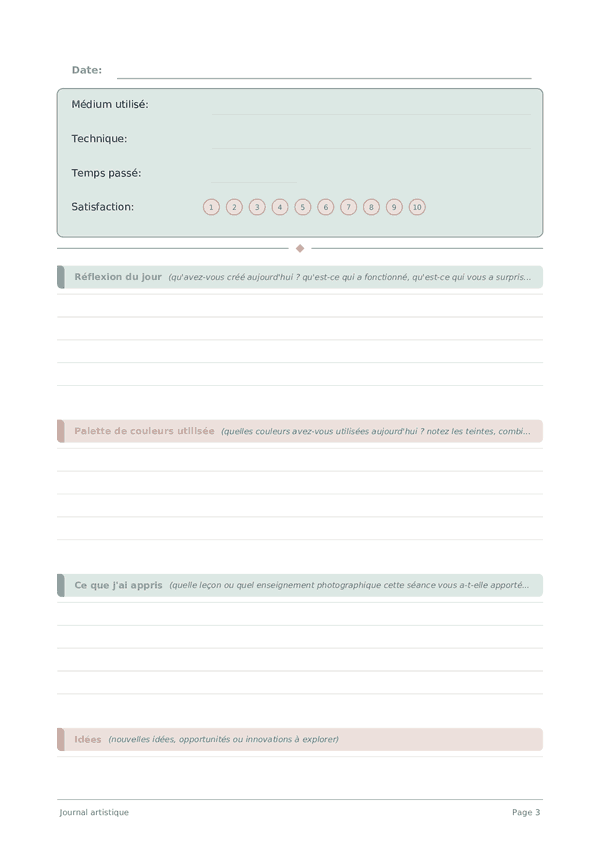
Journal artistique
Documentez votre processus créatif et votre évolution artistique
Journal de croquis
Pages à grille de points ouvertes pour le croquis, le dessin et l'exploration visuelle
Molette pour zoomer, glisser pour déplacer