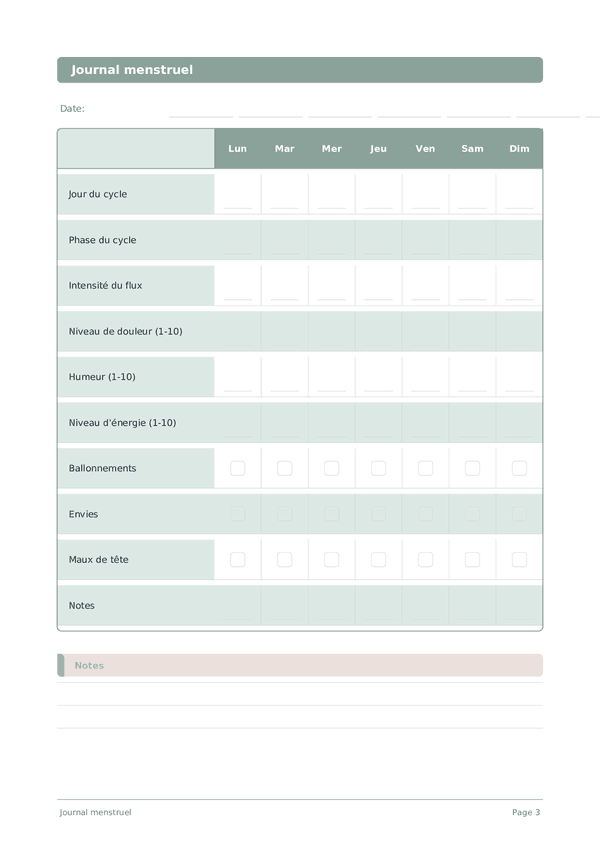
Printable Journal menstruel
Suivi du cycle menstruel et carnet de symptômes
Track your menstrual cycle with detailed symptom logging, mood and energy patterns, and phase awareness. Build a comprehensive picture of your cycle for better health and self-understanding.
Personnaliser les champs
Activez ou désactivez les champs. Cliquez sur le crayon pour renommer, ou ajoutez vos propres champs.
Qu'est-ce que ce journal ?
A period journal is a daily tracker where you record the details of your menstrual cycle — cycle day, flow intensity, pain levels, mood, energy, and common symptoms like bloating, cravings, and headaches. By tracking these patterns consistently cycle after cycle, you develop a deep understanding of your body's rhythms that no app algorithm can replicate, because it is grounded in your own lived experience.
This journal is for anyone who menstruates and wants to understand their cycle better. Whether you are trying to predict your period more accurately, manage painful symptoms, prepare for hormonal shifts that affect your mood and energy, or gather data to share with a gynecologist, this tracker gives you a structured and private space to record it all.
Many people are surprised by what their period journal reveals. You might discover that your energy peaks during the follicular phase, that headaches reliably appear two days before your period, or that cravings are strongest on specific cycle days. This knowledge is empowering — it allows you to plan demanding tasks for your high-energy days, prepare for symptom management before symptoms start, and have informed conversations with healthcare providers about your menstrual health.
Exemple rempli
Voici à quoi ressemble une entrée typique une fois remplie :
| Mon | Tue | Wed | Thu | Fri | Sat | Sun | |
|---|---|---|---|---|---|---|---|
| Jour du cycle | 1 | 2 | 3 | 4 | 5 | 6 | 7 |
| Phase du cycle | Menstrual | Menstrual | Menstrual | Menstrual | Menstrual | Follicular | Follicular |
| Intensité du flux | 3 | 8 | 7 | 5 | 3 | 1 | 0 |
| Niveau de douleur (1-10) | 7 | 6 | 4 | 3 | 2 | 1 | 0 |
| Humeur (1-10) | 4 | 5 | 5 | 6 | 6 | 7 | 8 |
| Niveau d'énergie (1-10) | 3 | 4 | 4 | 5 | 6 | 7 | 8 |
| Ballonnements | ✓ | ✓ | ✓ | ✓ | |||
| Envies | ✓ | ✓ | ✓ | ||||
| Maux de tête | ✓ | ||||||
| Notes | First day, heavy cramps in the morning. Took ibuprofen. | Heaviest day. Stayed home. Hot water bottle helped. | Flow easing. Mild cramps in the evening. | Much lighter. Energy starting to return. | Spotting only. Felt almost normal. | Period basically over. Good energy. | Feeling great. Went for a run. |
Comment remplir chaque champ
Chaque page est une grille hebdomadaire. Les lignes sont vos éléments de suivi, les colonnes sont les jours de la semaine. Voici ce que signifie chaque élément :
Jour du cycle
Enregistrez le jour de votre cycle. Un suivi régulier aide à prédire les cycles futurs et à identifier les irrégularités.
Phase du cycle
Intensité du flux
Niveau de douleur (1-10)
Évaluez l'intensité de votre douleur sur une échelle. Suivre les niveaux de douleur aide à identifier les déclencheurs, évaluer les traitements et communiquer avec les professionnels de santé.
Humeur (1-10)
Évaluez votre état émotionnel général de la journée. 1 signifie très bas ou déprimé, 10 signifie exceptionnellement heureux et positif. Ne réfléchissez pas trop — fiez-vous à votre instinct.
Niveau d'énergie (1-10)
Évaluez votre niveau d'énergie physique et mentale. 1 signifie épuisé et vidé, 10 signifie plein d'énergie et alerte. Cela vous aide à identifier quelles activités stimulent ou drainent votre énergie.
Ballonnements
Envies
Maux de tête
Notes
Ajoutez tout contexte ou réflexion supplémentaire. Cette colonne fourre-tout est pour tout ce qui ne rentre pas ailleurs mais pourrait être utile plus tard.
Conseils pour réussir
Quand et à quelle fréquence écrire
Mark flow and symptoms every day during your period, and note any mid-cycle symptoms (ovulation pain, spotting, discharge changes) as they occur. On non-event days, a quick daily check-in about mood and energy still provides valuable cycle data. At the end of each cycle, review the full pattern. After 3 months, you will be able to predict symptom onset and prepare accordingly. Share tracked data with your gynecologist at annual checkups for more productive appointments.
Questions fréquentes
Pourquoi suivre la phase du cycle en plus du jour du cycle ?
Les recommandations gynécologiques conseillent d'enregistrer les deux parce que la phase révèle le contexte hormonal, tandis que le jour permet la prédiction. Les quatre phases — menstruelle, folliculaire, ovulatoire, lutéale — génèrent des changements prévisibles d'humeur, d'énergie, de douleur et de gonflement. Connaître votre phase lutéale explique les symptômes prémenstruels ; enregistrer les deux champs permet à votre gynécologue de relier les plaintes à la fenêtre hormonale correspondante.
Qu'est-ce qui est considéré comme une longueur de cycle et un flux « normaux » ?
Les recommandations gynécologiques définissent la normale comme des cycles de 21 à 35 jours avec des saignements de 2 à 7 jours. Les saignements menstruels abondants (ménorragie) correspondent généralement à un volume > 80 ml au total, ou à un besoin de changer de protection toutes les heures. L'échelle intensité du flux 0–10 capture le changement subjectif dans le temps de façon plus utile qu'un volume absolu. Des cycles persistants hors de cette plage, ou des changements soudains, justifient une consultation gynécologique.
Comment ce journal aide-t-il à diagnostiquer des pathologies comme le SOPK ou l'endométriose ?
Les gynécologues utilisent 3 à 6 mois de données de cycle pour identifier les tendances suggérant un SOPK (cycles irréguliers, souvent > 35 jours), une endométriose (douleur sévère ≥ 7/10, surtout pendant les menstruations), un TDPM (scores d'humeur 7+ jours avant les règles) ou des fibromes (flux abondant). L'ACOG et le NICE s'appuient sur les journaux de patientes pour le diagnostic différentiel. Les évaluations niveau de douleur (1-10) et intensité du flux, combinées aux scores d'humeur, donnent à votre clinicienne des preuves au-delà d'un seul rendez-vous.
Que révèlent les cases à cocher gonflement, envies et maux de tête ?
Ce sont des symptômes clés du syndrome prémenstruel (SPM) selon les critères de l'OMS. L'APA définit le TDPM quand 5+ symptômes se concentrent dans la phase lutéale pendant la plupart des cycles. Les cocher sur 2 à 3 cycles révèle si les symptômes sont systématiquement cycliques (SPM/TDPM) vs aléatoires. Cette distinction importe pour le traitement — les ISRS aident le TDPM ; les modifications du mode de vie aident le SPM léger selon les recommandations gynécologiques.
En quoi diffère-t-il d'une application de suivi du cycle comme Clue ou Flo ?
Les applications stockent et prédisent ; les journaux papier favorisent la réflexion. De nombreuses applications de suivi partagent des données avec des tiers — une préoccupation de confidentialité. Le format papier garde vos données menstruelles entièrement privées. Les évaluations 0–10 permettent également un suivi des symptômes plus nuancé que les cases à cocher binaires de la plupart des applications. Utilisez les deux si utile — papier pour les notes sensibles, application pour les prédictions.
Peut-on suivre des cycles périménopausiques avec ce journal ?
Oui. La périménopause (généralement entre 45 et 55 ans) se caractérise par des cycles irréguliers, des bouffées de chaleur et des sautes d'humeur. Les évaluations intensité du flux, humeur et énergie capturent bien cette transition ; jour du cycle reste utile même quand les cycles s'allongent. Apportez 6+ mois de données à votre gynécologue si les cycles dépassent régulièrement 35 jours ou sautent des mois — cela aide à évaluer la transition ménopausique et à exclure d'autres causes.
Combien de temps avant que les tendances deviennent utiles ?
Les recommandations gynécologiques conseillent 3 cycles complets pour une caractérisation de base, et 6 cycles pour détecter des troubles cycliques comme le TDPM. Le premier mois révèle souvent peu car l'identification de la phase dépend de la connaissance du début des prochaines règles. Après 3 cycles, la durée moyenne du cycle, les tendances d'ovulation et le regroupement des symptômes deviennent clairs. Un diagnostic fiable de SPM/TDPM nécessite au moins 2 cycles enregistrés prospectivement.
Quand les changements du cycle doivent-ils motiver une visite chez le médecin ?
Signaux d'alarme : cycles systématiquement inférieurs à 21 ou supérieurs à 35 jours, saignements durant plus de 7 jours, flux très abondant (protection à changer toutes les heures), douleur sévère ne répondant pas aux analgésiques courants, saignements entre les règles, ou changements soudains du cycle. Apportez au moins 3 cycles de données. L'absence soudaine de menstruation justifie un test de grossesse et une évaluation si celle-ci est exclue.
Vous aimerez aussi
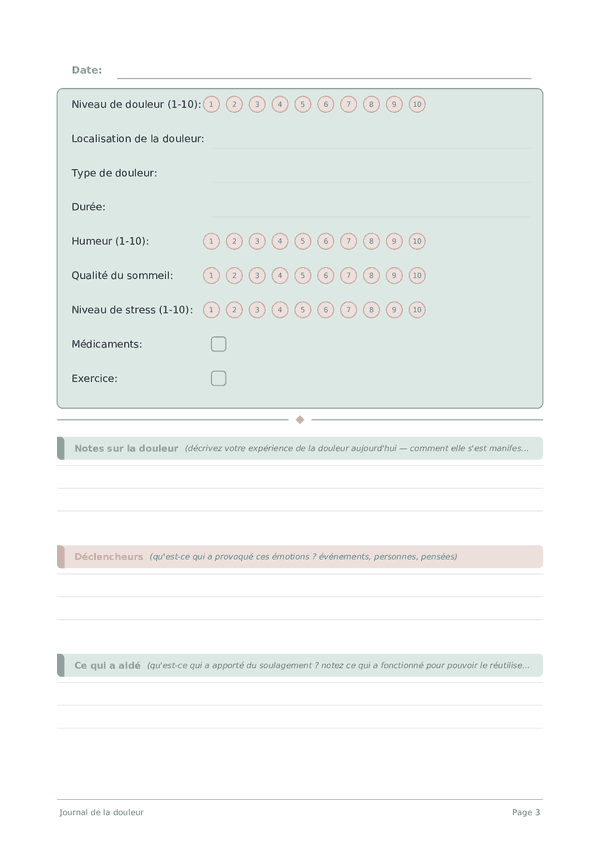
Journal de la douleur
Suivez les schémas de douleur, les déclencheurs et les stratégies de soulagement
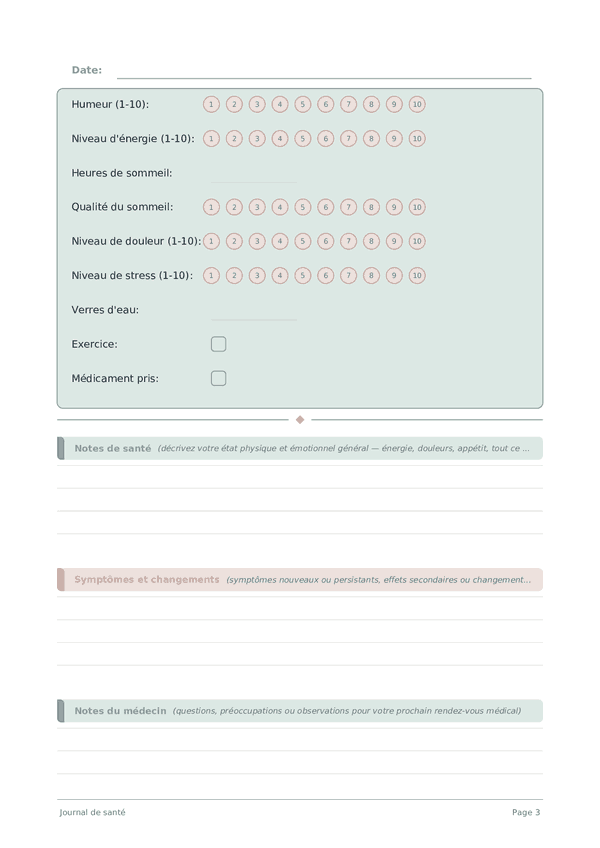
Journal de santé
Suivez votre corps, votre esprit et votre bien-être chaque jour
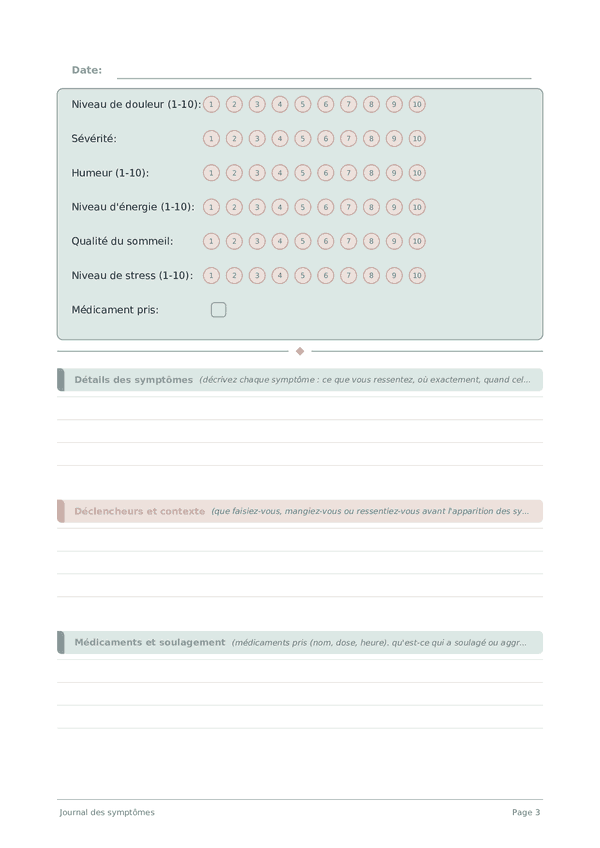
Journal des symptômes
Suivez vos symptômes, déclencheurs et traitements au quotidien
Journal des calories
Suivez les calories et les macros à chaque repas
Molette pour zoomer, glisser pour déplacer