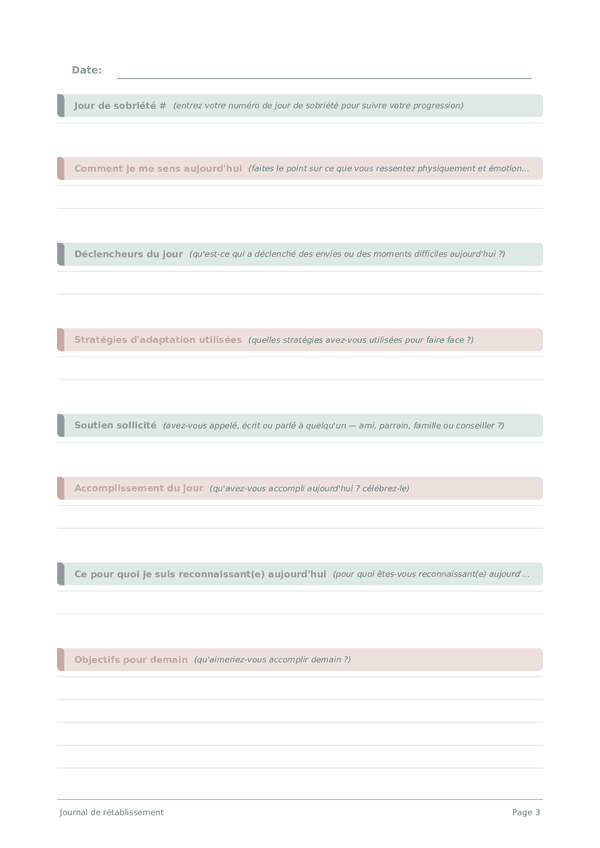
Printable Journal de rétablissement
Soutien quotidien au rétablissement et journal de responsabilisation pour la sobriété
Support your recovery journey with daily check-ins, trigger awareness, and coping strategy documentation. Track sobriety milestones, celebrate progress, and maintain connection to your recovery community.
Personnaliser les champs
Activez ou désactivez les champs. Cliquez sur le crayon pour renommer, ou ajoutez vos propres champs.
Qu'est-ce que ce journal ?
A recovery journal is a deeply personal daily writing practice designed for individuals on the path of addiction recovery or healing from any life-altering challenge. Each entry provides structured prompts that guide you through reflecting on your emotional state, identifying triggers, acknowledging your coping strategies, and celebrating daily accomplishments — no matter how small they may seem.
Recovery is not a straight line, and a journal helps you navigate its inevitable ups and downs with greater awareness. Writing about your feelings and triggers creates emotional distance, allowing you to process difficult experiences rather than react impulsively. Documenting the coping strategies that work reinforces healthy patterns, while noting what you are grateful for shifts your focus toward the positive aspects of your new life.
Many recovery programs, including 12-step and therapeutic approaches, recommend journaling as a core practice. This journal supports that recommendation with a clear daily structure that reduces the intimidation of a blank page. Over time, reading back through your entries becomes a powerful reminder of how far you have come and the strength you carry within you.
Exemple rempli
Voici à quoi ressemble une entrée typique une fois remplie :
Comment remplir chaque champ
Chaque jour, vous trouverez plusieurs sections étiquetées avec des lignes pour écrire. Voici à quoi sert chaque section :
Jour de sobriété #
Entrez votre numéro de jour de sobriété pour suivre votre progression
Comment je me sens aujourd'hui
Faites le point avec vous-même : comment vous sentez-vous physiquement et émotionnellement en ce moment ? Soyez précis — « fatigué mais plein d'espoir » est plus utile que « ça va ».
Déclencheurs du jour
Qu'est-ce qui a déclenché des envies ou des moments difficiles aujourd'hui ?
Stratégies d'adaptation utilisées
Quelles stratégies avez-vous utilisées pour faire face ?
Soutien sollicité
Avez-vous appelé, écrit ou parlé à quelqu'un — ami, parrain, famille ou conseiller ?
Accomplissement du jour
Notez quelque chose que vous avez accompli aujourd'hui, aussi petit soit-il. Reconnaître les petites victoires quotidiennes renforce la confiance et l'élan.
Ce pour quoi je suis reconnaissant(e) aujourd'hui
Listez 1 à 3 choses pour lesquelles vous êtes reconnaissant aujourd'hui. Elles peuvent être grandes ou minuscules — un bon repas, un mot gentil, du soleil. Le journal de gratitude est l'une des pratiques de bien-être les plus soutenues scientifiquement.
Objectifs pour demain
Qu'aimeriez-vous accomplir demain ?
Conseils pour réussir
Quand et à quelle fréquence écrire
Write every single day, especially in the first 90 days. Evening journaling is ideal — it processes the day and releases emotional pressure that might otherwise build overnight. On hard days, write in the moment if you can. In early recovery, even a 3-sentence entry counts. After 90 days, daily remains ideal, but the habit should feel natural by then. Weekly, re-read your entries to see growth you cannot feel in the moment. Monthly, note how your triggers and coping strategies have evolved.
Questions fréquentes
Comment le journal quotidien soutient-il la convalescence d'une dépendance ?
L'auto-surveillance est identifiée comme une compétence clé de prévention de la rechute. Des études montrent que la réflexion quotidienne — notamment la prise de conscience des déclencheurs et la pratique de la gratitude — réduit le risque de rechute en renforçant l'identité de convalescence et le rappel des stratégies d'adaptation. Les prompts structurés de ce modèle (jour de sobriété #, déclencheurs, stratégies d'adaptation, contacts de soutien) s'alignent sur les modèles cognitivo-comportementaux de prévention de la rechute. Utilisez-le en complément d'un traitement professionnel, pas en remplacement.
Quelle est la valeur du suivi des jours de sobriété ?
Les jalons de sobriété renforcent le changement d'identité. La recherche comportementale montre que les compteurs de jours visibles sont corrélés à une abstinence plus longue. Le champ jour de sobriété # fournit une affirmation quotidienne — des études notent que le petit renforcement cohérent surpasse les marqueurs intenses peu fréquents. Célébrez les jalons (30, 60, 90 jours ; 1 an) avec votre parrain/marraine ou votre réseau de soutien.
Comment identifier et documenter les déclencheurs ?
Les déclencheurs se répartissent en catégories émotionnelles (HALT : Hungry/Faim, Angry/Colère, Lonely/Solitude, Tired/Fatigue), sociales (personnes/lieux), environnementales (signaux visuels) et internes (pensées/envies). Utilisez le prompt déclencheurs du jour pour enregistrer les événements spécifiques, l'intensité (légère/modérée/sévère) et votre réponse. Les tendances sur 4 à 8 semaines révèlent les situations à haut risque à planifier.
Qu'est-ce qui compte comme une « stratégie d'adaptation » méritant d'être suivie ?
Les stratégies d'adaptation validées incluent : le « surf des envies », appeler son parrain, assister à une réunion, faire de l'exercice, la pratique de la pleine conscience, quitter l'endroit déclencheur, appeler une ligne de crise. Documentez ce que vous avez utilisé dans stratégies d'adaptation utilisées et si cela a fonctionné. Des études montrent que rappeler par écrit une adaptation efficace passée renforce le sentiment d'auto-efficacité — le prédicteur le plus fort d'un rétablissement durable.
Pourquoi le prompt soutien sollicité est-il important ?
L'isolement social est le prédicteur aigu le plus fort de rechute ; la connexion quotidienne — même brève — protège significativement. Le champ soutien sollicité enregistre les appels au parrain, les présences aux réunions, les SMS à des amis, les séances de thérapie. Des études montrent que tout engagement dans une communauté de rétablissement est corrélé à une abstinence plus longue. Pas de contact pendant 3+ jours est un signal d'alarme clinique à soulever avec votre soignant.
Comment la pratique de la gratitude s'intègre-t-elle dans le rétablissement ?
Des études montrent que la pratique de la gratitude active les voies de récompense différemment de la consommation de substances et réduit la dysphorie — un moteur majeur de rechute. Le prompt ce pour quoi je suis reconnaissant(e) aujourd'hui exige de la spécificité : nommez trois choses concrètes, pas des items génériques. Trois semaines de pratique cohérente montrent une amélioration mesurable de l'humeur dans des études cliniques.
Ce journal est-il approprié sans traitement professionnel ?
Il soutient mais ne remplace pas les soins cliniques. Les spécialistes soulignent que les troubles d'usage de substances sévères nécessitent généralement une détoxication médicale, un traitement médicamenteux (ex. : buprénorphine, naltrexone) et une thérapie comportementale. Le sevrage de l'alcool, des benzodiazépines ou des opioïdes sans supervision médicale peut être fatal — consultez des spécialistes en addictologie. En France, vous pouvez appeler Drogues Info Service : 0 800 23 13 13 (gratuit, 24h/24).
Quand les tendances du journal doivent-elles motiver une aide urgente ?
Critères de crise : pensées d'automutilation ou de suicide — appelez le 3114 (Numéro National de Prévention du Suicide, France, gratuit, 24h/24), rechute active, symptômes de sevrage sévères, ou incapacité persistante à utiliser des stratégies d'adaptation. Des tendances dans le journal — déclencheurs croissants, contacts de soutien en baisse, entrées répétées d'envies — justifient un contact immédiat avec votre parrain, thérapeute ou centre de traitement.
Vous aimerez aussi
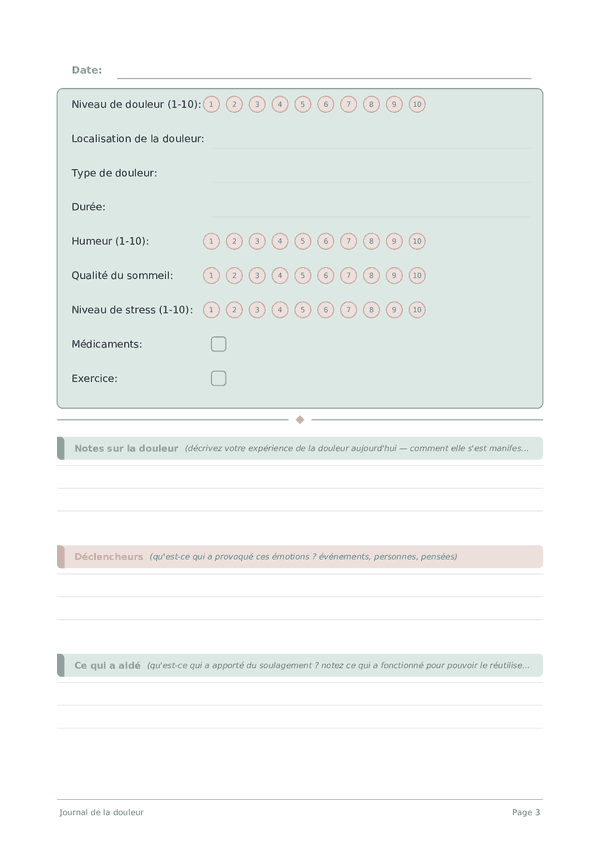
Journal de la douleur
Suivez les schémas de douleur, les déclencheurs et les stratégies de soulagement
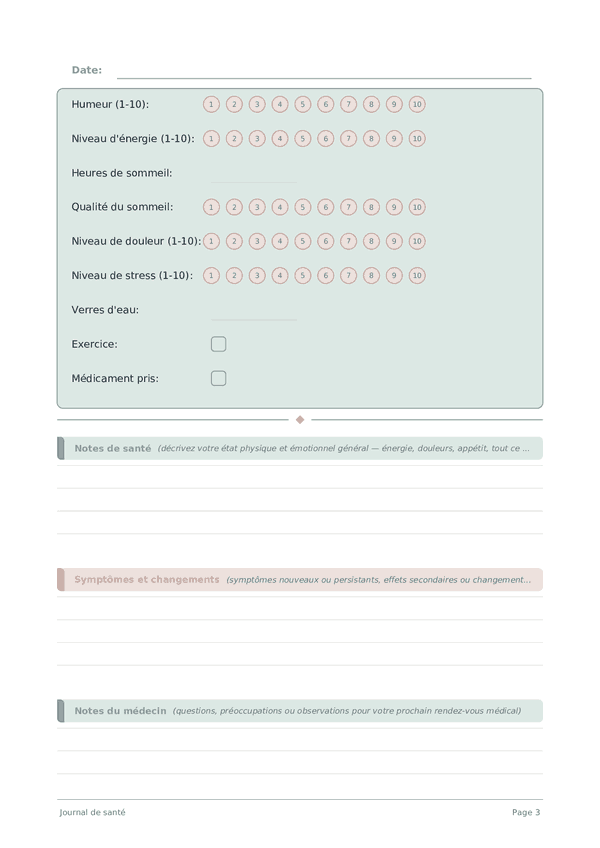
Journal de santé
Suivez votre corps, votre esprit et votre bien-être chaque jour
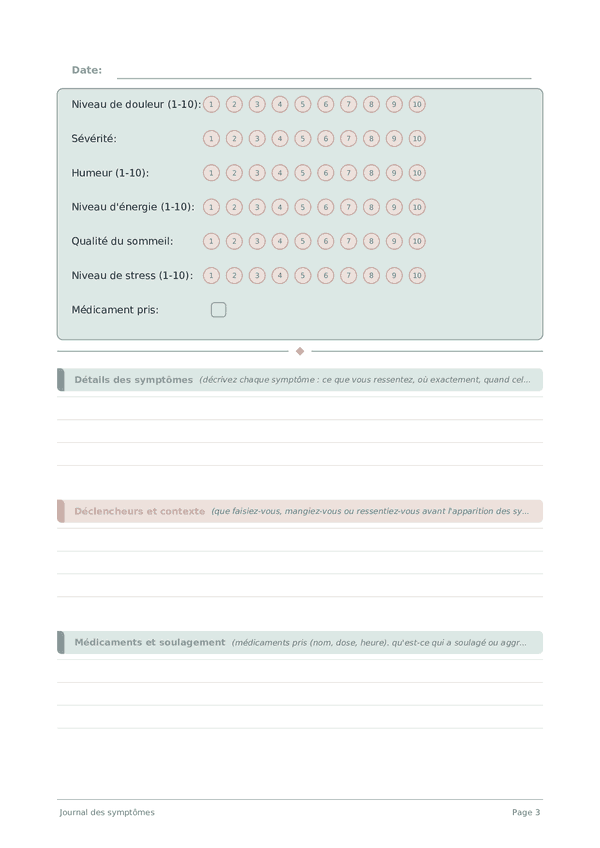
Journal des symptômes
Suivez vos symptômes, déclencheurs et traitements au quotidien
Journal des calories
Suivez les calories et les macros à chaque repas
Molette pour zoomer, glisser pour déplacer