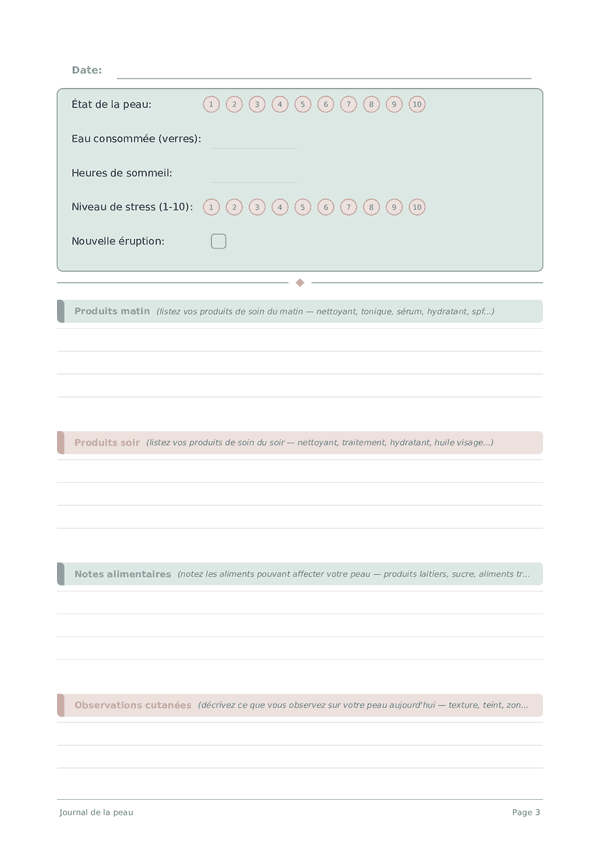
Printable Journal de la peau
Suivi quotidien de la routine de soins et journal de santé cutanée
Build your best skin through daily routine tracking and pattern recognition. Log products, monitor lifestyle factors like hydration and sleep, and identify what truly improves your complexion over time.
Personnaliser les champs
Activez ou désactivez les champs. Cliquez sur le crayon pour renommer, ou ajoutez vos propres champs.
Qu'est-ce que ce journal ?
A skin journal is a daily tracking tool designed for anyone who wants to understand and improve their skin health. By rating your skin condition, logging water intake, sleep, stress levels, and noting breakouts alongside your skincare routine and diet, you create a holistic picture of the factors influencing your complexion. This journal bridges the gap between guessing what works and knowing what works.
Skin is the body's largest organ, and its condition is influenced by a complex web of internal and external factors. A product that works wonders for one person may cause breakouts in another, and environmental changes can shift your skin's needs overnight. By maintaining consistent daily entries, you can isolate which products, foods, or habits correlate with your best and worst skin days — information that even a dermatologist cannot determine from a single office visit.
Whether you are battling acne, managing eczema or rosacea, building an anti-aging routine, or simply curious about optimizing your skin, this journal turns anecdotal impressions into reliable data. It is especially powerful when introducing new products, as you can precisely track their effects over the crucial first weeks of use.
Exemple rempli
Voici à quoi ressemble une entrée typique une fois remplie :
Comment remplir chaque champ
Le haut de chaque page comporte des champs à remplissage rapide (évaluations, cases à cocher, chiffres). En dessous se trouve une section lignée pour écrire. Voici ce que signifie chaque champ :
État de la peau
Évaluez l'état de votre peau aujourd'hui. Suivez les améliorations ou les poussées pour identifier les déclencheurs comme l'alimentation, le stress ou les produits.
Eau consommée (verres)
Combien de verres d'eau avez-vous bu aujourd'hui ? Visez 6 à 8 verres pour une hydratation cutanée optimale
Heures de sommeil
Notez combien d'heures vous avez réellement dormi (pas seulement le temps passé au lit). Suivre cela en parallèle de l'humeur et de l'énergie révèle souvent des connexions puissantes.
Niveau de stress (1-10)
Évaluez votre stress sur une échelle de 1 à 10. Avec le temps, vous identifierez vos schémas de stress et les stratégies d'adaptation qui fonctionnent le mieux.
Nouvelle éruption
De nouvelles éruptions sont-elles apparues aujourd'hui ? Cochez oui pour suivre les tendances dans le temps
Produits matin
Listez vos produits de soin du matin — nettoyant, tonique, sérum, hydratant, SPF...
Produits soir
Listez vos produits de soin du soir — nettoyant, traitement, hydratant, huile visage...
Notes alimentaires
Notez les aliments pouvant affecter votre peau — produits laitiers, sucre, aliments transformés, alcool, ou aliments bénéfiques pour la peau
Observations cutanées
Décrivez ce que vous observez sur votre peau aujourd'hui — texture, teint, zones préoccupantes, améliorations
Ce qui a changé
Avez-vous changé quelque chose aujourd'hui — nouveau produit, alimentation différente, plus de sommeil ? Notez-le pour suivre les causes et effets
Conseils pour réussir
Quand et à quelle fréquence écrire
Do a brief skin check and log every morning — note any new breakouts, irritation, dryness, or improvement. Record your full skincare routine (AM and PM products) and mark any product changes. Weekly, review your skin photos side by side to detect gradual changes invisible day-to-day. Monthly, assess which products and habits correlate with your best and worst skin weeks. Before dermatologist visits, prepare a summary from your journal: current routine, recent changes, trigger patterns, and product duration. This data transforms your appointment from guesswork into evidence-based care.
Questions fréquentes
Comment le suivi quotidien améliore-t-il réellement l'état de la peau ?
Un suivi structuré identifie quels produits, aliments et facteurs de mode de vie affectent réellement votre peau. Le renouvellement cellulaire cutané prend ~28 jours, donc les tendances cause-effet émergent sur 4 à 6 semaines. La combinaison de métriques objectives (sommeil, eau, stress) et de journaux de produits permet des tests d'hypothèses — la plupart identifient 1 à 3 déclencheurs actionnables en 8 semaines.
Quel est le lien entre sommeil, stress et peau ?
Des études dermatologiques confirment que le cortisol dû au mauvais sommeil (< 7 heures) et au stress chronique augmente la production de sébum, aggrave l'acné et ralentit la réparation de la barrière cutanée. Les champs heures de sommeil et niveau de stress (1-10) suivent ces variables clés. Les tendances sur 6 à 8 semaines révèlent des seuils personnels — beaucoup constatent que les poussées d'acné sont corrélées à un stress ≥ 7/10 ou un sommeil < 6 heures pendant 3+ nuits consécutives.
Comment noter les produits de soin AM et PM ?
Des listes de produits séparées rendent l'analyse des tendances plus claire. Utilisez les prompts produits matin et produits soir pour lister chaque produit (marque, principe actif clé comme rétinol, acide salicylique, niacinamide). Lors de l'introduction d'un nouveau produit, notez la date de début et observez 4 à 6 semaines avant de juger — le « purging » initial des rétinoïdes et acides est normal. Arrêtez et consultez un dermatologue en cas d'irritation persistante.
L'alimentation peut-elle vraiment affecter la peau ?
Des études dermatologiques montrent que les régimes à index glycémique élevé et les produits laitiers sont corrélés à l'acné ; la rosacée peut être aggravée par l'alcool et les aliments épicés ; l'eczéma peut s'aggraver avec des allergènes alimentaires. Utilisez le prompt notes alimentaires pour noter les aliments suspects, avec la réaction cutanée 24 à 48 heures plus tard. Les effets alimentaires sont individualisés — vos tendances de journal importent plus que les moyennes de population.
Que me dit la case nouvelle éruption au fil du temps ?
Cocher nouvelle éruption quotidiennement crée un graphique de fréquence des poussées sur des semaines. Les recommandations dermatologiques considèrent des tendances constantes comme cliniquement significatives : 3+ nouvelles lésions par semaine peuvent indiquer une acné hormonale, des réactions de contact ou une irritation par les produits. La case associée aux journaux de stress, sommeil et produits révèle des tendances causales. Des photographies parallèles (appareil séparé) ajoutent des preuves objectives que les dermatologues apprécient.
En quoi diffère-t-il d'applications de soins de la peau comme TroveSkin ?
Les applications basées sur l'IA analysent les photos pour des métriques de surface mais intègrent rarement le contexte de mode de vie. Des revues de dermatologie numérique montrent que la précision des applications varie largement et ne peut pas diagnostiquer des pathologies. Le journal papier capture les facteurs comportementaux et environnementaux — alimentation, sommeil, stress, produits — qui génèrent réellement la plupart des problèmes cutanés. Combinez si utile : application pour le suivi visuel, journal pour le contexte.
Combien de temps avant de voir des résultats d'une nouvelle routine de soins ?
Le renouvellement cellulaire prend ~28 jours chez les adultes, plus avec l'âge. La plupart des actifs (rétinoïdes, acides exfoliants, vitamine C) montrent des résultats mesurables en 6 à 12 semaines. Le prompt ce qui a changé est le plus utile aux marques des 4, 8 et 12 semaines — comparez les évaluations de base aux évaluations actuelles. La patience est critique ; changer de produits trop rapidement empêche une évaluation correcte.
Quand les problèmes de peau doivent-ils motiver une consultation chez un dermatologue ?
Signaux d'alarme : acné persistante ne répondant pas au traitement en vente libre après 8+ semaines, poussées sévères soudaines, lésions kystiques douloureuses, éruption persistante, grains de beauté suspects (critères ABCDE : asymétrie, bord, couleur, diamètre > 6 mm, évolution), changements cutanés inexpliqués. Apportez 8+ semaines de données de journal. Un gonflement soudain du visage ou une éruption vésiculeuse avec fièvre nécessite des soins urgents.
Vous aimerez aussi
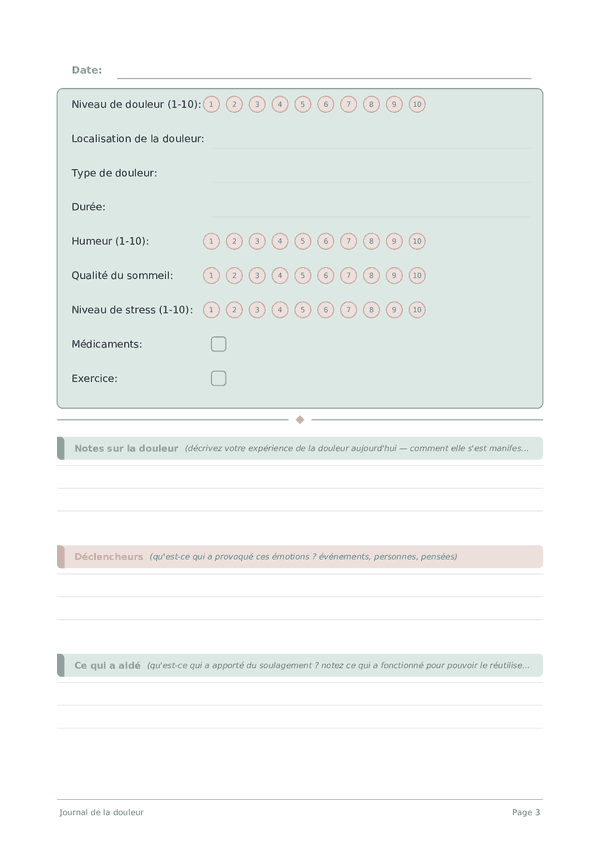
Journal de la douleur
Suivez les schémas de douleur, les déclencheurs et les stratégies de soulagement
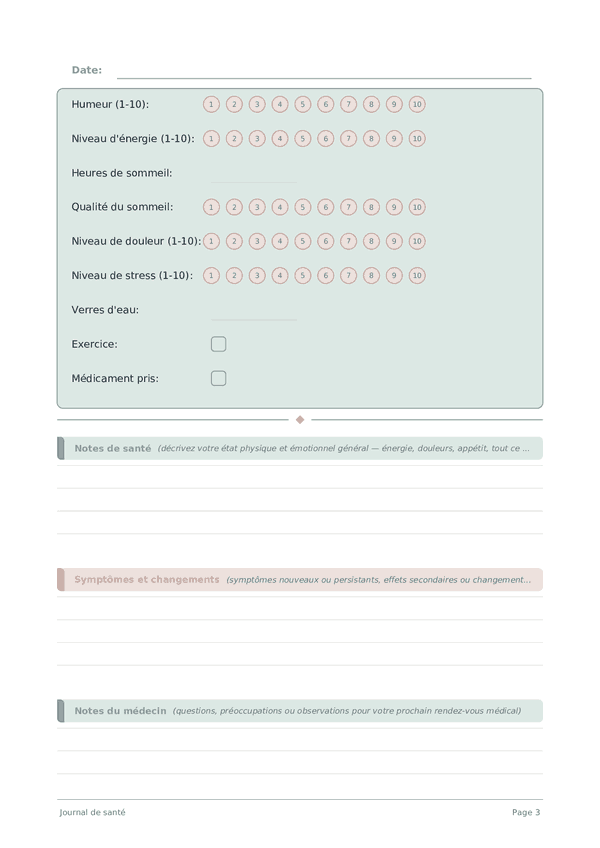
Journal de santé
Suivez votre corps, votre esprit et votre bien-être chaque jour
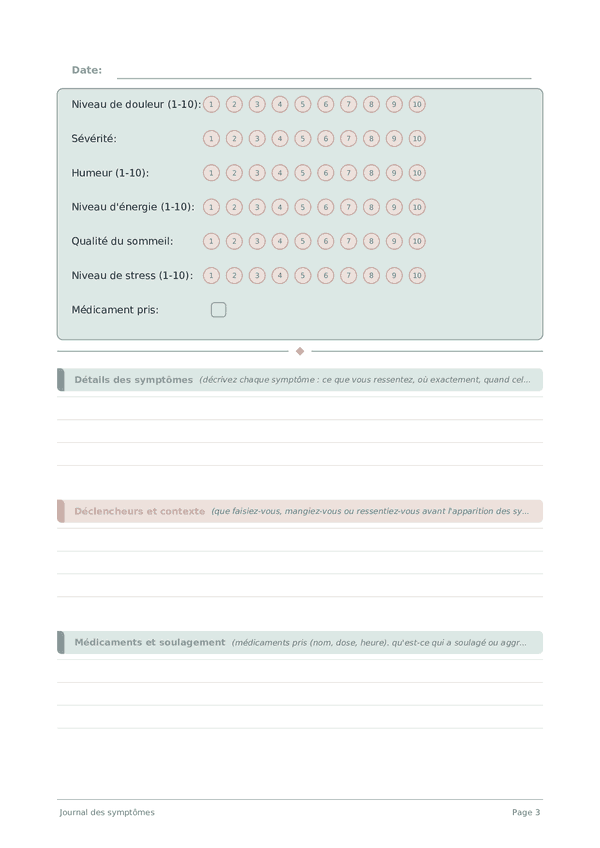
Journal des symptômes
Suivez vos symptômes, déclencheurs et traitements au quotidien
Journal des calories
Suivez les calories et les macros à chaque repas
Molette pour zoomer, glisser pour déplacer