Printable Journal de poids
Suivez vos mensurations et atteignez vos objectifs de poids
Monitor weight, waist measurements, exercise, and water intake in a weekly grid. See trends that help you stay on course toward your body composition goals.
Personnaliser les champs
Activez ou désactivez les champs. Cliquez sur le crayon pour renommer, ou ajoutez vos propres champs.
Avantages
Comment utiliser
Qu'est-ce que ce journal ?
A weight journal is a weekly tracker where you record your body weight alongside related measurements — body fat percentage, waist and hip circumference — as well as daily habits like exercise and water intake. By capturing these numbers consistently over time, you build a clear, objective picture of your body composition changes that goes far beyond what the scale alone can tell you.
This journal is for anyone with a body composition goal: people looking to lose weight, gain muscle, or maintain their current physique. It is equally useful for those who have struggled with inconsistent tracking or who feel discouraged by day-to-day weight fluctuations and want a more balanced, data-driven perspective on their progress.
Daily weight can swing by a kilogram or more due to water retention, meal timing, and other factors that have nothing to do with actual fat loss or gain. A weight journal helps you see through this noise by showing weekly trends and correlations. When you notice that your waist measurement is decreasing even though the scale hasn't moved, you know your body composition is improving. Tracking exercise and water intake alongside your measurements reveals which habits most strongly correlate with the results you want.
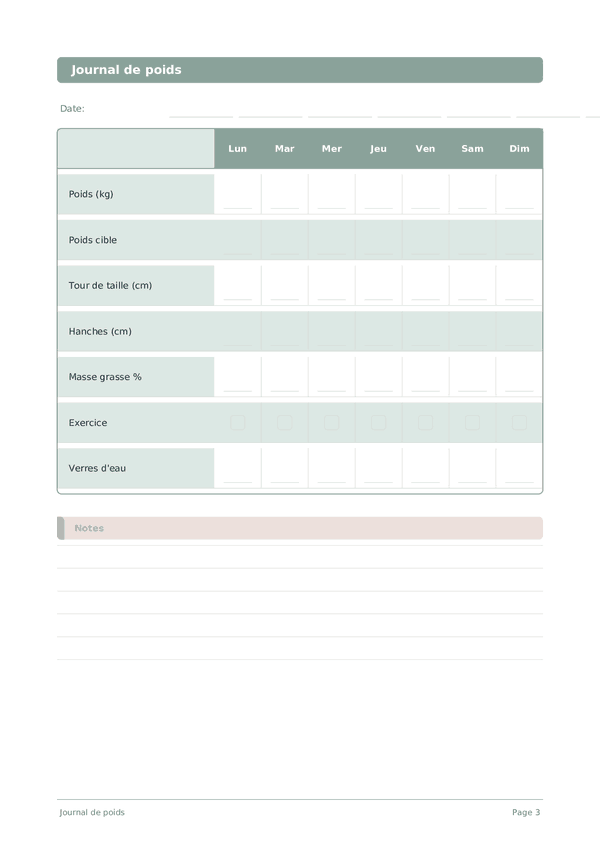
Exemple rempli
Voici à quoi ressemble une entrée typique une fois remplie :
| Mon | Tue | Wed | Thu | Fri | Sat | Sun | |
|---|---|---|---|---|---|---|---|
| Poids (kg) | 82.4 | 82.1 | 82.6 | 82 | 81.8 | 82.2 | 81.5 |
| Poids cible | 79 | 79 | 79 | 79 | 79 | 79 | 79 |
| Tour de taille (cm) | 88 | 88 | 87.5 | ||||
| Hanches (cm) | 101 | 101 | 100.5 | ||||
| Masse grasse % | 22.1 | 22 | 21.8 | ||||
| Exercice | ✓ | ✓ | ✓ | ✓ | |||
| Verres d'eau | 8 | 6 | 9 | 8 | 7 | 10 | 8 |
Comment remplir chaque champ
Chaque page est une grille hebdomadaire. Les lignes sont vos éléments de suivi, les colonnes sont les jours de la semaine. Voici ce que signifie chaque élément :
Poids (kg)
Enregistrez votre poids si vous le suivez. Pesez-vous à la même heure chaque jour pour des données cohérentes. Concentrez-vous sur les tendances hebdomadaires, pas sur les fluctuations quotidiennes.
Poids cible
Tour de taille (cm)
Mesurez votre tour de taille. Plus fiable que le poids seul, le tour de taille reflète les changements réels de composition corporelle.
Hanches (cm)
Masse grasse %
Exercice
Cochez si vous avez fait de l'exercice aujourd'hui. Même une marche de 10 minutes compte. L'objectif est de prendre conscience de vos habitudes d'activité.
Verres d'eau
Suivez votre consommation d'eau quotidienne. La plupart des gens ont besoin de 6 à 8 verres. Cocher les verres tout au long de la journée vous aide à rester hydraté.
Conseils pour réussir
Quand et à quelle fréquence écrire
Step on the scale every morning under the same conditions for the most reliable trend data. Record the number without judgment — it is just data. At the end of each week, calculate and log your 7-day average weight. Compare weekly averages, not daily readings, to determine real progress. Monthly, take body measurements (waist, hips, chest) to capture changes the scale misses. A rate of 0.5–1% body weight change per week is sustainable in either direction.
Questions fréquentes
Pourquoi le journal suit-il le tour de taille et des hanches en plus du poids ?
L'AHA et l'OMS identifient le tour de taille comme un prédicteur plus fort du risque cardio-métabolique que le poids seul — la graisse viscérale importe plus que la masse totale. Un tour de taille > 94 cm (hommes) ou > 80 cm (femmes) est considéré à risque élevé en Europe. La taille et les hanches révèlent aussi des changements de composition corporelle quand le poids est stable, utile lors des phases de recomposition où le muscle remplace la graisse.
À quelle fréquence devrais-je réellement me peser ?
Quotidiennement, à la même heure après être allé aux toilettes et avant de manger. Des études montrent que la pesée quotidienne améliore le maintien du poids à long terme. La clé est de se concentrer sur la moyenne mobile sur 7 jours — et non sur les pics journaliers — pour éviter le découragement face aux fluctuations normales de 1 à 2 kg liées à l'hydratation, au sodium et aux réserves de glycogène.
Quel rythme de perte de poids viser ?
Les recommandations officielles préconisent 0,5 à 1 kg par semaine — soit un déficit d'environ 250 à 500 kcal/jour. Une perte plus rapide augmente la perte musculaire et le risque de reprise. Même une réduction de 5 à 10 % du poids corporel améliore significativement la tension artérielle, le contrôle glycémique et les lipides. Les tendances hebdomadaires dans la colonne poids sont la bonne métrique, pas les lectures isolées.
Pourquoi mesurer le pourcentage de graisse corporelle et à quel point les estimations à domicile sont-elles précises ?
Le pourcentage de graisse corporelle reflète mieux la composition que l'IMC. Un taux > 25 % (hommes) ou > 32 % (femmes) est considéré à risque élevé. Les balances à impédance ont une erreur de ±3 à 8 % et dépendent fortement de l'hydratation. Utilisez la colonne masse grasse % pour la tendance mensuelle, pas la précision quotidienne. La DEXA est la référence clinique mais inutile pour le suivi — la cohérence de la méthode prime.
La pesée quotidienne est-elle sans risque pour quelqu'un ayant des antécédents de troubles alimentaires ?
Souvent non. Les associations spécialisées déconseillent la pesée quotidienne aux personnes souffrant d'anorexie, de boulimie, d'hyperphagie boulimique ou d'orthorexie. Les fluctuations de poids peuvent déclencher des comportements restrictifs. Si vous avez de tels antécédents, consultez un clinicien et envisagez de vous concentrer plutôt sur la case activité physique et la colonne eau. Le poids est un point de données, pas une mesure de la valeur personnelle.
Comment l'hydratation et le suivi de l'activité se rapportent-ils aux changements de poids ?
L'hydratation affecte le poids sur la balance de 1 à 2 kg par jour. L'activité physique maintient la masse musculaire lors d'un déficit calorique. Ensemble, les colonnes eau et activité expliquent environ 30 % du « bruit » quotidien dans le poids et aident à distinguer le progrès réel des fluctuations temporaires.
Quand consulter un médecin pour des changements de poids ?
Signaux d'alarme médicaux : perte non intentionnelle de 5 % du poids corporel en 6 à 12 mois, prise de poids rapide de 2+ kg par semaine, ou changements de poids accompagnés de fatigue, d'appétit altéré ou d'autres symptômes nécessitent une évaluation médicale. Les pathologies thyroïdiennes, le diabète et les maladies cardiovasculaires se manifestent toutes par des changements de poids. Apportez 4+ semaines de données de journal à votre rendez-vous.
Combien de temps avant de voir des tendances significatives dans le journal de poids ?
Environ 3 à 4 semaines. La variance quotidienne de ±1 à 2 kg est normale ; les tendances statistiquement fiables nécessitent au moins trois cycles hebdomadaires complets pour filtrer le « bruit » lié au sodium, aux hormones et à la digestion. La grille hebdomadaire du modèle est conçue pour cela — calculez des moyennes du lundi au dimanche plutôt que de vous fixer sur des jours individuels. Les tendances dans les mesures de taille émergent souvent avant les changements de poids.
Vous aimerez aussi
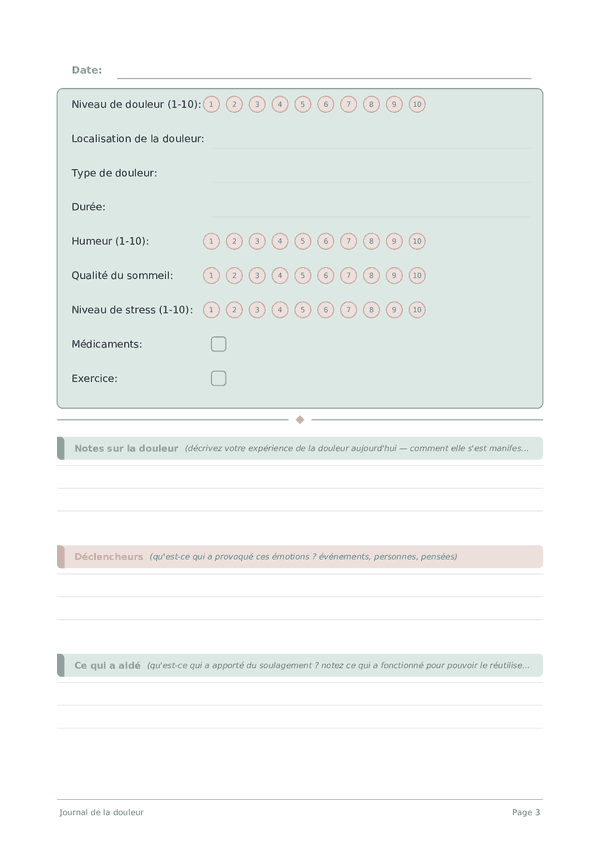
Journal de la douleur
Suivez les schémas de douleur, les déclencheurs et les stratégies de soulagement
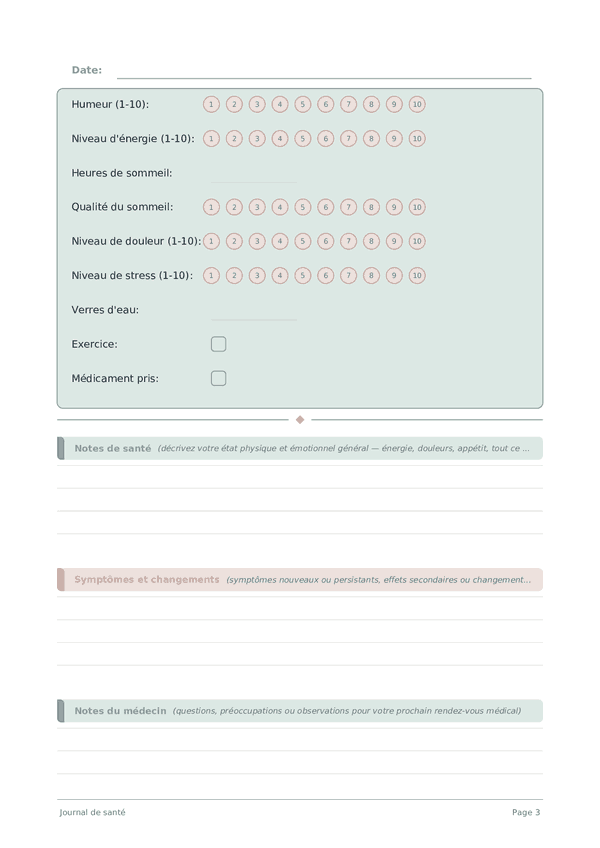
Journal de santé
Suivez votre corps, votre esprit et votre bien-être chaque jour
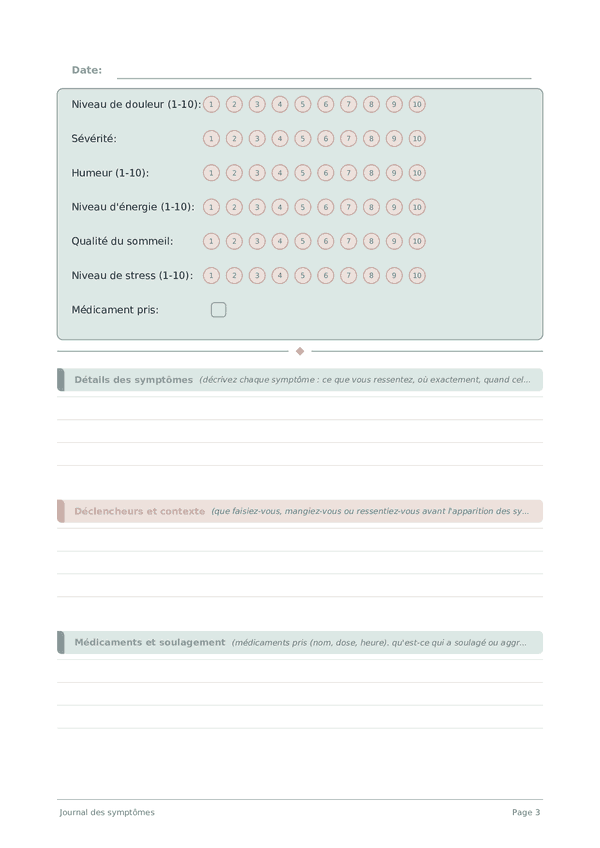
Journal des symptômes
Suivez vos symptômes, déclencheurs et traitements au quotidien
Journal des calories
Suivez les calories et les macros à chaque repas
Molette pour zoomer, glisser pour déplacer