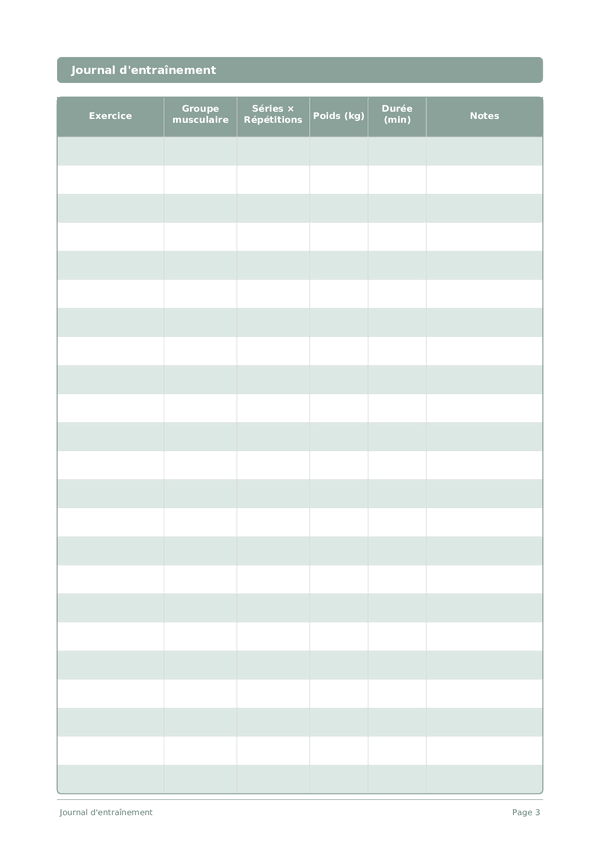
Printable Journal d'entraînement
Suivez chaque série, répétition et poids — voyez votre force progresser
A structured workout log that helps you record exercises, sets, reps, weights, and duration for each training session. Built for gym-goers and home athletes alike, this journal keeps your progress visible and your motivation high.
Personnaliser les champs
Activez ou désactivez les champs. Cliquez sur le crayon pour renommer, ou ajoutez vos propres champs.
Avantages
Comment utiliser
Qu'est-ce que ce journal ?
A workout journal is a structured training log where you record every exercise you perform — the type, target muscle group, sets, reps, weights, and duration. It serves as both a detailed record of what you did and a planning tool for progressive overload, helping you ensure that your training is moving forward rather than staying stagnant.
This journal is designed for anyone who exercises regularly and wants to train with intention, from gym beginners learning proper programming to experienced lifters tracking periodization cycles. It is equally valuable for people doing bodyweight training, group fitness classes, or rehabilitation exercises — any physical activity where tracking progress leads to better outcomes.
The difference between people who make consistent progress in the gym and those who plateau often comes down to one thing: tracking. When you write down that you bench pressed 60 kg for 3 sets of 8 reps, you know that next session you should aim for 3 sets of 9 or increase the weight. Without a journal, most people repeat the same weights and reps for months without realizing it. Your workout journal transforms each session from an isolated event into part of a coherent, progressive plan.
Exemple rempli
Voici à quoi ressemble une entrée typique une fois remplie :
| Exercice | Groupe musculaire | Séries × Répétitions | Poids (kg) | Durée (min) | Notes |
|---|---|---|---|---|---|
| Barbell Back Squat | Legs / Glutes | 4 x 8 | 80 | 12 | Warm-up: 2x10 at 40kg. Depth was good on all sets. |
| Romanian Deadlift | Hamstrings / Lower Back | 3 x 10 | 60 | 10 | Focused on slow eccentric. Felt stretch in hamstrings. |
| Leg Press | Quads | 3 x 12 | 140 | 8 | Feet placed high and wide |
| Walking Lunges | Legs / Glutes | 3 x 12 each leg | 16 | 8 | Dumbbells, 8kg each hand |
| Leg Curl Machine | Hamstrings | 3 x 12 | 35 | 6 | Last 2 reps were tough |
| Calf Raises (Standing) | Calves | 4 x 15 | 50 | 6 | Full range of motion, 2-sec pause at top |
| Plank | Core | 3 x 60 sec | 0 | 5 | Finished with 3 sets of planks for core stability |
Comment remplir chaque champ
Chaque page est un tableau avec des colonnes. Remplissez une ligne par entrée. Voici à quoi sert chaque colonne :
Exercice
Notez le type d'exercice que vous avez fait (par ex., course, yoga, musculation). La variété compte — le suivi aide à assurer une routine équilibrée.
Groupe musculaire
Pectoraux, dos, jambes, épaules, bras, abdominaux...
Séries × Répétitions
Enregistrez les séries et répétitions (par ex., 3×12). C'est votre journal de musculation — la surcharge progressive devient visible avec le temps.
Poids (kg)
Enregistrez votre poids si vous le suivez. Pesez-vous à la même heure chaque jour pour des données cohérentes. Concentrez-vous sur les tendances hebdomadaires, pas sur les fluctuations quotidiennes.
Durée (min)
Enregistrez la durée de votre exercice ou de votre pratique en minutes. Suivre la durée vous aide à voir votre engagement grandir et à trouver la durée de séance optimale.
Notes
Ajoutez tout contexte ou réflexion supplémentaire. Cette colonne fourre-tout est pour tout ce qui ne rentre pas ailleurs mais pourrait être utile plus tard.
Conseils pour réussir
Quand et à quelle fréquence écrire
Log every workout in the table format immediately during or after your session: exercise name, sets, reps, weight, and rest periods. On rest days, note recovery activities (stretching, foam rolling, walking) and how your body feels. Weekly, review your training log to ensure progressive overload is happening and no muscle group is neglected. Every 4-6 weeks, compare your current numbers to your starting point — this is where real motivation lives. Deload weeks should also be logged to track how recovery affects subsequent performance.
Questions fréquentes
Qu'est-ce que la surcharge progressive et comment la suivre ici ?
La surcharge progressive — augmentation graduelle du stimulus d'entraînement — est le moteur fondamental de la force et de l'hypertrophie. Suivez-la via les colonnes poids et séries × Répétitions : visez à ajouter 1 à 2,5 kg ou une répétition par séance pour le même exercice. Examinez les tendances mensuelles par mouvement. Les plateaux signalent la nécessité de semaines de décharge ou de changements de programme.
Combien de séries et de répétitions faire par exercice ?
Les recommandations de l'ACSM et le consensus de l'ISSN recommandent : 3 à 5 séries de 5 à 8 rép à 75–85 % du 1RM pour la force ; 3 à 4 séries de 8 à 12 rép à 65–75 % pour l'hypertrophie ; 2 à 3 séries de 12 à 20 rép pour l'endurance. Enregistrez toutes les séries dans séries × Répétitions (ex. : « 4x8 »). Le volume hebdomadaire total par groupe musculaire — séries × répétitions × poids — génère l'adaptation plus que toute séance isolée.
Pourquoi noter le poids corporel en haut de chaque page ?
Le contexte du poids corporel interprète les changements de force — gagner en force en perdant du poids indique une vraie amélioration de la performance, tandis que des gains de force lors d'une prise de poids peuvent partiellement refléter la masse. Le champ poids corporel (kg) en en-tête de page fournit un instantané hebdomadaire sans pesée quotidienne, utile pour les phases de sèche, de prise de masse ou de maintien.
Comment suivre des exercices comme les tractions ou les pompes sans poids externe ?
Entrez 0 dans la colonne poids et le contexte du poids corporel depuis l'en-tête de page. La progression au poids de corps s'effectue via l'augmentation des répétitions, des séries ou du tempo. Pour les variantes lestées (ex. : tractions lestées), entrez uniquement le poids ajouté. La colonne notes peut préciser les hypothèses de charge corporelle. Suivez la progression par répétitions et volume total plutôt que par charge seule.
En quoi diffère-t-il d'applications comme Strong, Jefit ou Hevy ?
Les applications automatisent les calculs et les minuteries de repos ; les journaux papier favorisent la réflexion et la planification intentionnelle. Des études de changement de comportement montrent que la programmation manuscrite améliore l'adhésion et la conscience de soi. La colonne notes capture des données qualitatives — niveau de fatigue, signaux techniques, retours articulaires — que les applications rejettent souvent. Beaucoup utilisent les deux : application en séance, journal pour la planification hebdomadaire.
À quelle fréquence changer les exercices ou modifier le programme ?
L'ACSM recommande des changements de programme toutes les 4 à 8 semaines pour prévenir la stagnation. La colonne notes est l'endroit idéal pour signaler les exercices avec plateau sur 2 à 3 séances consécutives. Des semaines de décharge (50 à 70 % du volume) toutes les 4 à 8 semaines permettent de gérer la fatigue. Suivez la durée totale de la séance en parallèle du poids pour détecter une fatigue croissante par entraînement.
Comment les débutants devraient-ils utiliser ce journal ?
Selon les recommandations pour débutants, concentrez-vous sur 2 à 3 séances full-body par semaine avec 6 à 8 exercices composés. Enregistrez chaque série pendant les 8 à 12 premières semaines pour construire une conscience technique et une base de progression. Des études montrent que l'entraînement en résistance réduit le risque de mortalité toutes causes confondues ; la régularité importe plus que l'intensité au début. Utilisez la colonne notes pour les signaux techniques d'un entraîneur ou d'une référence vidéo.
Quels signes indiquent un surentraînement ?
Signaux d'alarme : baisse des performances sur 2+ semaines, douleurs musculaires persistantes plus de 72 heures, troubles du sommeil, fréquence cardiaque de repos élevée, baisse de l'humeur, maladies bénignes fréquentes. Suivez-les dans la colonne notes. La récupération nécessite 1 à 2 semaines à 50 à 70 % du volume, pas un repos complet. Consultez un médecin du sport si les symptômes persistent.
Vous aimerez aussi
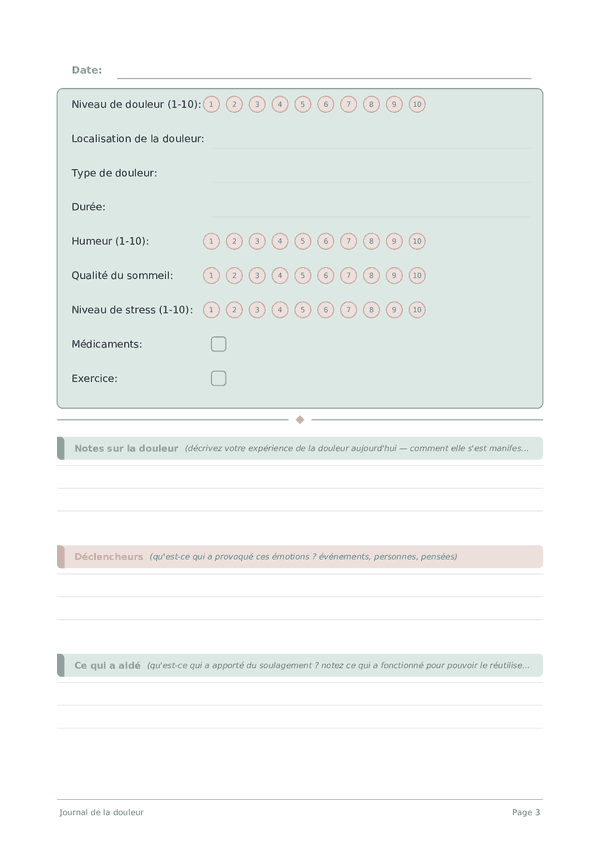
Journal de la douleur
Suivez les schémas de douleur, les déclencheurs et les stratégies de soulagement
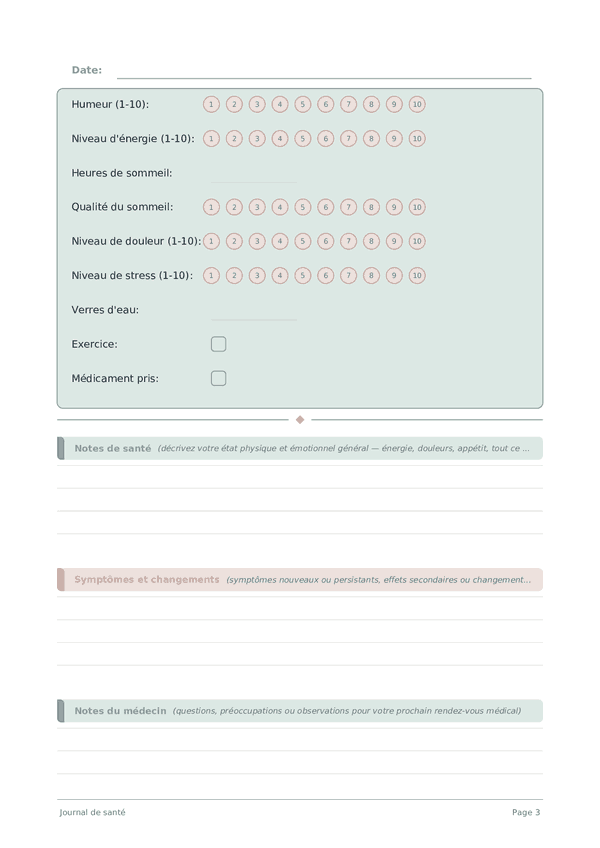
Journal de santé
Suivez votre corps, votre esprit et votre bien-être chaque jour
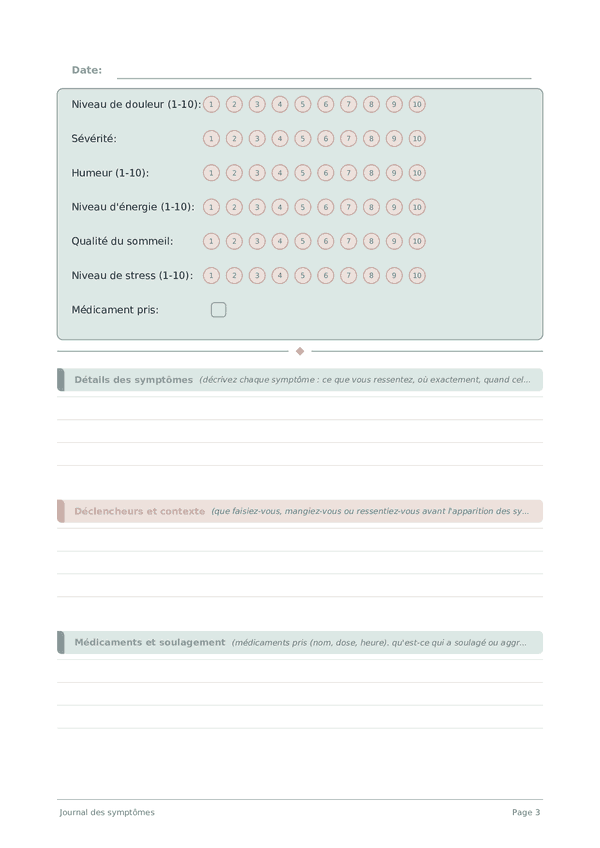
Journal des symptômes
Suivez vos symptômes, déclencheurs et traitements au quotidien
Journal des calories
Suivez les calories et les macros à chaque repas
Molette pour zoomer, glisser pour déplacer