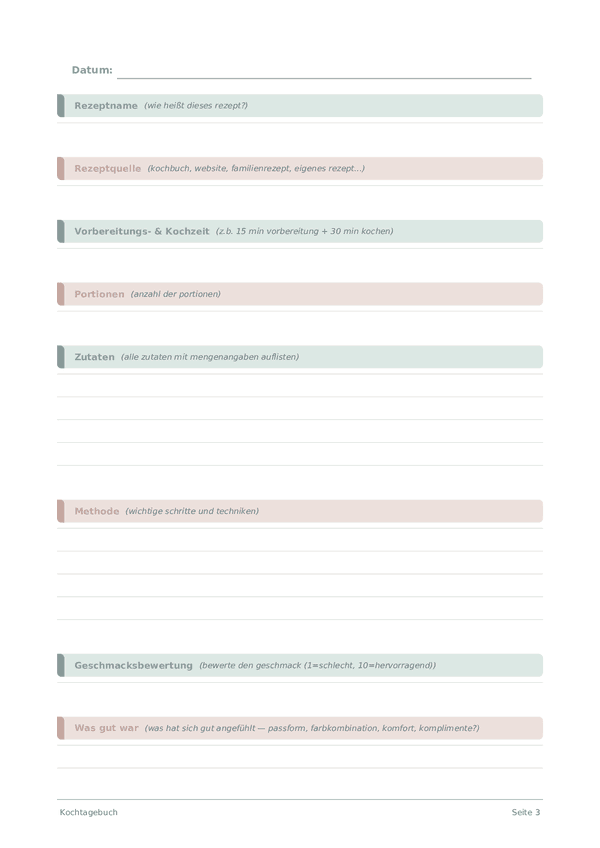
Printable Kochtagebuch
Rezepte testen und Kochnotizen festhalten
Document your culinary adventures with detailed recipe notes, ingredient lists, and technique observations. Rate dishes, note improvements, and build a personalized cookbook of your greatest hits.
Felder anpassen
Schalten Sie Felder ein oder aus. Klicken Sie auf den Stift zum Umbenennen oder fügen Sie eigene Felder hinzu.
Was ist dieses Journal?
A cooking journal is where your kitchen experiments stop being one-off events and start becoming a personal recipe archive enriched with honest notes on what actually happened. Cookbooks tell you what should work; your journal tells you what did work — and what did not — in your kitchen, with your ingredients, on your stove. That first-hand knowledge is irreplaceable.
Each entry captures the recipe name and source, prep and cook time, servings, a full ingredient list, your method notes, a taste rating, what worked well, and whether you would make it again. Writing these details down right after cooking preserves the small adjustments — an extra pinch of salt, two minutes less in the oven — that make the difference between good and great.
Over time your journal becomes a living cookbook tailored to your palate, your pantry, and your skill level. It is also the fastest way to improve: when you review past entries you spot repeating mistakes, identify techniques that reliably produce great results, and build confidence to improvise rather than follow every recipe to the letter.
Ausgefülltes Beispiel
So sieht ein typischer Eintrag aus, wenn er ausgefüllt ist:
Wie Sie jedes Feld ausfüllen
Jeden Tag finden Sie mehrere beschriftete Abschnitte mit Zeilen zum Schreiben. Hier erfahren Sie, wofür jeder Abschnitt gedacht ist:
Rezeptname
Wie heißt dieses Rezept?
Rezeptquelle
Kochbuch, Website, Familienrezept, eigenes Rezept...
Vorbereitungs- & Kochzeit
z.B. 15 min Vorbereitung + 30 min Kochen
Portionen
Anzahl der Portionen
Zutaten
Alle Zutaten mit Mengenangaben auflisten
Methode
Wichtige Schritte und Techniken
Geschmacksbewertung
Bewerte den Geschmack (1=schlecht, 10=hervorragend)
Was gut war
Was hat sich gut angefühlt — Passform, Farbkombination, Komfort, Komplimente?
Nochmal kochen?
Ja, Nein oder Vielleicht mit Anpassungen
Tipps für den Erfolg
Wann und wie oft schreiben
Make an entry every time you cook something noteworthy — a new recipe, a significant modification, or an interesting failure. For daily home cooks, three to four entries per week capture enough to build a useful personal cookbook without turning meals into homework. Write immediately after eating while taste memory is still acute. Weekly, plan your next cooking experiments based on journal insights. Seasonally, review your entries and compile your greatest hits into a personal recipe collection. Over a year, you will have a cookbook that no store can sell you — one perfectly tuned to your life.
Häufig gestellte Fragen
Was erfasst das Kochjournal pro Gericht?
Neun Felder pro Rezept: Rezeptname, Rezeptquelle, Vor- und Kochzeit, Portionen, Zutaten (5 Zeilen), Methode (5 Zeilen), Geschmacksbewertung, was funktionierte (2 Zeilen) und ob du es wieder kochen würdest. Die Struktur macht jeden Kochversuch zum dokumentierten Experiment statt zur Einmalsache — über die Zeit baust du ein persönliches Kochbuch, abgestimmt auf deinen Geschmack, deine Zutaten und Ausstattung.
Warum Zutaten notieren, wenn das Rezept sie schon hat?
Du notierst, was du tatsächlich verwendet hast, nicht was das Rezept vorgab. Ersatz, verfügbare Teilstücke, reife versus unreife Produkte und Mengenanpassungen beeinflussen das Ergebnis. Deine echten Zutaten festzuhalten macht aus einem einmaligen Erfolg einen wiederholbaren — und aus einem Misserfolg ein diagnostizierbares Problem. Die 5 Zutatenzeilen fassen ein Gericht mittlerer Komplexität; komplexe Rezepte können über Seiten gehen.
Wie unterscheidet sich das vom Online-Speichern von Rezepten?
Gespeicherte Rezepte sind nur Lesezeichen; dieses Journal ist eine persönliche Aufzeichnung deiner Version. Online-Rezepte gehen von einer idealen Küche und Durchschnittszutaten aus; dein Journal notiert genau, was in deiner Küche passierte — mit deinem Herd, deinem Salz, den heißen Stellen deines Backofens. Nach 20-30 Einträgen wird das Journal nützlicher als jedes Kochbuch, weil es auf deine spezifische Kochumgebung und Vorlieben kalibriert ist.
Was kommt in den Abschnitt "was funktionierte"?
Konkrete Technik-Beobachtungen: "Brühe vor der Sahne um die Hälfte reduziert — die Sauce überzog den Löffelrücken", "60-Sekunden-Anbraten ergab bessere Kruste als 90 Sekunden". Konkrete Spezifik zählt: vage Einträge ("wurde toll") verblassen schnell; konkrete bauen übertragbare Kochintuition auf. Über Küchen und Methoden hinweg wird die "was funktionierte"-Spalte deine persönliche Sammlung kleiner, hart erlernter Techniken.
Wie nutze ich die Geschmacksbewertung ehrlich?
Bewerte gegen deine Erwartung an das Gericht, nicht gegen Sterne-Standard. Eine solide Wochentags-Pasta mit 7/10 gegen "gute Wochentags-Pasta" ist nützlicher als 4/10 gegen ein unrealistisches Ideal. Verbinde die Bewertung mit Notizen — eine 5/10 mit "zu salzig" ist handlungsreif; eine 5/10 allein nur entmutigend. Über die Zeit enthüllen Bewertungsmuster Küchen und Methoden, die für dich konsequent funktionieren.
Soll ich oft gekochte Gerichte loggen oder nur neue Rezepte?
Beides, aus verschiedenen Gründen. Neue Rezepte brauchen die volle Vorlage — du lernst. Wiederholgerichte profitieren von periodischen Einträgen, um Verfeinerung zu tracken: vorgenommene Änderungen, Verbessertes, Plateaus. Viele Hobby-Köche erreichen eine bequeme Decke bei vertrauten Gerichten, ohne zu merken, dass sie aufgehört haben zu iterieren. Das Journal unterbricht diesen Drift, indem jede Wiederholung Chance für eine kleine Änderung wird.
Macht ein Kochjournal mich wirklich zu einer besseren Köchin?
Ja, wenn Einträge konkrete Beobachtungen und Revision enthalten. Kochen verbessert sich durch denselben Mechanismus der deliberate practice, den Ericsson (2016, Peak, Houghton Mifflin Harcourt) für andere Fertigkeitsbereiche dokumentiert — fokussierte Aufmerksamkeit auf spezifische Techniken mit Feedback. Die Geschmacksbewertung liefert Feedback; "was funktionierte" die spezifische Aufmerksamkeit. Ohne Schreiben wiederholen die meisten Köche dieselben Gerichte, ohne sie bewusst zu verbessern.
Wie nutze ich das Journal für Menüplanung oder Einkauf?
Blättere durch Einträge mit "nochmal kochen = ja", um den Wochenplan zu bauen, und stelle dann eine Einkaufsliste aus den Zutatenabschnitten zusammen. Das vermeidet die Falle, für Wunschgerichte einzukaufen, die nie gekocht werden. Vierteljährliche Durchsicht der Geschmacksbewertungen enthüllt, welche Lebensmittelkategorien konsequent gut ankommen — nützlich für Planung und für das Verbessern der am häufigsten gekochten Rezepte.
Das könnte Ihnen auch gefallen
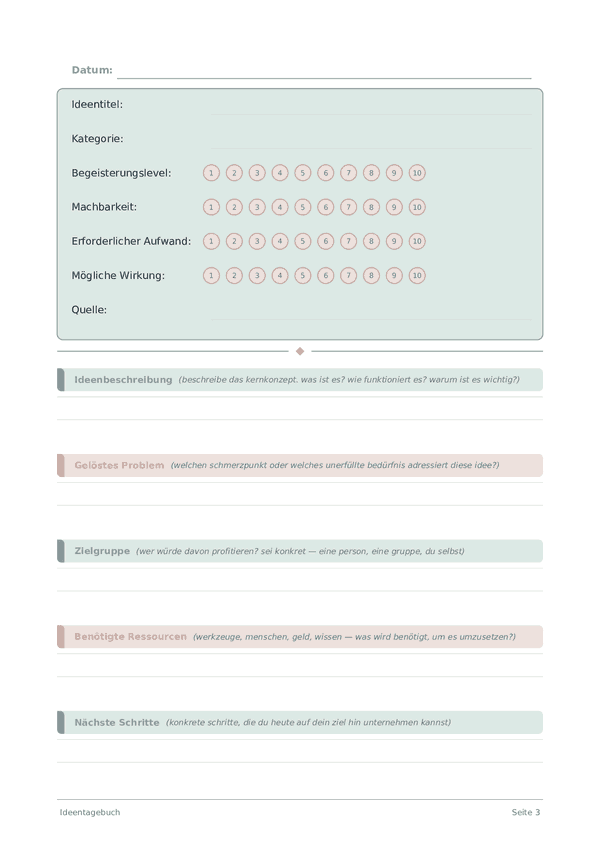
Ideentagebuch
Ihre besten Ideen festhalten, bewerten und weiterentwickeln
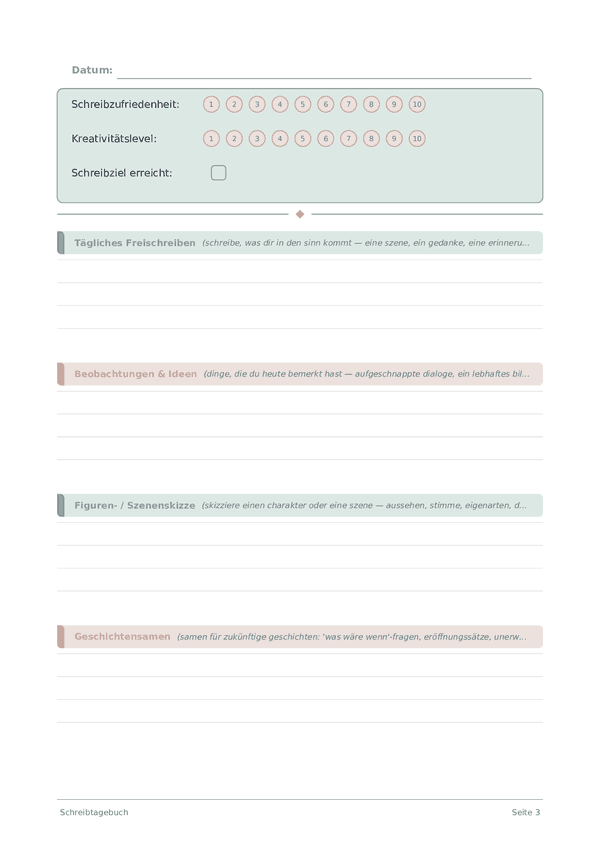
Schreibtagebuch
Tägliche kreative Schreibpraxis & Handwerksentwicklung
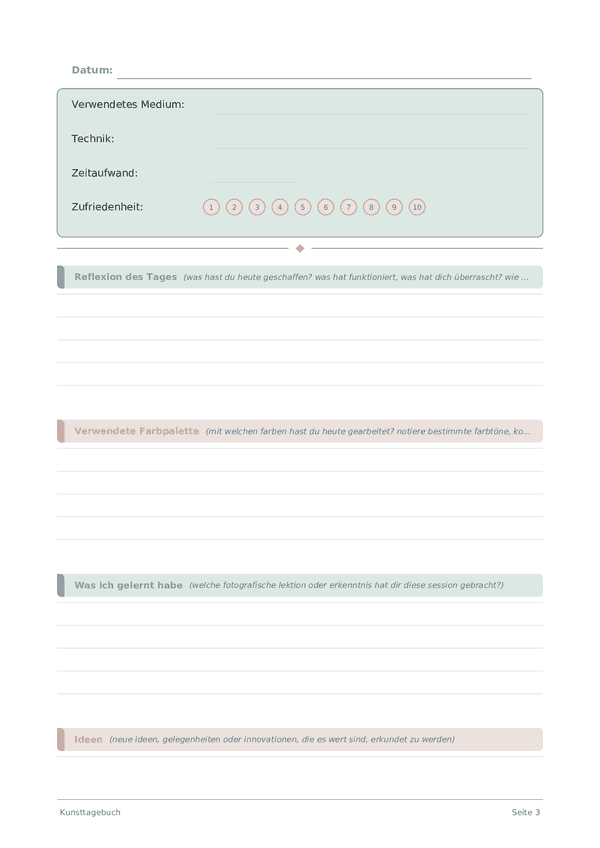
Kunsttagebuch
Dokumentieren Sie Ihren kreativen Prozess und künstlerisches Wachstum
Skizzenbuch-Tagebuch
Offene Punktraster-Seiten zum Skizzieren, Zeichnen und visuellen Entdecken

Scrollen zum Zoomen, ziehen zum Bewegen