Printable Modetagebuch
Täglicher Outfit- und Stil-Tracker
Document your daily outfits, track your personal style evolution, and build a visual wardrobe diary that inspires future fashion choices.
Felder anpassen
Schalten Sie Felder ein oder aus. Klicken Sie auf den Stift zum Umbenennen oder fügen Sie eigene Felder hinzu.
Was ist dieses Journal?
A fashion journal is a daily outfit diary that helps you develop and refine your personal style. By tracking what you wear, rating how it made you feel, and reflecting on what worked and what to try next, you build a visual and written record of your evolving style identity.
This journal is for anyone who wants to be more intentional about how they dress — whether you are discovering your personal style, curating a capsule wardrobe, or simply want to stop the "nothing to wear" feeling by understanding what actually works for your body and lifestyle.
Fashion psychology research shows that clothing significantly affects mood, confidence, and cognitive performance — a phenomenon called "enclothed cognition." By tracking the connection between what you wear and how you feel, you develop a data-driven approach to getting dressed that maximizes both style and confidence. Over time, your journal reveals patterns that help you invest wisely and dress intentionally.
Ausgefülltes Beispiel
So sieht ein typischer Eintrag aus, wenn er ausgefüllt ist:
Wie Sie jedes Feld ausfüllen
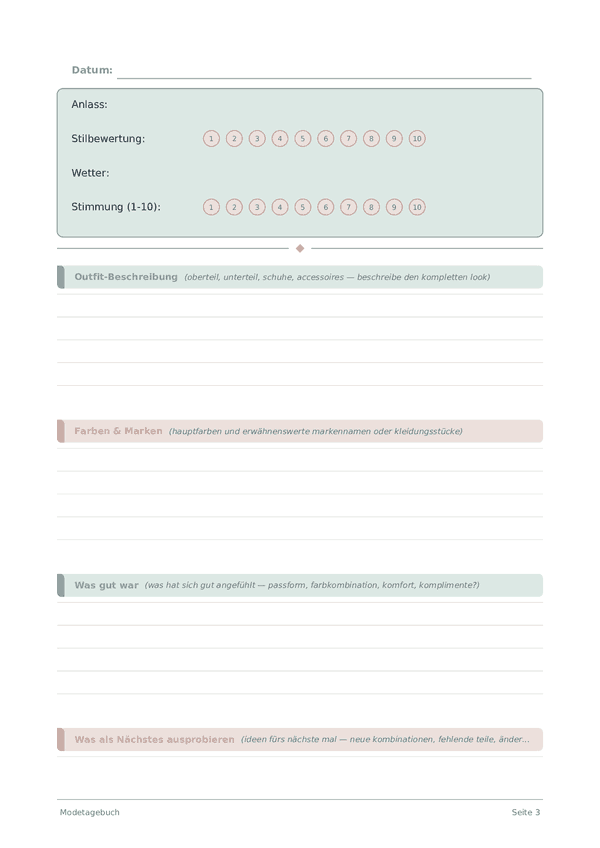
Oben auf jeder Seite befinden sich schnell ausfüllbare Felder (Bewertungen, Kontrollkästchen, Zahlen). Darunter ist ein linierter Bereich zum Schreiben. Hier erfahren Sie, was jedes Feld bedeutet:
Anlass
Arbeit, lässig, Date-Abend, Party, Gym, Reise, besonderer Anlass...
Stilbewertung
Wie gut hast du dich in diesem Outfit gefühlt? (1=unwohl, 10=perfekt)
Wetter
Temperatur und Bedingungen — sonnig, regnerisch, kalt, heiß...
Stimmung (1-10)
Bewerten Sie Ihren allgemeinen emotionalen Zustand für den Tag. 1 bedeutet sehr niedergeschlagen oder deprimiert, 10 bedeutet außergewöhnlich glücklich und positiv. Denken Sie nicht zu lange nach — vertrauen Sie Ihrem Bauchgefühl.
Outfit-Beschreibung
Oberteil, Unterteil, Schuhe, Accessoires — beschreibe den kompletten Look
Farben & Marken
Hauptfarben und erwähnenswerte Markennamen oder Kleidungsstücke
Was gut war
Was hat sich gut angefühlt — Passform, Farbkombination, Komfort, Komplimente?
Was als Nächstes ausprobieren
Ideen fürs nächste Mal — neue Kombinationen, fehlende Teile, Änderungen
Tipps für den Erfolg
Wann und wie oft schreiben
Log your outfit daily — even a 30-second entry builds a powerful style archive over time. Detailed entries (fabric notes, mood, occasion, comfort rating) are best for statement outfits or new purchases. Weekly, review what you wore most and least. Seasonally, use your journal to plan wardrobe edits: what to keep, donate, or replace. Before shopping trips, review your recent entries to avoid buying duplicates of what you already own.
Häufig gestellte Fragen
Wie hilft das Protokollieren von Outfit, Anlass, Wetter und Stimmung beim Aufbau eines persönlichen Stils?
Forschung im Journal of Fashion Marketing and Management zur Garderoben-Nutzung zeigt, dass die meisten Trägerinnen nur 20-30% besessener Kleidungsstücke aktiv nutzen. Anlass, Wetter und Stimmung neben Outfits zu protokollieren bringt Stücke an die Oberfläche, die kontextübergreifend wiederholten Einsatz verdienen — Grundlage für evidenzbasiertes Garderoben-Editieren. Susie Faux' ursprüngliches Capsule-Wardrobe-Konzept (1970er) und Donna Karans Seven Easy Pieces (1985) ruhen auf demselben Prinzip: finden, was funktioniert, dann zu weniger, besseren Stücken verfeinern.
Warum sowohl Stil als auch Stimmung bewerten — ist das nicht dasselbe?
Sie weichen bedeutsam voneinander ab. Das Journal of Fashion Marketing and Management dokumentiert Enclothed Cognition — den Einfluss von Kleidung auf den psychologischen Zustand der Tragenden. Stimmung 9/10 bei Stil 6/10 sagt, dass das Outfit nicht außergewöhnlich aussah, sich aber richtig anfühlte; Stil 9/10 bei Stimmung 5/10 signalisiert ein eindrucksvolles Outfit, das Ihnen nicht diente. Beides zu tracken zeigt, wann Stilentscheidungen Wohlbefinden stützen und wann sie Kostümierung sind.
Wie nutze ich die Felder was funktionierte und was als Nächstes probieren effektiv?
Diese Felder verwandeln jeden Eintrag in ein kleines Experiment. Die Capsule-Wardrobe-Methodik von Susie Faux (1970er) und verfeinert in Donna Karans Seven Easy Pieces (1985) basiert auf iterativem Lernen: jedes Outfit bestätigt oder revidiert Hypothesen zu Silhouette, Farbe, Proportion. 'Was funktionierte' erfasst erfolgreiche Elemente (hohe Taille mit cropped Strick); 'was als Nächstes probieren' verpflichtet Sie zu einem konkreten Test — andere Ärmellänge, ein Layering-Experiment, eine neue Farbkombination.
Wie unterscheidet sich dieses Journal von Outfit-Planungs-Apps wie Stylebook oder Whering?
Apps fotografieren und katalogisieren Stücke, verlassen sich aber darauf, dass Sie sich erinnern, warum etwas funktionierte. Schreiben erzwingt Artikulation — Proportion, Stofffall, Anlasspassung zu benennen — was Lernen vertieft. Die Literatur des Journal of Fashion Marketing and Management zur Stilidentitäts-Entwicklung betont reflexive Praxis über passives Katalogisieren. App und Journal sind komplementär: die App für Inventar und visuelle Referenz, das Journal für die analytische Erzählung, die wiederholte Outfits zu kohärentem persönlichem Stil formt.
Kann dieses Journal nachhaltige Garderoben-Entscheidungen unterstützen?
Ja. Die Ellen MacArthur Foundation dokumentiert in A New Textiles Economy (2017), dass die Bekleidungsindustrie 53 Millionen Tonnen Fasern jährlich produziert, vieles unterausgenutzt. McKinseys State of Fashion-Berichte betonen ebenso, dass Tragehäufigkeit der entscheidende persönliche Nachhaltigkeits-Hebel ist. Outfit-Wiederholungen zu protokollieren offenbart 'Cost-per-wear'-Muster — Stücke mit 30+ Tragungen sind weit nachhaltiger als selten getragene Statement-Teile. Das Journal verwandelt abstrakte Nachhaltigkeit in konkrete Garderoben-Daten.
Wie lange, bis ich meinen persönlichen Stil aus Einträgen erkennen kann?
Planen Sie 60-90 protokollierte Tage. Capsule-Wardrobe-Methodik (Faux, 1970er; Karan, 1985) und Stilidentitäts-Forschung im Journal of Fashion Marketing and Management legen nahe, dass Muster der Farbpräferenz, Silhouetten-Gravitation und Proportions-Intuition mehrere Monate zur Klärung brauchen. Sichten Sie monatlich: welche Kombinationen erhalten wiederholt 8+ Stil-Bewertungen? Welche Farben tauchen in Ihren stimmungsstärksten Einträgen auf? Persönlicher Stil ist empirisch, nicht aspirativ — das Journal macht ihn sichtbar.
Was sollte ich im Feld Farben und Marken schreiben — und warum zählt das?
Notieren Sie spezifische Farben (nicht 'blau', sondern 'navy' oder 'kobalt') und exakte Markennamen. Über 100+ Einträge zeigen die Daten, welche Marken wiederholtes Tragen verdienen — nützlich für künftige Käufe. Die Forschung des Journal of Fashion Marketing and Management zur Markentreue bestätigt, dass persönliche Erfahrung das Marketing in langfristigen Vorlieben überwiegt. Farb-Tracking offenbart auch unbewusste Paletten-Gravitation; viele entdecken, dass sie tatsächlich fünf Farben in Rotation tragen, nicht das Dutzend im Schrank.
Häufige Fehler, die Fashion-Journal-Einträge verschwenden?
Erstens Fotografieren ohne Schreiben — Bilder allein erfassen nicht, warum ein Outfit gelang. Zweitens nur 'süße' Outfits bewerten und tägliche Basics auslassen, die tatsächlich 80% des Lebens füllen. Drittens generische Beschreibungen wie 'Jeans und T-Shirt' statt spezifischer Schnitt, Passform und Marke. Viertens Wetterfeld ignorieren — ein toller Winter-Look scheitert im Juli. Fünftens Einträge nicht durchsehen; das Ellen MacArthur Foundation-Prinzip der Tragehäufigkeit verlangt periodische Datensichtung, nicht nur Sammlung.
Das könnte Ihnen auch gefallen
Scrollen zum Zoomen, ziehen zum Bewegen