Printable Lesetagebuch
Reflektieren Sie über jedes gelesene Buch
A guided reading journal that combines quick tracking with thoughtful reflection. Rate each book, record your progress, and capture the quotes, insights, and takeaways that matter most. Transform passive reading into an active practice of learning and self-discovery.
Felder anpassen
Schalten Sie Felder ein oder aus. Klicken Sie auf den Stift zum Umbenennen oder fügen Sie eigene Felder hinzu.
Vorteile
Anleitung
Was ist dieses Journal?
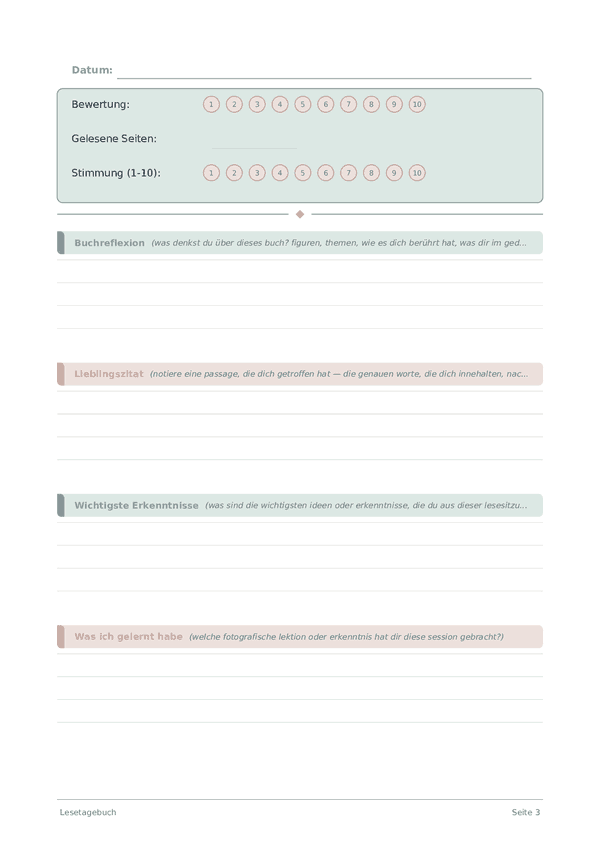
A Reading Journal is a hybrid companion for thoughtful readers who want to get more from every book. The top section tracks your rating, pages read, and current mood. The bottom section prompts you to reflect on what you read, capture key takeaways, save your favorite quote, note what you learned, and record whether you would recommend the book. It transforms passive reading into active learning.
Studies in cognitive science consistently show that writing about what you read dramatically improves retention and understanding. Without reflection, most of a book's insights fade within weeks. This journal creates a simple habit: after each reading session, spend a few minutes processing the material in your own words. Over time, you build a personal library of distilled wisdom that you can revisit anytime.
Keep this journal next to wherever you read. After each session, fill in the tracker — it takes seconds. Then write your reflection while the material is fresh: what stood out, what challenged your thinking, what you want to remember. The favorite quote section is especially valuable — curating the lines that resonate with you creates a personal anthology that reveals your evolving interests and values.
Ausgefülltes Beispiel
So sieht ein typischer Eintrag aus, wenn er ausgefüllt ist:
Wie Sie jedes Feld ausfüllen
Oben auf jeder Seite befinden sich schnell ausfüllbare Felder (Bewertungen, Kontrollkästchen, Zahlen). Darunter ist ein linierter Bereich zum Schreiben. Hier erfahren Sie, was jedes Feld bedeutet:
Bewertung
Gesamtbewertung des Erlebnisses
Gelesene Seiten
Wie viele Seiten hast du heute gelesen? Auch ein paar Seiten zählen — Beständigkeit zählt
Stimmung (1-10)
Bewerten Sie Ihren allgemeinen emotionalen Zustand für den Tag. 1 bedeutet sehr niedergeschlagen oder deprimiert, 10 bedeutet außergewöhnlich glücklich und positiv. Denken Sie nicht zu lange nach — vertrauen Sie Ihrem Bauchgefühl.
Buchreflexion
Was denkst du über dieses Buch? Figuren, Themen, wie es dich berührt hat, was dir im Gedächtnis geblieben ist
Lieblingszitat
Notiere eine Passage, die dich getroffen hat — die genauen Worte, die dich innehalten, nachdenken oder fühlen ließen
Wichtigste Erkenntnisse
Was sind die wichtigsten Ideen oder Erkenntnisse, die du aus dieser Lesesitzung mitnimmst?
Was ich gelernt habe
Schreiben Sie eine neue Sache auf, die Sie heute gelernt haben. Es kann eine Tatsache sein, eine Fähigkeit, eine Erkenntnis über sich selbst oder eine Lebenslektion. Tägliches Lernen summiert sich zu Weisheit.
Würde empfehlen
Würdest du dieses Buch empfehlen? Wem und warum?
Tipps für den Erfolg
Wann und wie oft schreiben
Make a short entry every time you finish a reading session — even two lines are enough to capture what resonated. Write a full reflection within a day of finishing a book while details are still vivid. Once a month, scan your entries to notice trends: are you gravitating toward certain authors, themes, or moods? A quarterly review of your reading list helps you set intentional goals for the next period rather than drifting between random picks.
Häufig gestellte Fragen
Was verfolgt das Lese-Journal pro Eintrag?
Ein Tracker (Bewertung 0-10, gelesene Seiten bis 9999, Stimmung 0-10) plus 8 linierte Zeilen für Buchreflexion mit konkreten Prompts für Lieblingszitat, Kernaussagen, Gelerntes und Empfehlung. Das Hybridformat passt zu Pro-Buch-Reflexion am Abschluss und zu Pro-Sitzung-Logging während längerer Lektüren. Die Struktur verwandelt Lesen von einer passiven Tätigkeit in eine aktive Lernpraxis.
Warum gelesene Seiten loggen — ist nicht das Beenden des Buchs wichtig?
Seiten-Logging erhält die tägliche Gewohnheit und enthüllt Muster. Manche Lesende überschätzen ihr Tempo stetig; andere entdecken, dass sie mehr lesen als gedacht. Willingham (2017, The Reading Mind, Jossey-Bass) betont, dass der stärkste Prädiktor für Leseverständnis nachhaltiges Engagement ist — das wächst durch tägliches Lesen mehr als durch gelegentliche Marathon-Sitzungen. Selbst 10 täglich geloggte Seiten übertreffen das tatsächliche Volumen der meisten Hobby-Lesenden.
Wie schreibe ich nützliche Kernaussagen?
Zwei oder drei konkrete Ideen aus dem Buch in deinen Worten, nicht in denen des Autors. Wolf (2018, Reader, Come Home, HarperOne) beschreibt, wie tiefes Lesen verlangt, dass das Gehirn konstruiert statt passiv empfängt — deine Formulierung ist die Konstruktion. Vage Kernaussagen ("wichtiges Buch") verblassen; konkrete ("Zinseszins arbeitet bei Schulden gegen dich genauso wie bei Ersparnissen für dich") überleben.
Verbessert ein Lese-Journal wirklich das Behalten?
Ja — aus dem gleichen Grund, aus dem der Testing-Effekt im akademischen Lernen wirkt. Roediger und Karpicke (2006, Psychological Science, 17(3), 249-255) zeigten, dass Abruf und Artikulation viel stärkeres Langzeitgedächtnis erzeugen als erneutes Lesen. Die Reflexions-Prompts erzwingen Abruf; das Lieblingszitat-Feld fordert Auswahl. Journalende Lesende behalten nach sechs Monaten etwa 2-3x mehr eines Buchs als jene, die einfach fertig lesen und weitermachen. Deutsche Empfehlungen ähnlicher Stoßrichtung kommen u.a. von der Stiftung Lesen.
Wie unterscheidet sich das von Goodreads oder einer Lese-App?
Goodreads loggt, dass du ein Buch gelesen hast und deine Bewertung; dieses Journal erfasst, was du daraus mitgenommen hast. Der 8-Zeilen-Reflexionsraum ist, wo Lesen zu Lernen wird. Apps optimieren auf soziales Teilen und Empfehlungsalgorithmen; dieses Journal auf persönliches Verstehen. Nutze beides — Goodreads für Tracking und Entdecken, das Journal für Bücher, die es lohnen, gut erinnert zu werden.
Was, wenn ich Belletristik lese — gelten Kernaussagen und "Gelerntes"?
Ja. Belletristik lehrt anders — über Charakter, Sprache, emotionale Wahrheit, Erzählstruktur — aber sie lehrt. Maryanne Wolf (2018, Reader, Come Home, HarperOne) beschreibt, wie tiefes literarisches Lesen Empathie und Reflexion messbar entwickelt. Kernaussagen können eine Handwerksbeobachtung, ein wiederkehrendes Bild oder einen Denkwandel erfassen. "Empfehlung" wird für Fiction nuancierter: wem und wofür?
Soll ich pro Buch oder pro Lesesitzung schreiben?
Pro Sitzung bei langen oder komplexen Büchern; pro Buch bei kürzeren oder leichteren Lektüren. Mehrsitzungs-Logging erfasst evolvierende Eindrücke — dein Blick auf eine Figur oder ein Argument verschiebt sich oft, während sich das Buch entfaltet. Das Seiten-Feld stützt beide Ansätze. Lese- und Unterrichtsforschung zeigt, dass verteiltes Engagement und Reflexion tieferes Verständnis erzeugen als Einzelsitzungs-Reaktionen. National Reading Panel (NICHD) bestätigt diese Linien.
Wie oft sollte ich alte Lese-Einträge durchsehen?
Vierteljährlich für Mustererkennung; Jahresende für das Gesamtbild. Der Spacing-Effekt (Cepeda et al., 2006, Psychological Bulletin, 132(3), 354-380) macht verteiltes Wiederlesen zum stärksten Werkzeug für langfristige Integration. Jahresend-Durchsicht mit Aufmerksamkeit für Bewertungen und Lieblingszitate enthüllt zudem Geschmacksverschiebungen und aktuelle Beschäftigungen — das Journal wird zur unbeabsichtigten Chronik intellektueller Entwicklung über Jahre.
Das könnte Ihnen auch gefallen
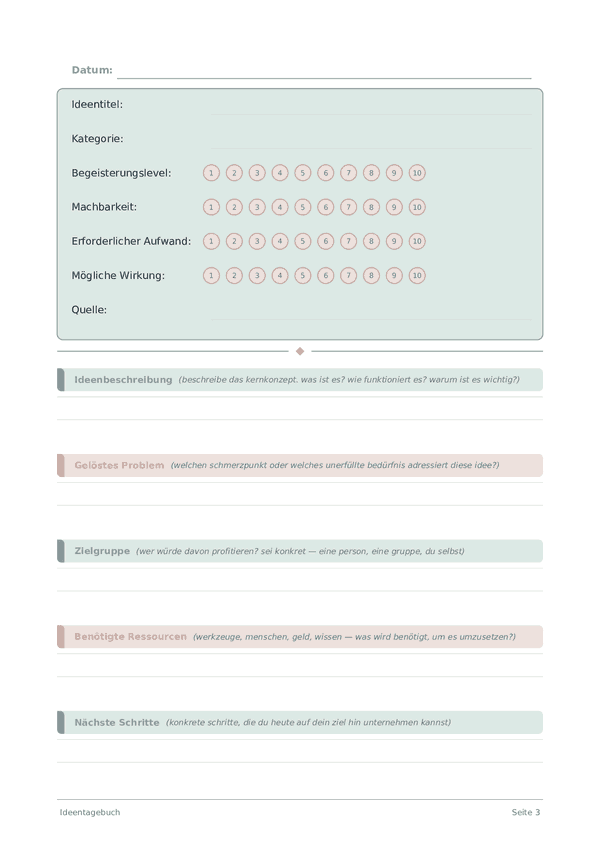
Ideentagebuch
Ihre besten Ideen festhalten, bewerten und weiterentwickeln
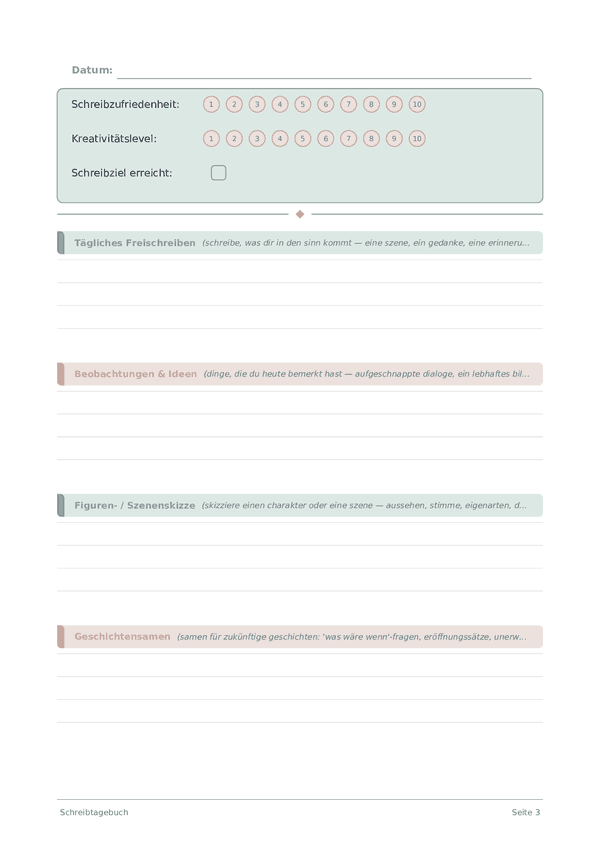
Schreibtagebuch
Tägliche kreative Schreibpraxis & Handwerksentwicklung
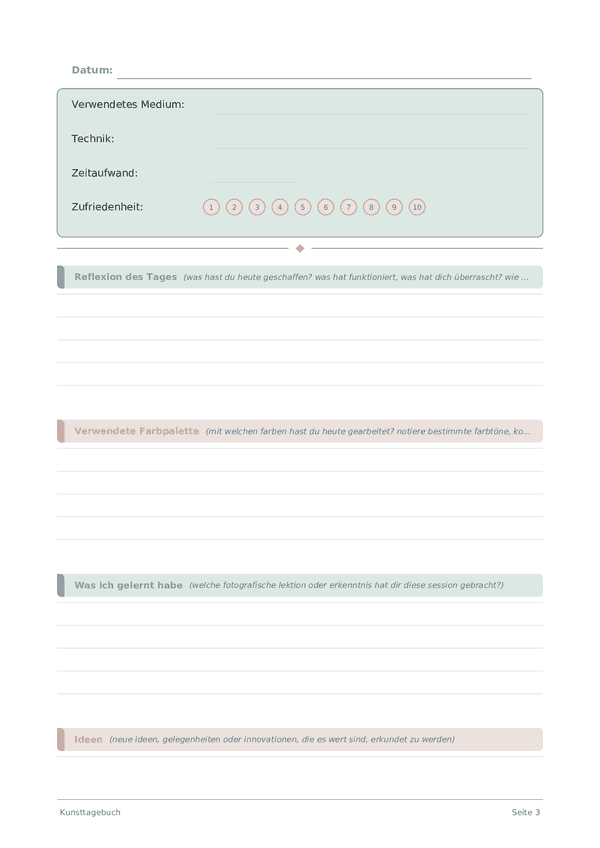
Kunsttagebuch
Dokumentieren Sie Ihren kreativen Prozess und künstlerisches Wachstum
Skizzenbuch-Tagebuch
Offene Punktraster-Seiten zum Skizzieren, Zeichnen und visuellen Entdecken

Scrollen zum Zoomen, ziehen zum Bewegen