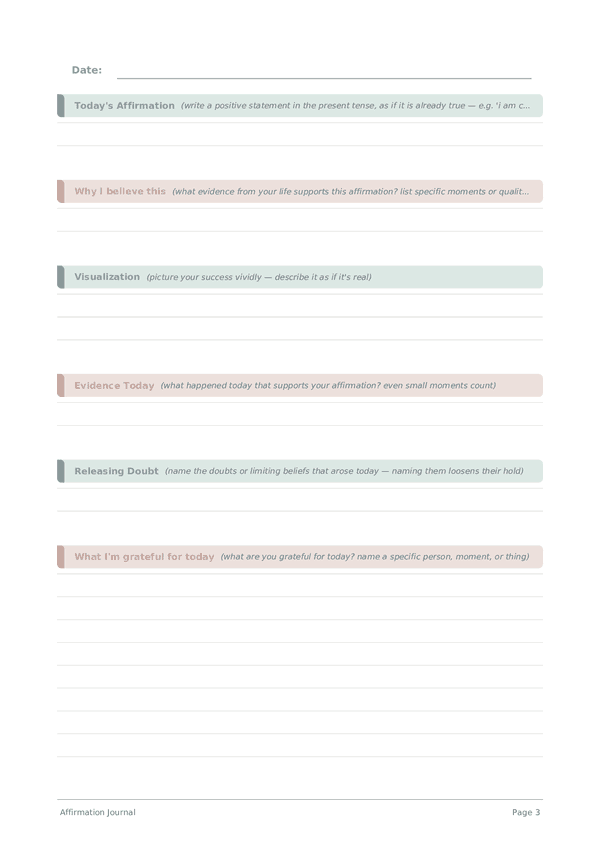
Printable Affirmation Journal
Daily affirmation practice and positive belief journal
Reinforce positive beliefs and rewire your mindset with daily affirmations. Visualize your goals, gather evidence for your beliefs, and release limiting doubts through guided reflection.
Customize fields
Toggle fields on or off. Click the pencil to rename, or add your own fields.
What is this journal?
An affirmation journal is a daily practice of consciously reprogramming your inner dialogue through positive, present-tense statements about yourself and your life. Rooted in cognitive behavioral therapy and neuroscience, affirmations work by gradually replacing negative thought patterns with constructive ones — not through denial, but through evidence-based self-belief.
Research shows that self-affirmation activates the brain's reward centers and reduces the stress response. The key to effective affirmations is not just repeating words, but building genuine belief through evidence and visualization. That is exactly what this journal's structure facilitates.
Each day, you write your chosen affirmation, explain why you believe it, visualize it in action, find real evidence from your day, practice releasing doubt, and anchor it all in gratitude. This six-step process transforms affirmations from empty mantras into deeply felt truths that reshape how you see yourself.
Filled example
Here's what a typical entry looks like when filled in:
How to fill in each field
Each day you'll find several labeled sections with lines for writing. Here's what each section is for:
Today's Affirmation
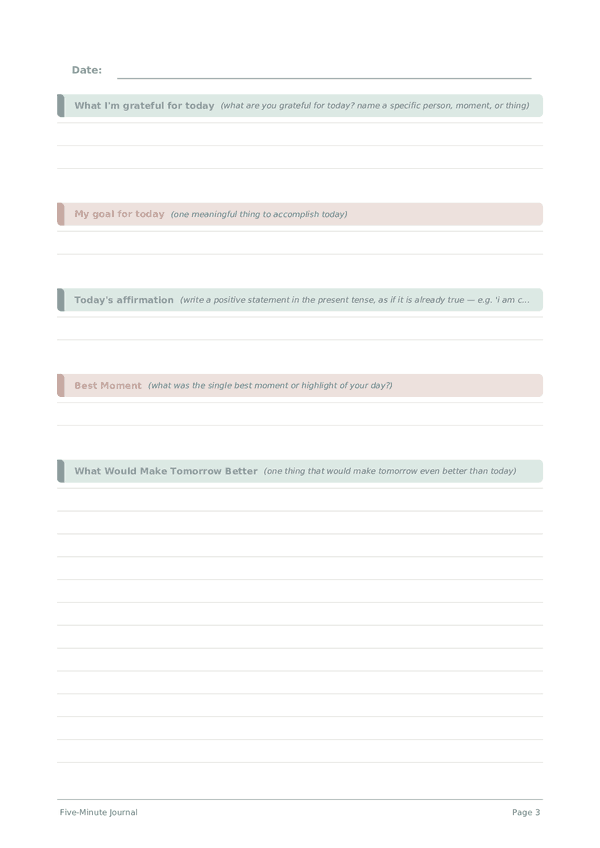
Write a positive statement in the present tense, as if it is already true — e.g. 'I am confident and capable'
Why I believe this
Explain why your affirmation is true. List evidence from your life that supports it. This transforms affirmations from empty words into grounded beliefs.
Visualization
Picture your success vividly — describe it as if it's real
Evidence Today
What happened today that supports your affirmation? Even small moments count
Releasing Doubt
Name the doubts or limiting beliefs that arose today — naming them loosens their hold
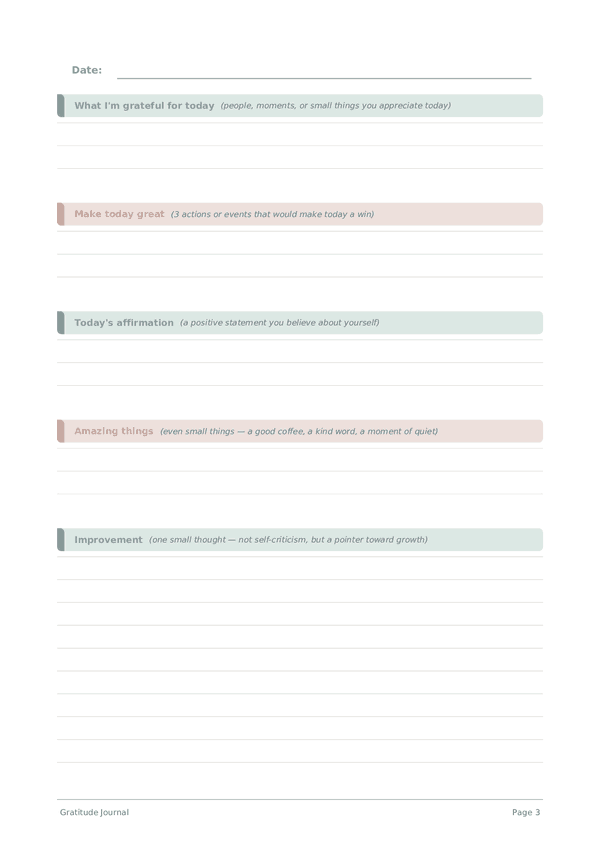
What I'm grateful for today
List 1–3 things you're grateful for today. They can be big or tiny — a good meal, a kind word, sunshine. Gratitude journaling is one of the most scientifically supported well-being practices.
Tips for success
When and how often to write
Write every morning as part of your first-10-minutes routine. Morning affirmation practice primes your reticular activating system (the brain's filter) to notice evidence supporting your affirmation throughout the day. In the evening, fill in the 'evidence today' section to close the loop. This morning-and-evening rhythm is what makes affirmation practice truly transformative.