Printable Five-Minute Journal
Five-minute daily gratitude and reflection journal
Transform your mindset in just five minutes a day. Start mornings with gratitude and intention, end evenings with reflection and growth. Based on the world popular five-minute journaling practice.
Customize fields
Toggle fields on or off. Click the pencil to rename, or add your own fields.
What is this journal?
The five-minute journal is a scientifically backed morning and evening practice distilled into its most essential form. In just five minutes a day — split between morning intentions and evening reflections — you build habits of gratitude, focus, and continuous self-improvement.
This journal is perfect for busy people who want the proven benefits of journaling without the time commitment. Its minimalist structure makes it the easiest journal to maintain consistently, which is exactly what makes it effective. Whether you are new to journaling or returning after a break, this format removes all friction.
Based on research from positive psychology, the five-minute journal targets three high-impact areas: gratitude (which rewires your brain for positivity), daily intention-setting (which doubles follow-through), and reflective learning (which compounds personal growth over time). Five minutes is the minimum effective dose for lasting change.
Filled example
Here's what a typical entry looks like when filled in:
How to fill in each field
Each day you'll find several labeled sections with lines for writing. Here's what each section is for:
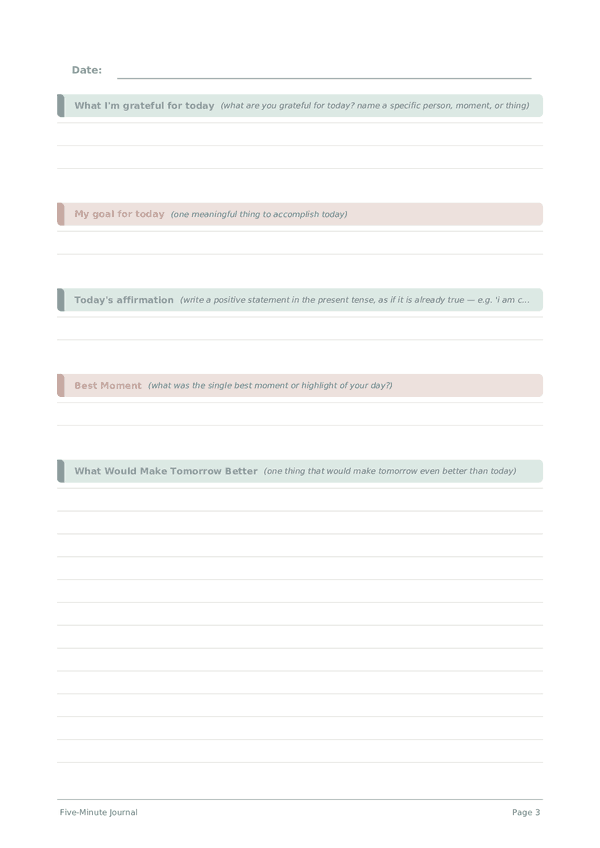
What I'm grateful for today
List 1–3 things you're grateful for today. They can be big or tiny — a good meal, a kind word, sunshine. Gratitude journaling is one of the most scientifically supported well-being practices.
My goal for today
Write one specific, achievable goal for today. Having a single focus dramatically improves your chances of actually completing it.
Today's affirmation
Write a positive statement about yourself in the present tense, as if it's already true. For example: 'I am capable and resilient.' Repeating affirmations rewires your thinking patterns over time.
Best Moment
What was the single best moment or highlight of your day?
What Would Make Tomorrow Better
One thing that would make tomorrow even better than today
Tips for success
When and how often to write
The format is designed for twice daily: morning and evening. In the morning (2-3 minutes), write your gratitudes, affirmation, and daily goals before checking your phone. In the evening (2-3 minutes), list your highlights and one improvement. Never spend more than 5 minutes total — this constraint is a feature, not a limitation. The journal works through brevity and consistency. Missing the morning is okay; do both parts in the evening. The goal is never missing a full day.
Frequently Asked Questions
What is the Five-Minute Journal designed to do?
It bundles three evidence-based practices into one short page: morning gratitude (three lines for what you're grateful for), intention setting (a daily goal plus an affirmation), and evening reflection (best moment plus what would make tomorrow better). Emmons and McCullough (2003, JPSP, 84(2)) showed weekly gratitude lists improved well-being. The five-minute format keeps adherence high while still engaging these mechanisms every day.
How do I fill in the 'what I'm grateful for today' section properly?
Use the three lines for specific, concrete items rather than broad categories. Instead of 'family,' write 'my sister called during lunch and made me laugh.' Emmons (2007, 'Thanks!', Houghton Mifflin) and Wood et al. (2010, Clinical Psychology Review, 30(7)) found that specificity and variation both matter — repeating identical entries reduces the gratitude effect over weeks of practice.
Is the affirmation line backed by real evidence?
Self-affirmation theory (Steele, 1988) and Cohen and Sherman (2014, Annual Review of Psychology, 65) show that value-affirmations buffer against threat and improve performance. Effective affirmations align with personal values, not generic positive slogans. Wood et al. (2009, Psychological Science, 20(7)) warn that positive statements people don't actually believe can backfire — keep the affirmation realistic and personally meaningful.
Should I do this in the morning or the evening?
Split it. The structure assumes two sittings: gratitude, today's goal, and affirmation in the morning to prime your mindset; best moment and what would make tomorrow better at night to consolidate the day. This mirrors expressive-writing protocols (Pennebaker, 1997, Psychological Science, 8(3)) where bookending reflection improved emotional processing more than a single session. The compact daily format prioritizes adherence over depth — and consistency is what drives outcomes in journaling research.
How is this different from a mood-tracking app?
Apps capture ratings; this journal captures language. Writing by hand engages slower, deeper encoding — Mueller and Oppenheimer (2014, Psychological Science, 25(6)) showed handwriting promotes conceptual processing over verbatim recording. Five prompts encourage narrative reflection rather than scores, and the paper format eliminates the notification-driven attention costs well documented in attention research.
Can a five-minute practice really shift my mindset?
Short interventions add up. Seligman et al. (2005, American Psychologist, 60(5)) found that a one-week 'three good things' exercise produced happiness gains lasting six months. Lyubomirsky (2007, 'The How of Happiness', Penguin) reports gratitude practices contribute substantially to the 40% of well-being variance considered intentional. Consistency over months matters more than session length.
What's the difference between 'my goal for today' and 'affirmation'?
Today's goal is a behavioral intention — one specific action you'll complete (Gollwitzer, 1999, American Psychologist, 54(7), on implementation intentions). The affirmation is an identity-level statement about your values or qualities. The first answers 'what will I do?'; the second answers 'who am I being?' Pairing them links daily action to identity-based motivation.
Is this suitable if I'm struggling with depression?
Gratitude journaling shows modest benefits as a supportive practice but is not a treatment. Cregg and Cheavens (2021, Journal of Happiness Studies, 22) found gratitude interventions had small effects on depression. If you have clinical depression, consult a licensed mental health professional — journaling complements but does not replace evidence-based therapy such as CBT or medication management when indicated.
You Might Also Like
Scroll to zoom, drag to move