Printable Emotion Journal
Understand, process, and grow through your emotions
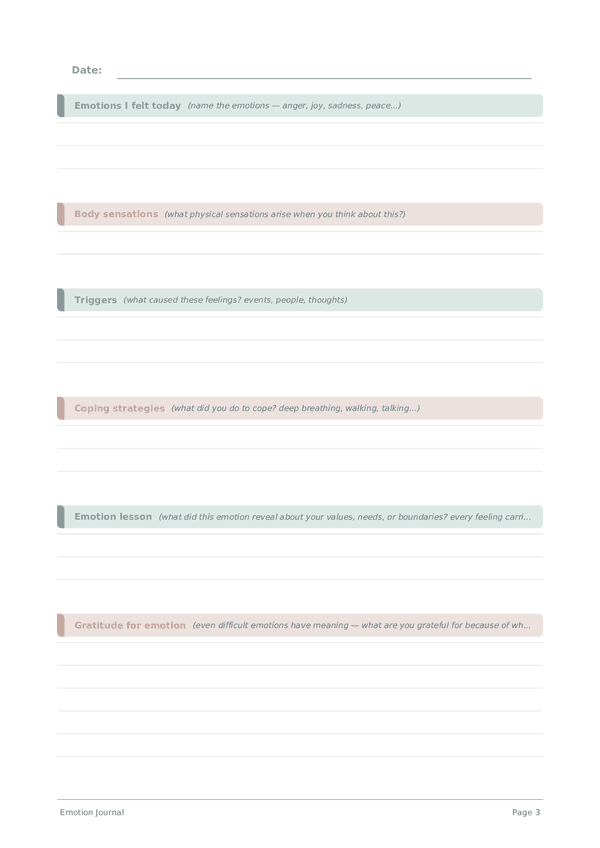
Explore the full spectrum of your emotional life with this science-backed daily journal. Name what you feel, locate it in your body, uncover what triggered it, discover how you coped, extract the lesson it carries, and find gratitude even in difficulty. Built on evidence-based emotional intelligence practices used by therapists and mindfulness coaches.
Customize fields
Toggle fields on or off. Click the pencil to rename, or add your own fields.
Benefits
How to Use
What is this journal?
An emotion journal is a therapeutic writing practice focused specifically on understanding and processing your emotional experiences. Unlike a mood tracker that captures a snapshot, this journal invites you to explore the full texture of your feelings — what you felt, where you felt it in your body, what triggered it, and what it can teach you.
Emotional awareness is the foundation of emotional intelligence. Research by psychologist James Pennebaker has shown that expressive writing about emotions significantly reduces anxiety, improves immune function, and enhances overall wellbeing. The key is not just naming emotions but exploring them with curiosity rather than judgment.
This journal guides you through six focused sections: identifying emotions, noticing body sensations, exploring triggers, documenting coping strategies, extracting lessons, and finding gratitude within emotional experiences. This structured approach transforms overwhelming feelings into manageable insights.
Filled example
Here's what a typical entry looks like when filled in:
How to fill in each field
Each day you'll find several labeled sections with lines for writing. Here's what each section is for:
Emotions I felt today
Name the specific emotions you experienced. Research shows that labeling emotions reduces their intensity and increases self-awareness.
Body sensations
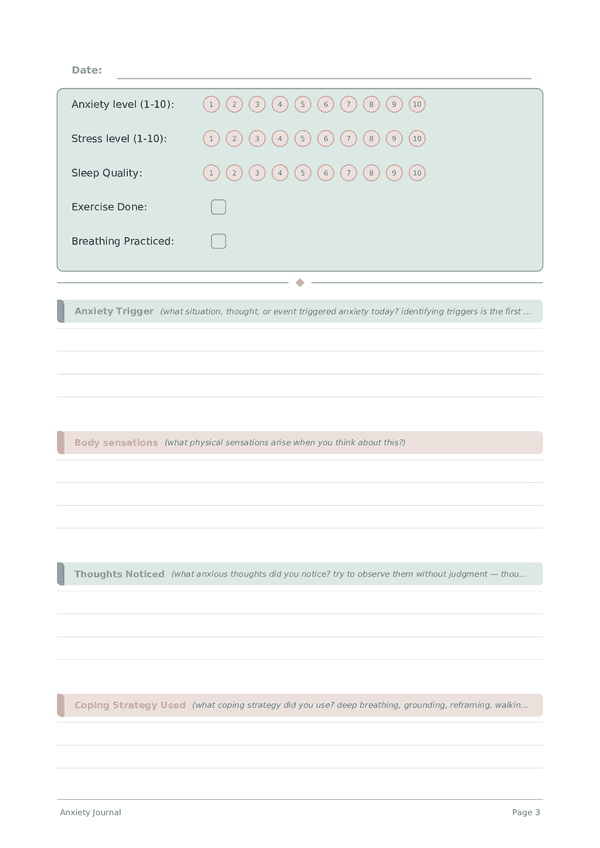
What physical sensations arise when you think about this?
Triggers
Identify what caused your emotional reactions — events, people, thoughts, environments. Recognizing triggers gives you the power to prepare for or avoid them.
Coping strategies
What did you do to cope? Deep breathing, walking, talking...
Emotion lesson
What did this emotion reveal about your values, needs, or boundaries? Every feeling carries a message worth hearing
Gratitude for emotion
Even difficult emotions have meaning — what are you grateful for because of what you felt today?
Tips for success
When and how often to write
Write at the end of your day, when emotions from the day are still fresh but you have some distance from them. If a strong emotion hits during the day, jot a quick note to expand on later. Daily practice is ideal for building emotional awareness, but even 3–4 times per week will sharpen your ability to name and navigate feelings.
Frequently Asked Questions
How specific should I be in the 'emotions I felt today' section?
Very specific. Lisa Feldman Barrett's research on emotional granularity (Kashdan, Barrett, McKnight, 2015, Current Directions in Psychological Science, 24(1)) shows people who distinguish fine-grained emotions — 'frustrated', 'resentful', 'humiliated' rather than just 'bad' — regulate emotion more effectively and use less alcohol or aggression under stress. Use the three lines to name distinct feelings, not a single umbrella word.
Why does the journal ask about 'body sensations'?
Emotions surface as physical signals before conscious labels. The interoception-emotion link is documented in Critchley and Garfinkel (2017, Current Opinion in Psychology, 17). Naming where you feel tightness, heat, or heaviness improves what Hayes (Acceptance and Commitment Therapy) calls cognitive defusion — observing the feeling rather than fusing with it. Two lines is enough for a quick body scan.
How do I identify a 'trigger' accurately?
Use the three lines to map the situation, the thought, and the emotion in sequence — the A-B-C model from Albert Ellis's REBT and Aaron Beck's cognitive therapy ('Cognitive Therapy and the Emotional Disorders', 1976). The trigger is rarely the event alone; it's the meaning your mind assigned. Writing all three exposes the appraisal that drove the emotion.
What counts as a healthy 'coping strategy' to log?
Separate approach from avoidance. Folkman and Lazarus's transactional model and Carver's COPE inventory sort strategies into problem-focused, emotion-focused, or avoidant. Log what you actually did — including unhelpful coping like scrolling or eating. Honest tracking reveals patterns. Aldao, Nolen-Hoeksema, Schweizer (2010, Clinical Psychology Review, 30(2)) found rumination and suppression predict worse outcomes than reappraisal.
Is this journal the same as a mood tracker?
No. Mood trackers use numeric ratings; this journal builds emotional granularity through narrative. Three lines for emotions I felt today, plus body sensations, triggers, and lesson, follow Pennebaker's expressive-writing format (Pennebaker, 1997, Psychological Science, 8(3)), which produced health and mood benefits ratings alone do not. Pair it with a tracker for full data. Brief but daily entries produce more reliable patterns than infrequent longer reflections.
What does 'emotion lesson' mean and how do I find one?
Every emotion signals an unmet need or violated value. Marc Brackett's RULER framework (Yale Center for Emotional Intelligence) and Susan David's 'emotional agility' work treat emotions as information. Ask: what does this feeling want me to notice — about my boundaries, values, or unmet needs? Three lines is space for one honest insight, not a complete philosophy.
Can I use this for difficult emotions like anger or shame?
Yes, that's its strength. Suppressing emotions worsens outcomes (Gross, 2002, Psychophysiology, 39(3) on expressive suppression). Naming difficult emotions on paper — including gratitude for emotion at the end — supports what Linehan's DBT calls 'radical acceptance'. If shame, anger, or grief feel overwhelming or persistent, consult a licensed mental health professional alongside journaling.
How often should I fill it in to see results?
Aim for daily during emotionally active periods, three to four times weekly otherwise. Burton and King (2004, Journal of Research in Personality, 38(2)) found two-minute expressive writing across three days produced measurable well-being improvements. Consistency matters more than length. Review weekly to spot which triggers and coping strategies recur. Brief but daily entries produce more reliable patterns than infrequent longer reflections.
You Might Also Like
Scroll to zoom, drag to move