Printable Gratitude Journal
Cultivate thankfulness and positivity daily
Transform your mindset by focusing on the good in your life. This journal provides a simple daily structure to record what you are grateful for, capture positive moments, and affirm your best self.
Customize fields
Toggle fields on or off. Click the pencil to rename, or add your own fields.
Benefits
How to Use
What is this journal?
A gratitude journal is one of the most researched and effective wellbeing practices in positive psychology. The concept is simple: each day, you deliberately focus on the good things in your life — from major blessings to small everyday pleasures. This conscious shift in attention rewires your brain over time, making you naturally more attuned to positivity.
Developed from research by psychologists Robert Emmons and Michael McCullough, gratitude journaling has been shown to increase happiness by 25%, improve sleep quality, and reduce symptoms of depression. The practice takes just 5-10 minutes per day but compounds dramatically over weeks and months.
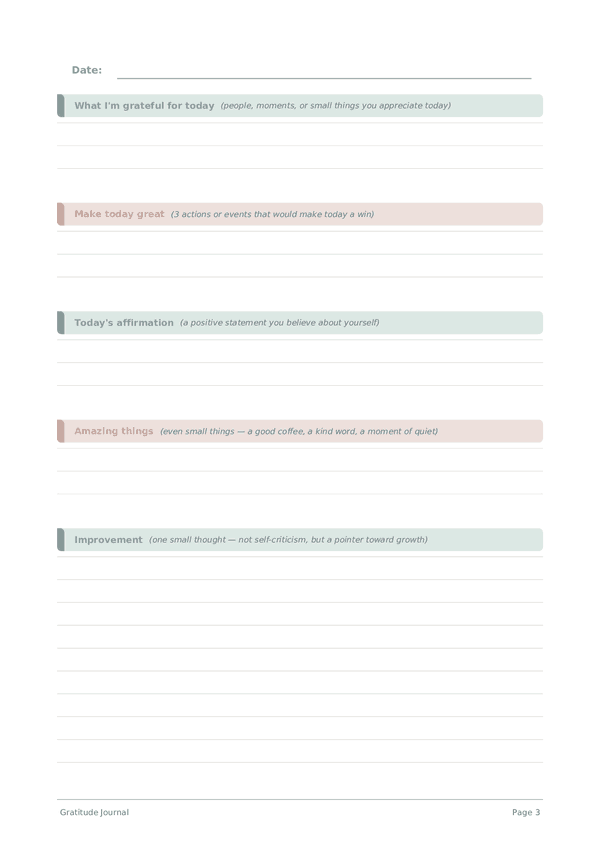
This journal uses a proven five-section structure: what you are grateful for, how to make today great, a personal affirmation, amazing things that happened, and what you could improve. This balanced approach ensures you are not just counting blessings but actively shaping a more positive, intentional life.
Filled example
Here's what a typical entry looks like when filled in:
How to fill in each field
Each day you'll find several labeled sections with lines for writing. Here's what each section is for:
What I'm grateful for today
List 1–3 things you're grateful for today. They can be big or tiny — a good meal, a kind word, sunshine. Gratitude journaling is one of the most scientifically supported well-being practices.
Make today great
3 actions or events that would make today a win
Today's affirmation
Write a positive statement about yourself in the present tense, as if it's already true. For example: 'I am capable and resilient.' Repeating affirmations rewires your thinking patterns over time.
Amazing things
Even small things — a good coffee, a kind word, a moment of quiet
Improvement
One small thought — not self-criticism, but a pointer toward growth
Tips for success
When and how often to write
Write every evening before bed — gratitude journaling at night has been shown to improve sleep quality (research by Emmons & McCullough, 2003). It takes just 5 minutes. If daily feels like too much, three times per week still produces significant well-being benefits. The key is writing at a consistent time so it becomes automatic.
Frequently Asked Questions
What should I write in a gratitude journal when nothing special is happening?
Record small, specific moments: a good cup of coffee, a colleague's help, pleasant weather. Emmons & McCullough (2003, Journal of Personality and Social Psychology, 84(2), 377-389) showed that specific gratitudes outperform generic ones — 'Anna helped me with the report' works better than 'grateful for friends.' The brain responds to concrete detail; abstractions lose impact through hedonic adaptation.
Is morning or evening better for gratitude journaling?
Morning sets a positive tone; evening improves sleep. Wood et al. (2009, Journal of Psychosomatic Research, 66(1), 43-48) studied 401 participants and linked evening gratitude practice to better sleep quality and shorter sleep latency. If you struggle with sleep, write at night. Pick one consistent time — habit formation averages 66 days (Lally et al., 2010, European Journal of Social Psychology, 40(6)).
How many weeks until I notice results from gratitude journaling?
A meta-analysis by Davis et al. (2016, Journal of Counseling Psychology, 63(1), 20-31) across 38 studies found measurable mood improvements and anxiety reduction after 2-3 weeks of consistent practice. Cregg & Cheavens (2021, Journal of Happiness Studies, 22, 413-445) confirmed across 64 studies that durable effects emerge by 8 weeks; effect sizes are small but statistically significant (Hedges' g approximately 0.29).
What's the difference between this gratitude journal and the Five Minute Journal?
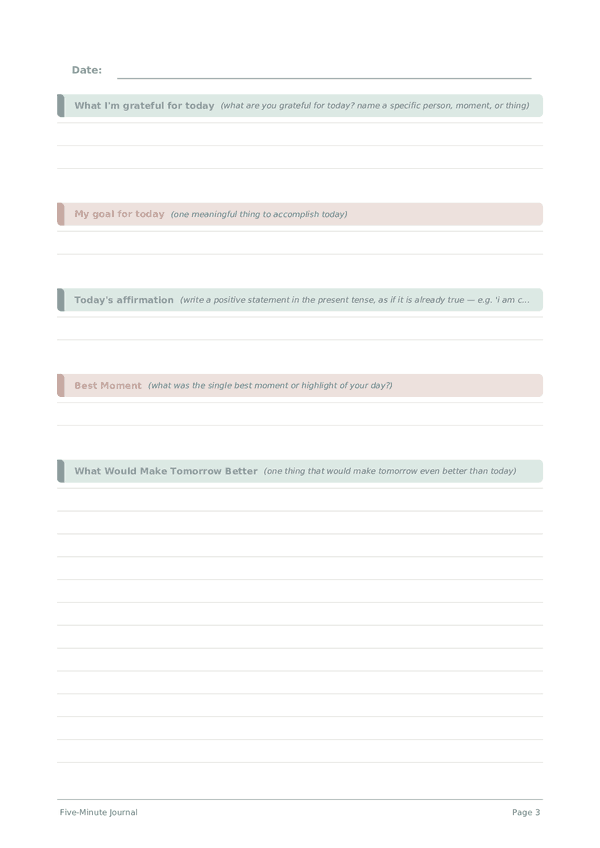
The Five Minute Journal is a commercial format released by Intelligent Change in 2013: 3 morning gratitudes plus an affirmation and a daily intention, and 2 evening reflections. Our template expands the structure with 'amazing moments' and 'what to improve' sections, offering more reflection space. The scientific foundation is the same: Emmons & McCullough (2003) and the 'Three Good Things' protocol from Seligman et al. (2005, American Psychologist, 60(5)).
Can I write the same gratitudes every day?
Not recommended. Hedonic adaptation (Brickman & Campbell, 1971) means the brain habituates to repeated stimuli and the practice loses impact. Sheldon & Lyubomirsky (2006, Journal of Happiness Studies, 7) demonstrated that varying positive activities sustains effects significantly longer than repetition. Log fresh specifics, or revisit the same category from a new angle: not 'grateful for family' but 'Dad called today.'
Does gratitude journaling help with anxiety and depression?
It complements therapy but does not replace it. Cregg & Cheavens' 2021 meta-analysis in Journal of Happiness Studies across 64 studies found small but significant effects (Hedges' g approximately 0.29) on depression and anxiety symptoms. The American Psychological Association recognizes gratitude practice as a supportive intervention. For clinical depression or anxiety disorders, consult a licensed mental health professional first — journaling is not a substitute for psychotherapy or medication.
How long does gratitude journaling take each day?
5-10 minutes. Emotional benefits don't require lengthy entries. Seligman et al. (2005, American Psychologist, 60(5), 410-421) used the brief 'Three Good Things' protocol — 3 items per evening — and mood improvements persisted for up to 6 months after just one week of practice. In 'Thanks!' (Houghton Mifflin, 2007), Robert Emmons recommends 5 entries as an optimal balance between depth and habit sustainability.
Is this journal suitable for teens and children?
Yes, for ages 8 and up. Froh et al. (2008, Journal of School Psychology, 46(2), 213-233) studied gratitude journaling in 11-13-year-olds and observed significant gains in optimism and school satisfaction after 3 weeks. For younger children, simplify to 3 entries and add drawings. For teens, the affirmation section supports identity development during a critical period for self-esteem.
You Might Also Like
Scroll to zoom, drag to move