Printable Habit Tracker
Build better habits one day at a time
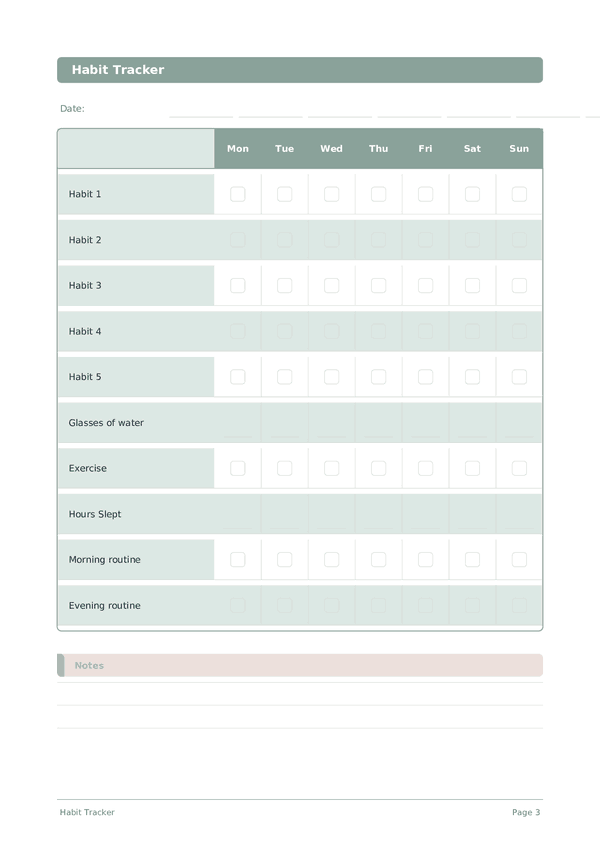
Track up to five custom habits plus water intake and exercise in a clean grid layout. Visualize your streaks and build momentum toward lasting behavior change.
Customize fields
Toggle fields on or off. Click the pencil to rename, or add your own fields.
Benefits
How to Use
What is this journal?
A habit tracker is a visual accountability tool that turns abstract intentions into concrete daily actions. By marking off habits each day on a grid, you create a chain of consistency that becomes increasingly motivating to maintain — a concept known as the "don't break the chain" method, popularized by Jerry Seinfeld.
Habit tracking works because it leverages several psychological principles at once: visual progress creates dopamine rewards, the fear of breaking a streak provides gentle accountability, and the act of marking a checkbox shifts your identity from "someone trying to build a habit" to "someone who does this every day."
This tracker lets you monitor up to five custom habits alongside water intake, exercise, sleep hours, and morning/evening routines. The weekly grid format gives you an instant visual snapshot of your consistency, making it easy to spot which habits stick and which need a different approach.
Filled example
Here's what a typical entry looks like when filled in:
| Mon | Tue | Wed | Thu | Fri | Sat | Sun | |
|---|---|---|---|---|---|---|---|
| Habit 1 | ✓ | ✓ | ✓ | ✓ | ✓ | ✓ | |
| Habit 2 | ✓ | ✓ | ✓ | ✓ | ✓ | ||
| Habit 3 | ✓ | ✓ | ✓ | ✓ | ✓ | ||
| Habit 4 | ✓ | ✓ | ✓ | ✓ | ✓ | ✓ | |
| Habit 5 | ✓ | ✓ | ✓ | ✓ | ✓ | ||
| Glasses of water | 8 | 6 | 7 | 8 | 5 | 7 | 9 |
| Exercise | ✓ | ✓ | ✓ | ✓ | |||
| Hours Slept | 7.5 | 6 | 7 | 8 | 6.5 | 8 | 9 |
| Morning routine | ✓ | ✓ | ✓ | ✓ | ✓ | ||
| Evening routine | ✓ | ✓ | ✓ | ✓ | ✓ |
How to fill in each field
Each page is a weekly grid. Rows are your tracking items, columns are days of the week. Here's what each item means:
Habit 1
Check off this habit for the day. Consistency is more important than perfection — even a partial completion counts.
Habit 2
Check off this habit for the day. Consistency is more important than perfection — even a partial completion counts.
Habit 3
Check off this habit for the day. Consistency is more important than perfection — even a partial completion counts.
Habit 4
Check off this habit for the day. Consistency is more important than perfection — even a partial completion counts.
Habit 5
Check off this habit for the day. Consistency is more important than perfection — even a partial completion counts.
Glasses of water
Track your daily water intake. Most people need 6–8 glasses. Ticking off glasses throughout the day helps you stay hydrated.
Exercise
Check off whether you exercised today. Even a 10-minute walk counts. The goal is building awareness of your activity patterns.
Hours Slept
Write how many hours you actually slept (not just time in bed). Tracking this alongside mood and energy often reveals powerful connections.
Morning routine
Did you complete your morning routine today? Note what you did or skipped
Evening routine
Tips for success
When and how often to write
Mark off each habit as you complete it throughout the day. For morning habits, check them off right after your morning routine. For evening habits, fill them in before bed. On Sunday evening, take 5 minutes to review the whole week — which habits stuck, which slipped, and why. After a month, replace any habit you've mastered with a new challenge.
Frequently Asked Questions
How many habits should I track on this grid?
Start with one to three, not all five slots. BJ Fogg ('Tiny Habits', Houghton Mifflin Harcourt, 2019) and Wood and Neal (2007, Psychological Review, 114(4)) on habit automaticity recommend stacking small behaviors onto existing routines rather than overloading. Reserve habit 4 and habit 5 for once your first habits run on autopilot — typically after several weeks of consistent check-ins.
How long before a habit becomes automatic?
Lally, van Jaarsveld, Potts, and Wardle (2010, European Journal of Social Psychology, 40(6)) found habit formation took a median of 66 days, ranging from 18 to 254 days depending on behavior complexity. The grid's seven-day layout gives you visible streaks while automaticity builds; their data showed that missing a single day did not derail the formation curve.
What goes in 'glasses of water' versus 'hours slept'?
Glasses of water is a count up to 12 — a behavioral output you control. Hours slept, up to 24, is an outcome partly outside your control. Use the first for accountability and the second as context data. WHO and Sleep Foundation guidance recommends 7-9 hours nightly for adults; logging it alongside habits reveals how sleep affects your adherence.
Should I check boxes only for full completion?
Yes — use an all-or-nothing rule for habit 1 through habit 5. Charles Duhigg ('The Power of Habit', Random House, 2012) and James Clear ('Atomic Habits', Avery, 2018) both emphasize binary completion to build identity-level habits. Partial credit blurs the streak and weakens the cue-routine-reward loop documented in habit-formation research. Visible weekly streaks serve as immediate reinforcement and support habit formation over time.
What if I miss a day — does the streak matter?
Don't let one miss become two. Lally et al. (2010, European Journal of Social Psychology, 40(6)) found a single missed day did not significantly reset the formation trajectory. The seven-day grid is designed to make missed cells visible without catastrophizing. Note the context beside the gap so you can address situational triggers rather than blaming willpower.
How is this different from a habit-tracking app?
Paper removes the variable-reward loop apps create through notifications and gamification. Sellen and Harper ('The Myth of the Paperless Office', MIT Press, 2003) and broader attention research show paper supports focused review without the cost of app-switching. The grid's visual density lets you spot weekly patterns at a glance — something scrolling through app history tends to obscure.
Should 'morning routine' and 'evening routine' each be one habit?
Yes — that's why they're single checkboxes. Anchoring multiple behaviors to a routine block is a stacking technique BJ Fogg ('Tiny Habits', 2019) calls anchoring. Define your morning routine as a fixed sequence (e.g., make bed, drink water, stretch). One check confirms the whole block, training the behavioral chain as a single unit.
Will tracking habits actually change my behavior?
Self-monitoring is one of the most consistently effective behavior-change techniques available. Harkin et al. (2016, Psychological Bulletin, 142(2)) meta-analyzed 138 studies and found progress monitoring significantly improved goal attainment, with stronger effects when monitoring was both physically recorded and shared. Daily check-ins here meet both criteria when combined with an accountability partner.
You Might Also Like
Scroll to zoom, drag to move