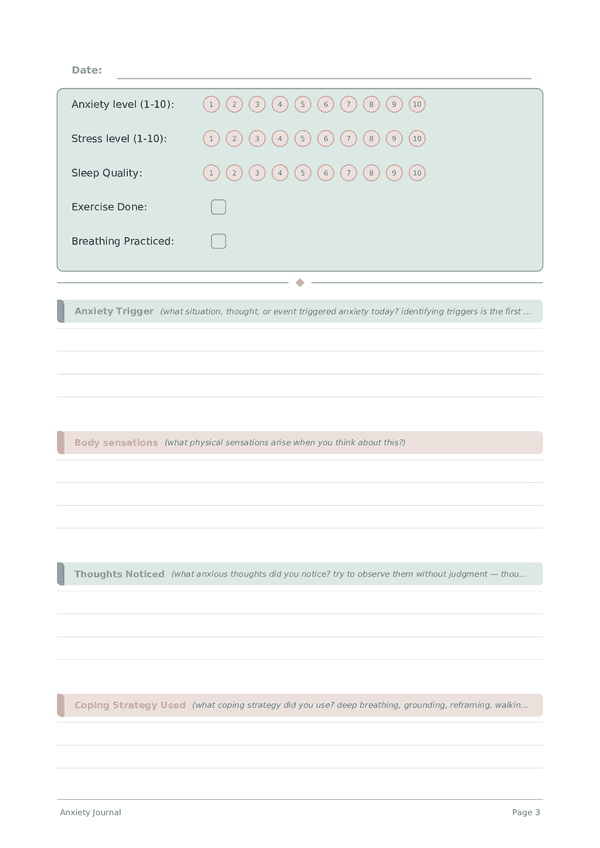
Printable Anxiety Journal
Daily anxiety tracking and CBT-based reflection journal
Manage anxiety with evidence-based daily tracking and reflection. Identify triggers, notice body sensations, challenge anxious thoughts, and document what coping strategies actually work for you.
Customize fields
Toggle fields on or off. Click the pencil to rename, or add your own fields.
What is this journal?
An anxiety journal is a therapeutic self-monitoring tool specifically designed to help you understand, manage, and gradually reduce anxiety. By combining daily anxiety ratings with structured writing about triggers, body sensations, thought patterns, and coping strategies, you create a personal anxiety management system backed by cognitive behavioral therapy principles.
Anxiety often feels overwhelming because it operates in the background of your mind — vague, persistent, and hard to pin down. This journal brings anxiety into the light where it becomes manageable. Research shows that the simple act of writing about anxious thoughts reduces their intensity by up to 47%. Tracking your anxiety numerically also helps you see that it fluctuates — it is not permanent, even when it feels that way.
The hybrid format combines quick daily ratings (anxiety level, stress, sleep quality, exercise, breathing practice) with guided writing prompts that help you identify triggers, notice physical sensations, examine your thoughts, document what coping strategies you used, and reflect on what actually helped. Over time, this builds a personalized toolkit for managing anxiety.
Filled example
Here's what a typical entry looks like when filled in:
How to fill in each field
The top of each page has quick-fill fields (ratings, checkboxes, numbers). Below that is a lined section for writing. Here's what each field means:
Anxiety level (1-10)
Rate your anxiety level today. Putting a number on it makes the feeling more manageable and trackable.
Stress level (1-10)
Rate your stress on a scale of 1–10. Over time, you'll identify your stress patterns and which coping strategies work best.
Sleep Quality
Rate how restful your sleep was. 1 means terrible and restless, 5 means deep and refreshing. Quality matters as much as quantity.
Exercise Done
Did you exercise today? Even a short walk counts. Movement is one of the most effective natural anxiety reducers.
Breathing Practiced
Did you practice conscious breathing today? Diaphragmatic breathing activates the parasympathetic nervous system and calms anxiety.
Anxiety Trigger
What situation, thought, or event triggered anxiety today? Identifying triggers is the first step in CBT-based anxiety management.
Body sensations
What physical sensations arise when you think about this?
Thoughts Noticed
What anxious thoughts did you notice? Try to observe them without judgment — thoughts are not facts.
Coping Strategy Used
What coping strategy did you use? Deep breathing, grounding, reframing, walking, talking to someone — what helped?
What helped
What brought relief? Note what worked so you can use it again when anxiety rises.
Tips for success
When and how often to write
Fill in the tracker daily, even on calm days — data from low-anxiety days is just as valuable for understanding your patterns. When anxiety spikes during the day, do a quick 'thought dump' in the writing section as soon as possible. Full evening reflection should take 5–10 minutes. Over time, this journal becomes your personal CBT workbook.
Frequently Asked Questions
Why does this journal rate anxiety, stress, and sleep separately?
These constructs overlap but are distinct. The American Psychological Association defines anxiety as anticipatory worry, stress as a response to demand, and sleep quality as a physiological factor that moderates both. NIMH guidance on anxiety disorders treats them as related but measurably separate. Three 0-10 ratings let you identify which dimension is driving a bad day rather than collapsing all three into a single number.
How do I fill in 'thoughts noticed' using CBT principles?
Write the automatic thought verbatim — exactly the sentence running through your head — then label the cognitive distortion present. Aaron Beck ('Cognitive Therapy and the Emotional Disorders', 1976) cataloged patterns such as catastrophizing, mind-reading, and all-or-nothing thinking. Naming the distortion is the first step of cognitive restructuring, before you write 'what helped.' Be specific: 'I'll fail' rather than 'I felt bad.'
What's the point of logging body sensations for anxiety?
Anxiety produces somatic signals — racing heart, tight chest, shallow breath — that interoceptive exposure work (Barlow's Unified Protocol; Barlow et al., 2017, Behavior Research and Therapy, 88) targets directly. Recording sensations builds the awareness needed to distinguish a panic spike from a stable elevated baseline and to apply breathing or grounding techniques before escalation.
Why is there a 'breathing practiced' checkbox?
Slow paced breathing activates vagal tone and reduces physiological arousal. Laborde et al. (2022, Neuroscience and Biobehavioral Reviews, 138) reviewed slow-breathing protocols and found consistent acute effects on HRV and self-reported anxiety. The checkbox builds a practice habit; over weeks you can correlate days where breathing was practiced against anxiety level ratings. Daily entries accumulate the data needed to bring concrete patterns to therapy or self-review.
Is this a substitute for therapy if I have an anxiety disorder?
No. The journal supports evidence-based treatment but does not replace it. NIMH and APA recommend CBT, exposure therapy, or pharmacotherapy for diagnosed anxiety disorders. If you have a clinical anxiety disorder — generalized anxiety, panic, social anxiety — consult a licensed mental health professional. This journal works best as a between-session homework tool used alongside therapy.
How do I make sense of weeks of ratings?
Look for correlations, not isolated days. After two weeks, scan whether anxiety level rises when sleep quality drops, or falls on days when the exercise checkbox is checked. Hofmann et al. (2012, Cognitive Therapy and Research, 36(5)) meta-analyzed CBT for anxiety and found that symptom tracking improved treatment response by clarifying triggers. Bring any clear patterns to therapy if applicable.
What if I can't identify a clear anxiety trigger?
That's common with generalized anxiety, where worry is diffuse. Borkovec's avoidance model of worry (1994) and Behar et al. (2009, Journal of Anxiety Disorders, 23(8)) describe worry as suppressing concrete feared images. Write what you were doing, who you were with, and how tense your body felt — the trigger may surface as somatic context rather than a clearly identifiable event.
How is this different from a general mood journal?
It's structured around the CBT thought-record format: situation, automatic thoughts, body sensations, coping used, and what helped. That sequence — closer to Beck's daily thought record — targets cognitive restructuring specifically. A mood journal logs feelings; this journal works on the appraisals driving them, which is the active ingredient in Hofmann's CBT meta-analyses.
You Might Also Like
Scroll to zoom, drag to move