Printable Astrology Journal
Decode the stars, track transits, and align your daily life with cosmic rhythms
A daily astrology journal designed to help you track planetary transits, understand their energetic influence, and reflect on how cosmic cycles manifest in your everyday life. Ground your astrological study in lived experience and personal insight.
Customize fields
Toggle fields on or off. Click the pencil to rename, or add your own fields.
Benefits
How to Use
What is this journal?
An astrology journal is a daily practice for tracking planetary transits, celestial events, and their correlations with your inner and outer life. Each entry records the astrological weather of the day and invites you to reflect on how these cosmic patterns may be reflected in your personal experience.
This journal is for astrology enthusiasts who want to deepen their understanding beyond reading daily horoscopes. Whether you are a beginner learning about planets and houses or an experienced astrologer tracking complex transits, this journal builds a personal database of astrological correlations over time.
The value of an astrology journal lies not in proving cosmic causation but in developing pattern recognition and self-awareness. By consistently tracking transits alongside personal reflections, you build an increasingly nuanced understanding of your own natal chart and how planetary cycles correspond to themes in your life.
Filled example
Here's what a typical entry looks like when filled in:
How to fill in each field
Each day you'll find several labeled sections with lines for writing. Here's what each section is for:
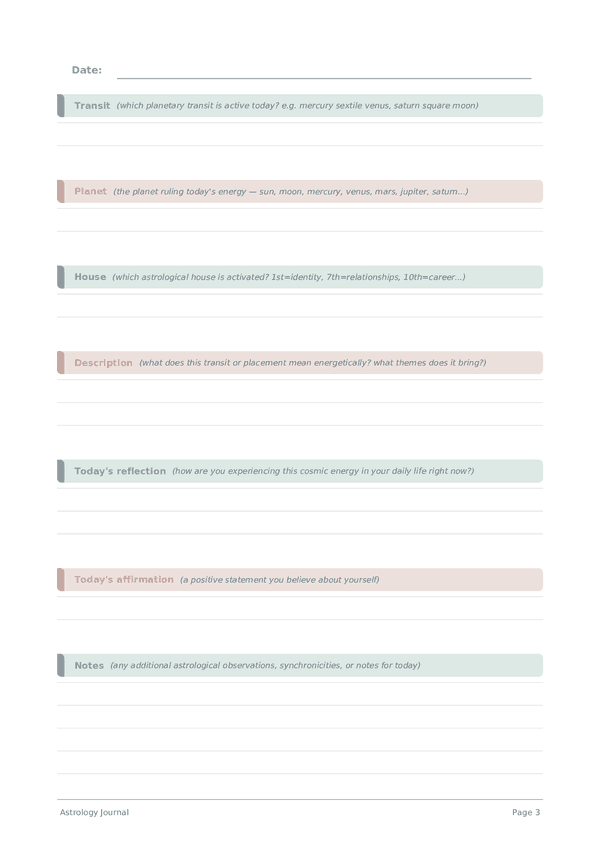
Transit
Which planetary transit is active today? e.g. Mercury sextile Venus, Saturn square Moon
Planet
The planet ruling today's energy — Sun, Moon, Mercury, Venus, Mars, Jupiter, Saturn...
House
Which astrological house is activated? 1st=identity, 7th=relationships, 10th=career...
Description
Write a brief description of what this entry is about. Future-you will thank present-you for the context.
Today's reflection
Look back at your day honestly. What went well? What could be better? This isn't about judgment — it's about learning and growing.
Today's affirmation
Write a positive statement about yourself in the present tense, as if it's already true. For example: 'I am capable and resilient.' Repeating affirmations rewires your thinking patterns over time.
Notes
Add any additional context or thoughts. This catch-all column is for anything that doesn't fit elsewhere but might be useful later.
Tips for success
When and how often to write
Daily entries aligned with the transiting Moon sign build awareness of emotional rhythms across the zodiac. Write in-depth entries when planets change signs, go retrograde, or form major aspects to your natal chart. Seasonal entries at equinoxes and solstices provide structural reflection points. Your birthday (solar return) deserves the year’s most thorough entry — a review of the past year and intentions for the new solar year. Weekly, note the overall astrological weather and how it manifests in your personal experience.
Frequently Asked Questions
What does this Astrology Journal help me track?
Seven sections per entry (transit, planet, house, description, reflection, affirmation, and notes) let you record the day's most active planetary transit, the ruling planet and house it activates, an interpretation of the energetic theme, and how it shows up in lived experience. The structure supports your study of astrology as a symbolic and reflective system rather than a predictive science.
Is astrology supported by scientific evidence?
Astrology is not supported by peer-reviewed science as a means of predicting events or personality (Carlson, 1985, Nature, 318, double-blind test is the classic study; subsequent reviews concur). Use the journal accordingly: treat description and reflection as symbolic frameworks for self-observation, not causal claims about planets. The affirmation field works as a personal intention regardless of metaphysical interpretation.
How do I fill in the transit and planet fields if I am a beginner?
Open a free astrology calendar or chart calculator and note the strongest aspect of the day in transit (for example, Moon trine Venus) and the ruling planet of that aspect. The house field needs your natal chart, specifically the house the transiting planet occupies in your chart. If you don't have a natal chart, leave house blank and focus on the transit and reflection fields.
How is the reflection field different from description?
Description records what the transit is supposed to signify according to astrological tradition: themes, archetypes, tensions. Reflection records what actually happened in your day. Separating the two guards against confirmation bias. You write the theoretical meaning first, then honestly note whether your experience fit, partially fit, or contradicted it. Over months this distinction reveals how your interpretations hold up.
How does this compare to using an astrology app?
Apps deliver passive daily horoscopes. This template asks you to identify a specific transit, locate it in your chart's houses, and reflect on lived experience. The handwritten record (supported by Pennebaker's expressive writing research) builds a personal archive that pre-written app content cannot match. The journal trains observation and symbolic thinking rather than feeding you generic interpretations.
What goes in the affirmation field?
A short first-person statement aligned with the day's energy as you read it. During a Mercury transit, for example, you might write a statement about communication. The affirmation works as a personal intention; Julia Cameron's morning pages tradition (1992, The Artist's Way, Tarcher) treats short written intentions as anchors for daily reflection. Two lines is enough.
What is a common mistake users make with this template?
Filling in reflection with what the transit was supposed to bring rather than what actually happened. This collapses the two columns and keeps you from testing your interpretations against reality. Write reflection before consulting description if possible, or commit to recording at least one detail that contradicts or qualifies the theoretical meaning. Honest data is more useful than confirming entries.
How long until journaling reveals patterns in my chart?
Slower transits (Saturn, Jupiter) span months; faster ones (Moon, Mercury) cycle quickly. Three to six months of daily entries usually builds enough data across recurring houses and planets for personal observation. Treat any patterns you see as personal symbolic interpretation, not evidence of cosmic causation. For mental health concerns, consult a clinician; astrology is reflective study, not treatment.
You Might Also Like
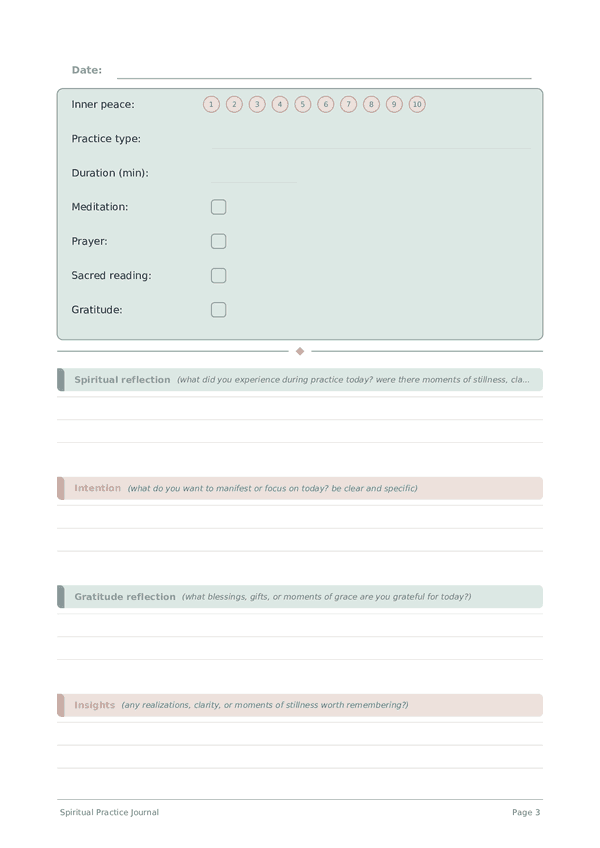
Spiritual Practice Journal
Nurture your inner life with daily practice and reflection
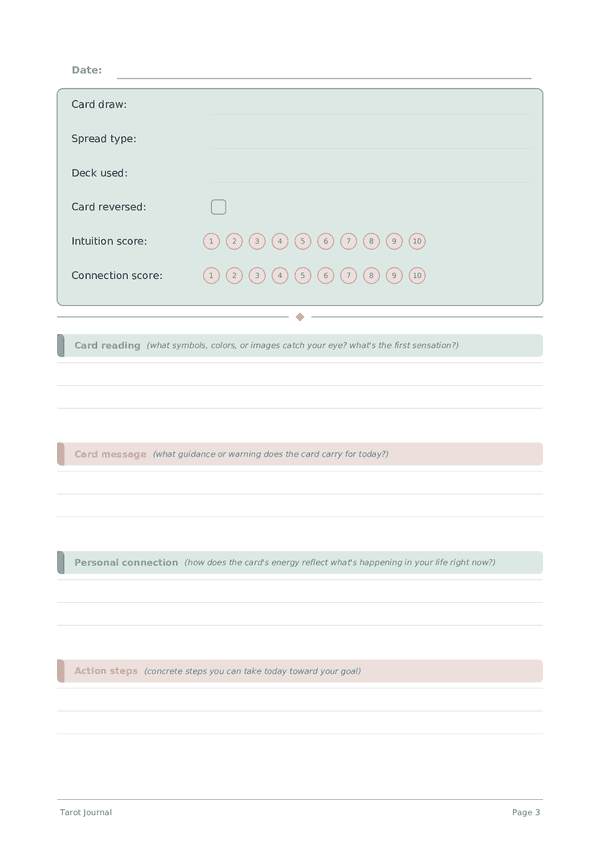
Tarot Journal
Track daily card draws, spreads, and intuitive insights
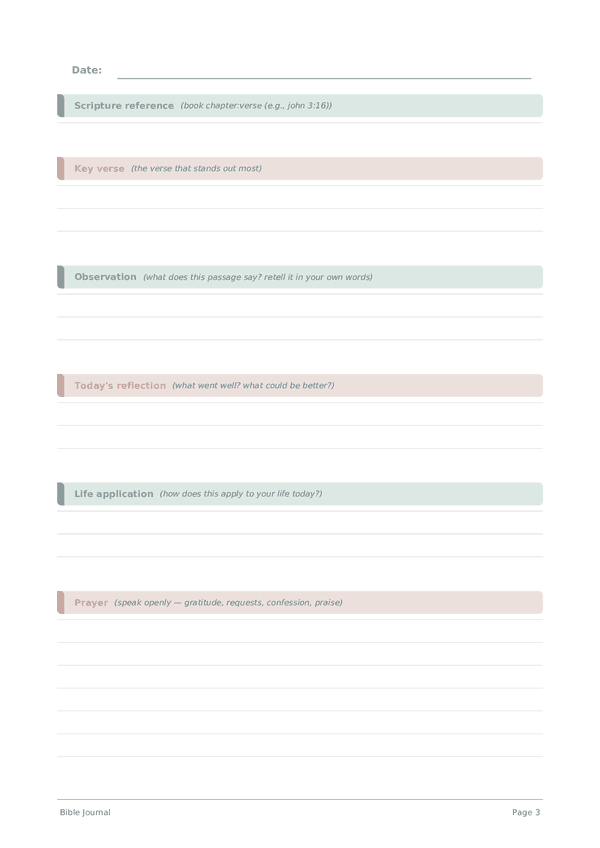
Bible Journal
Scripture, Observation, Application, Prayer — the SOAP method
Moon Journal
Align with the lunar cycle — track, reflect, and release
Scroll to zoom, drag to move